
Google Ads, Meta, TikTok, or in-app advertising networks? When launching a mobile game in Vietnam, choosing the right User Acquisition (UA) channels can significantly influence player acquisition costs and long-term business performance.
However, the channel with the largest reach does not necessarily deliver the most valuable players. UA performance also depends on game genre, player behavior, creative strategy, and the ability to convert installs into revenue.
As advertising competition intensifies, publishers need to rely on data to identify suitable channels rather than simply following platform popularity.
1. Downloads or Player Value?
Before choosing advertising channels, publishers need to define the primary objective of their UA strategy: expanding the player base, increasing conversion rates, or optimizing Lifetime Value (LTV).
According to the 2026 Southeast Asia Mobile Game Marketing Report by SocialPeta × Gamota, Vietnam accounted for 18.3% of mobile game downloads but only 10.6% of IAP revenue across the Southeast Asian markets analyzed in the first half of 2026. [1]
This gap indicates that large-scale player acquisition does not necessarily translate into proportional in-app purchase revenue.
Gamota’s Vietnam Mobile Gaming Year-in-Review 2025 also found that only 12 of the Top 50 games by downloads appeared in the Top 50 by revenue in Vietnam. [2]
For Casual and Hybrid-Casual games, publishers may prioritize scalable acquisition and cost efficiency. Meanwhile, MMORPGs and 4X Strategy games often require closer attention to retention, payer conversion, and LTV.
The objective is not simply to find the channel with the lowest CPI, but to identify which channels can attract the right players for a game’s business model.
Studios can download Gamota’s Vietnam Mobile Gaming Year-in-Review 2025 for free to explore the differences between download volume, revenue, and genre performance in Vietnam.
2. Which UA Channels Are Leading?
According to SocialPeta × Gamota, the average number of monthly active mobile game advertisers in Southeast Asia increased by 19.7% YoY during the period tracked through July 2026. [1]
As competition grows, publishers need to understand how different advertising platforms are being used.
Meta: A Prominent Channel for RPG and Strategy Advertising
Among the weekly Top 100 high-performing RPG creatives analyzed in Southeast Asia, Meta channels accounted for approximately 93% of recorded advertising placements. This share reached around 95% in the corresponding Strategy creative sample. [1]
Platforms such as Facebook, Instagram, and Audience Network are therefore worth considering when testing UA campaigns for RPG and Strategy games.
However, these figures represent placement distribution within the analyzed creative samples. They do not indicate advertising budget market share or prove that Meta delivers the highest ROAS.
Google and YouTube: Important Channels for Major IPs
The same report found that RPG titles such as Genshin Impact recorded approximately 33% advertising presence on AdMob and 29% on YouTube. For Honkai: Star Rail, the corresponding figures were 35% and 36%. [1]
These figures suggest that some major IP-based games distribute their advertising efforts across multiple touchpoints within Google’s ecosystem rather than relying solely on search advertising.
TikTok: Large Reach, but Conversions Still Need Validation
According to Digital 2026: Vietnam by DataReportal, the potential advertising reach in Vietnam at the end of 2025 was approximately:
- Facebook: 79 million users.
- TikTok: 76.1 million users aged 18 and above.
- YouTube: 62.1 million users. [3]
These figures represent potential advertising reach, not the number of gamers or unique users across platforms.
Therefore, reach can help publishers identify acquisition opportunities, but it is not enough to determine which platform delivers the best conversions.
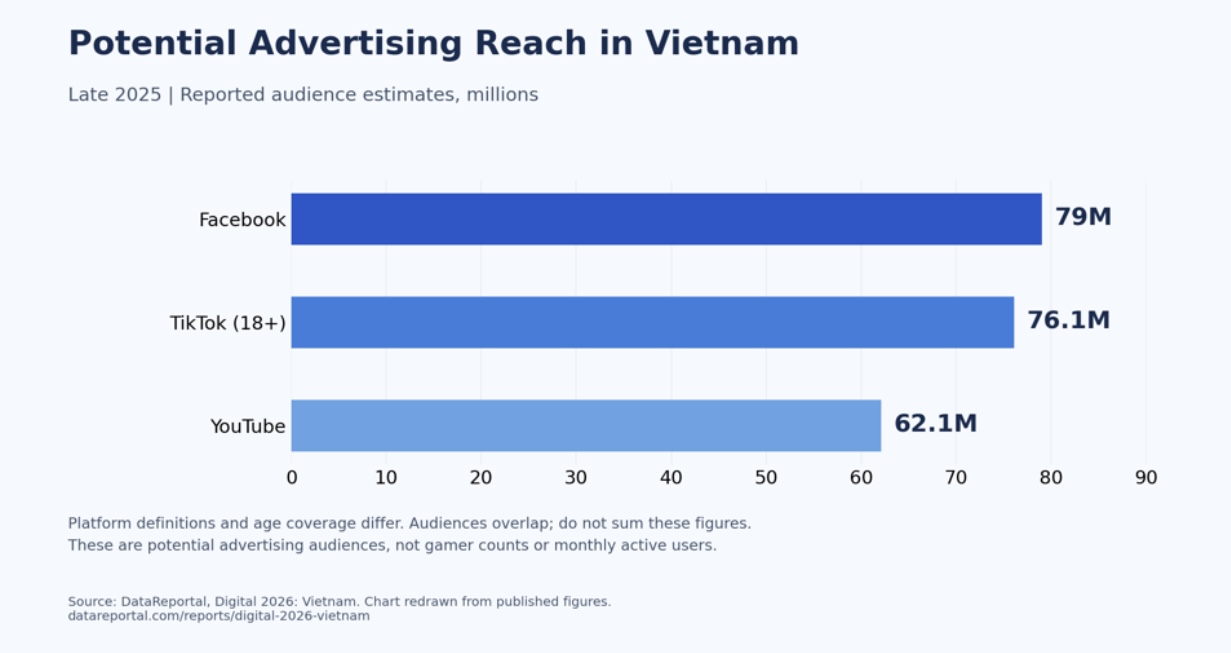
Chart redrawn from published figures
Source: DataReportal

TikTok for Gaming interface
Source: TikTok
3. Game Genre Shapes Channel Strategy
The same advertising platform can serve different strategic purposes depending on the characteristics of a game.
For RPGs, many publishers use creatives that highlight character systems, combat, rewards, or progression mechanics.
Meanwhile, Strategy games may use short gameplay sequences, Tower Defense elements, or accessible mechanics to attract initial attention before introducing deeper strategic systems.
The SocialPeta × Gamota report found that prominent local RPG publishers such as VPLAY, WEPLAY, OEG, VTC, and VNG dedicated 82–95% of their creatives specifically to Vietnam. For selected Strategy titles published in Vietnam, this proportion reached approximately 89–97%. [1]
These findings suggest that the publishers included in the study allocated substantial advertising resources to market-specific campaigns rather than distributing the same creative assets uniformly across the region.
However, genre should only serve as a starting point for channel selection hypotheses. Publishers still need to validate their choices against actual player data and campaign performance.
For a deeper understanding of how publishers select advertising channels, creative formats, and genre-specific strategies, studios can register to download the 2026 Southeast Asia Mobile Game Marketing Report for free by SocialPeta × Gamota.

Idle Rewards and Squad Growth
Source: Demon Squad:Idle RPG
4. Creative Strategy Influences UA Performance
Choosing an advertising channel is only one part of User Acquisition. Creatives determine how a game is presented and what expectations its advertisements create for potential players.
According to SocialPeta, video accounted for 73.7% of mobile game advertising creatives in Southeast Asia between January and July 2026. Among prominent RPG creatives, the share reached 82%, while Strategy creatives recorded 86%. [1]
Several case studies illustrate different approaches.
Samkok: New Force used actual gameplay footage on Facebook News Feed, emphasizing combat mechanics and direct player controls. SocialPeta estimated that the creative generated approximately 850,000 impressions over 101 days.
Nhất Niệm Tiêu Dao used a fantasy-themed video on YouTube, combining cultivation-inspired visuals, Vietnamese subtitles, and skill effects. The creative recorded approximately 52,000 estimated impressions over six days. [1]
These examples show how publishers can highlight different aspects of their products, including direct gameplay, visual world-building, and localized content. However, impression figures alone cannot determine which creative performed better in terms of conversions, as campaign duration, budgets, and distribution methods were different.
Creative competition is also increasing globally. According to AppsFlyer’s State of Gaming for Marketers 2026, gaming ad impressions increased by 20% in 2025, while leading gaming advertisers produced 25–30% more creative variations per quarter compared with the previous year. [4]
Publishers should therefore focus not only on advertising placements but also on continuously testing messaging, gameplay hooks, and how product value is communicated.

Nhat Niem Tieu Dao — Xianxia Cultivation Promotional Artwork
Source: GameK
5. Measure Player Quality, Not Just Installs
A channel with a low CPI does not necessarily deliver better business results if the acquired players have weak retention or limited spending potential.
Given the clear divergence between downloads and revenue in Vietnam [2], evaluating UA performance based solely on CPI can lead to ineffective budget allocation.
Publishers should assess performance across different stages:
- Acquisition: CPI, install volume, and user acquisition costs.
- Engagement: Onboarding completion rates, D1, D7, and D30 retention.
- Monetization: Payer conversion, ARPU, ROAS, and LTV.
Importantly, performance should be analyzed by player cohorts from individual acquisition sources, rather than relying only on aggregated metrics.
For example, a channel with a higher CPI may still generate better commercial value if its acquired players demonstrate stronger retention, higher payer conversion, and sufficient long-term revenue to offset acquisition costs.
However, evaluation periods should also reflect the product lifecycle. For MMORPGs and SLGs, early-stage ROAS may not fully capture the value of players who remain engaged over an extended period.
This is a measurement framework publishers should apply and validate using their own campaign data, rather than evidence that any particular channel currently delivers the best performance in Vietnam.
6. Test Before Scaling
No single UA channel can guarantee strong results for every mobile game.
SocialPeta’s data reveals how publishers distribute creatives and select advertising formats, but it does not directly identify which channels deliver the optimal CPI or ROAS for individual products in Vietnam. [1]
Publishers should therefore begin with a limited selection of channels supported by clear hypotheses about game genre, player behavior, and business objectives.
During the testing phase, channels should be evaluated using sufficiently consistent conversion objectives, budget allocation methods, and measurement periods to allow meaningful comparisons.
Budgets can then be adjusted based on cohort quality, conversion performance, and actual scalability.
More importantly, campaigns should continue to be monitored as spending increases. A channel that performs well during a small-scale test may not maintain the same efficiency when its audience reach expands.
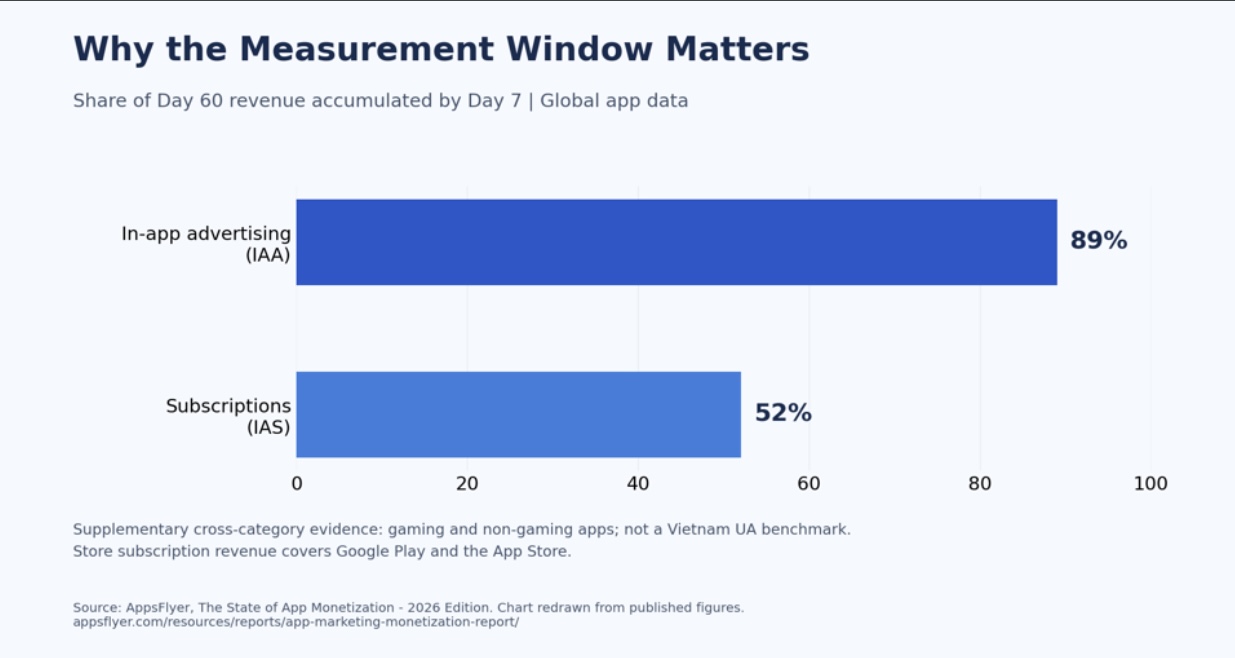
Chart redrawn from published data
Source: AppsFlyer
Choose UA Channels Based on Player Value
Choosing effective User Acquisition channels in Vietnam is not simply about deciding whether to advertise on Google, Meta, or TikTok.
Market reports show that audience reach, creative distribution strategies, and revenue-generation potential are separate factors that need to be evaluated independently.
For international studios, channel selection should begin with the characteristics of the product, business objectives, and target player segments. Market data helps establish initial hypotheses, while actual campaign performance determines how budgets should be allocated.
Through market research, player behavior analysis, and experience publishing games in Vietnam, Gamota continues to support international partners in developing marketing and UA strategies tailored to individual products.
An effective UA strategy should not only generate more installs, but also turn player acquisition into long-term business value.
References
[1] SocialPeta × Gamota (2026). 2026 Southeast Asia Mobile Game Marketing Report. Advertising data from January to July 2026, including advertiser activity, creative distribution, advertising channels, and RPG/Strategy case studies across Southeast Asia.
[2] Gamota (2026). Vietnam Mobile Gaming Year-in-Review 2025. Analysis of download performance, IAP and local payment revenue, genre distribution, and player value in Vietnam during 2025.
[3] DataReportal (2025). Digital 2026: Vietnam. Data on potential advertising reach across Facebook, TikTok, and YouTube in Vietnam at the end of 2025.
[4] AppsFlyer (2026). State of Gaming for Marketers 2026. Published on January 14, 2026, analyzing global gaming UA and advertising creative activity in 2025 based on aggregated data from 9,600 gaming apps.