

In Part 1, the article looked at changes related to game engines, AI-generated game worlds and 3D assets. These areas show that AI is gradually moving into the core tooling layer of game development, although there is still a meaningful gap between technology demos and production workflows.
In Part 2, the focus shifts to applications that are closer to content production, operations and player experience: Video AI, QA automation, AI voice and NPCs.
Video AI: From Content Generation to Control in Production
In its October 2025 article, Third Point spent a significant amount of time analyzing the limitations of AI video, especially consistency: characters, objects and visual style can easily change between frames, making AI-generated video difficult to integrate into real production workflows [1].
By 2026, video AI tools are moving more clearly in two directions: improving control and consistency, while also proving that the product can fit into real workflows.
Runway Gen-4 launched with a clear focus on consistency across characters, objects and visual style from a reference image [13], directly addressing the weakness that Third Point previously highlighted.
Runway Gen-4 overview.
Source: Wow Labz.
Google has also continued to expand its video AI capabilities. Veo 3.1 supports video generation with native audio through the Gemini API [14]. At I/O 2026, Google also introduced Gemini Omni, with Gemini Omni Flash as the first model in the Omni family. The model can take input from text, images, audio and video to generate video, and is being rolled out across the Gemini app, Google Flow and YouTube Shorts [15].

Gemini Omni, Google’s multimodal video generation model.
Source: Google Blog.
Adobe Firefly Video continues to position itself as a commercially safe model, making it more suitable for creative teams and enterprises that need to reduce copyright risk [16].
 Adobe Firefly for Video.
Source: Adobe Blog.
On the other side, OpenAI Sora was discontinued on web and mobile apps on April 26, 2026, and its API will be discontinued on September 24, 2026 [17]. Sora’s discontinuation does not automatically prove that AI video is ineffective, but it does show that the AI video landscape remains highly volatile. For video AI tools, the ability to generate impressive videos is not enough; the product also needs a clear use case, suitable content moderation and the ability to fit into real workflows.
For games and media production, video AI in 2026 can be evaluated through three practical criteria: consistency, fine-grained control and legal safety, not just raw image quality.
QA Automation: The Clearest Near-Term Benefit
If there is one AI area with an ROI that is easy for studios or publishers to understand, it may be QA automation.
By 2026, this area has seen several notable developments. At GDC 2026, Razer introduced QA Companion-AI, a tool designed to support game QA. It can detect bugs through computer vision, suggest test plans, use AI agents to play through predefined test scenarios, then validate results and report issues [18].
nunu.ai positions itself as a QA automation platform for games. Instead of having testers repeat manual actions one by one, the tool uses AI-controlled “virtual players” to continuously run through prepared test scenarios, helping detect bugs without requiring bespoke training for each game [19].
nunu.ai uses AI agents for game QA.
Source: nunu.ai.
modl.ai continues to follow a no-integration approach: its agents observe the screen and send inputs like real players, without requiring an SDK or code changes on the game side [20].
These tools do not replace QA teams. Instead, they help expand test coverage, reduce repetitive work and support earlier bug detection. As a result, QA can move from large test sweeps at the end of the cycle toward a more continuous testing process throughout development.
Read more about the impact of AI on QA in Gamota’s article here.
Audio and NPCs: From AI Voice to Real-Time Interaction
AI voice models are becoming increasingly natural, and Third Point predicts that by 2026–2027, AI voices that are difficult to distinguish from human voices will become more common [1]. However, the biggest barrier is not only technical. Consent from voice actors, rights to use voices and legal risks remain critical issues.
The SAG-AFTRA case against Epic Games over the use of an AI-generated Darth Vader voice in Fortnite shows why AI voice is a sensitive topic. It is not only about copyright or personal likeness, but also about labor rights and how the entertainment industry governs the use of AI-generated voices [1].
On the product side, Inworld is focusing on real-time AI voice with low latency [21], while Convai is developing conversational AI for 3D characters in virtual worlds [22]. If AI voice is combined with dynamic dialogue systems and NPC behavior, games could move closer to characters that respond more flexibly to player actions. However, this remains an area that needs tight control before being brought into real products.
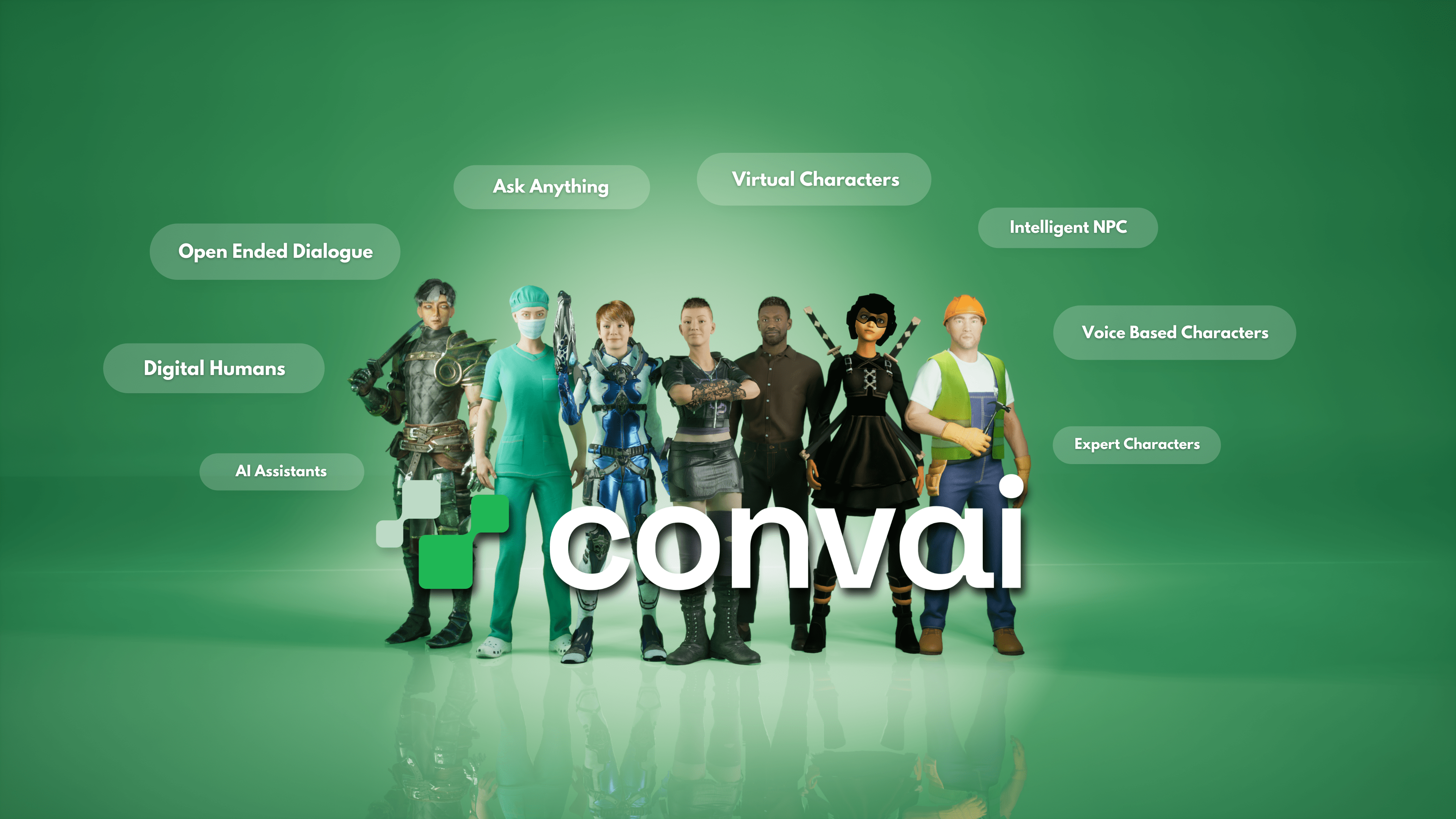
Convai’s conversational AI for virtual characters.
Source: Convai.
Conclusion: Five Major Shifts From October 2025 to May 2026
Looking across the full landscape, five directional shifts have become visible over the past seven months.
First, AI is being integrated into game engines.
Second, AI-generated game worlds are advancing quickly, but remain largely experimental.
Third, 3D assets are moving from “good enough to present” toward “production-ready.”
Fourth, video AI is moving from attention and hype toward consistency, control and product durability.
Fifth, QA automation is emerging as one of the clearest near-term use cases.
From late 2025 to mid-2026, the conversation around AI in game development has become less about “Will AI replace humans?” and more about “Where can AI help studios reduce bottlenecks across the production pipeline?”
In the near term, AI’s biggest impact is not in creating a complete game from a few lines of prompt. It is in the areas that directly affect operations: shortening asset iteration loops, supporting earlier QA, scaling localization, accelerating creative experimentation and opening up new forms of interactive NPCs.
For Gamota, this is also the more relevant way to approach AI in the games industry. AI should not be seen as a tool that replaces studios, but as a supporting layer that helps development, publishing and live operations teams work faster, experiment more and manage risks better.
AI has not replaced the studio. But it is changing how studios allocate time, budget and people across the entire game development lifecycle.
References
[1] Third Point Ventures, “AI Impact on Gaming and Media Tooling,” Dan Moskowitz, October 2025.
https://www.thirdpointventures.com/currents/AI-impact-on-gaming-and-media-tooling/
[13] Runway, “Introducing Runway Gen-4.”
https://runwayml.com/research/introducing-runway-gen-4
[14] Google AI for Developers, “Generate videos with Veo 3.1 in Gemini API.”
https://ai.google.dev/gemini-api/docs/video
[15] Google Blog, “Introducing Gemini Omni.”
https://blog.google/innovation-and-ai/models-and-research/gemini-models/gemini-omni/
[16] Adobe Firefly, “AI Video Generator.”
https://www.adobe.com/products/firefly/features/ai-video-generator.html
[17] OpenAI Help Center, “What to know about the Sora discontinuation.”
https://help.openai.com/en/articles/20001152-what-to-know-about-the-sora-discontinuation
[18] Razer, “AI That Plays to Test: Razer QA Companion-AI at GDC 2026.”
https://www.razer.com/blog/ai-that-plays-to-test-razer-qa-companion-ai-at-gdc-2026/
[19] nunu.ai.
https://nunu.ai/
[20] modl.ai.
https://modl.ai/
[21] Inworld AI.
https://inworld.ai/
[22] Convai.
https://www.convai.com/