
How long does it take to launch a mobile game in Vietnam?
If the game is already in a relatively stable state and the studio works with a local publisher that holds the required licenses or service certificates, 8–12 weeks can be a reasonable planning window.
This is not a statutory timeline. Games that require significant content changes, technical rework or a licensing process built from scratch may take considerably longer.
Vietnam is different from a market where launch timing depends mainly on localization, testing and marketing. Here, the game’s G1, G2, G3 or G4 classification, the publisher’s licensing status and the completeness of the application can directly affect when a title is legally ready to go live.
Vietnam had around 54 million mobile gamers and an estimated US$825 million in mobile game revenue in 2025 [1]. For studios entering the market, spending a few extra weeks on product assessment and regulatory preparation can be more valuable than forcing an early launch.
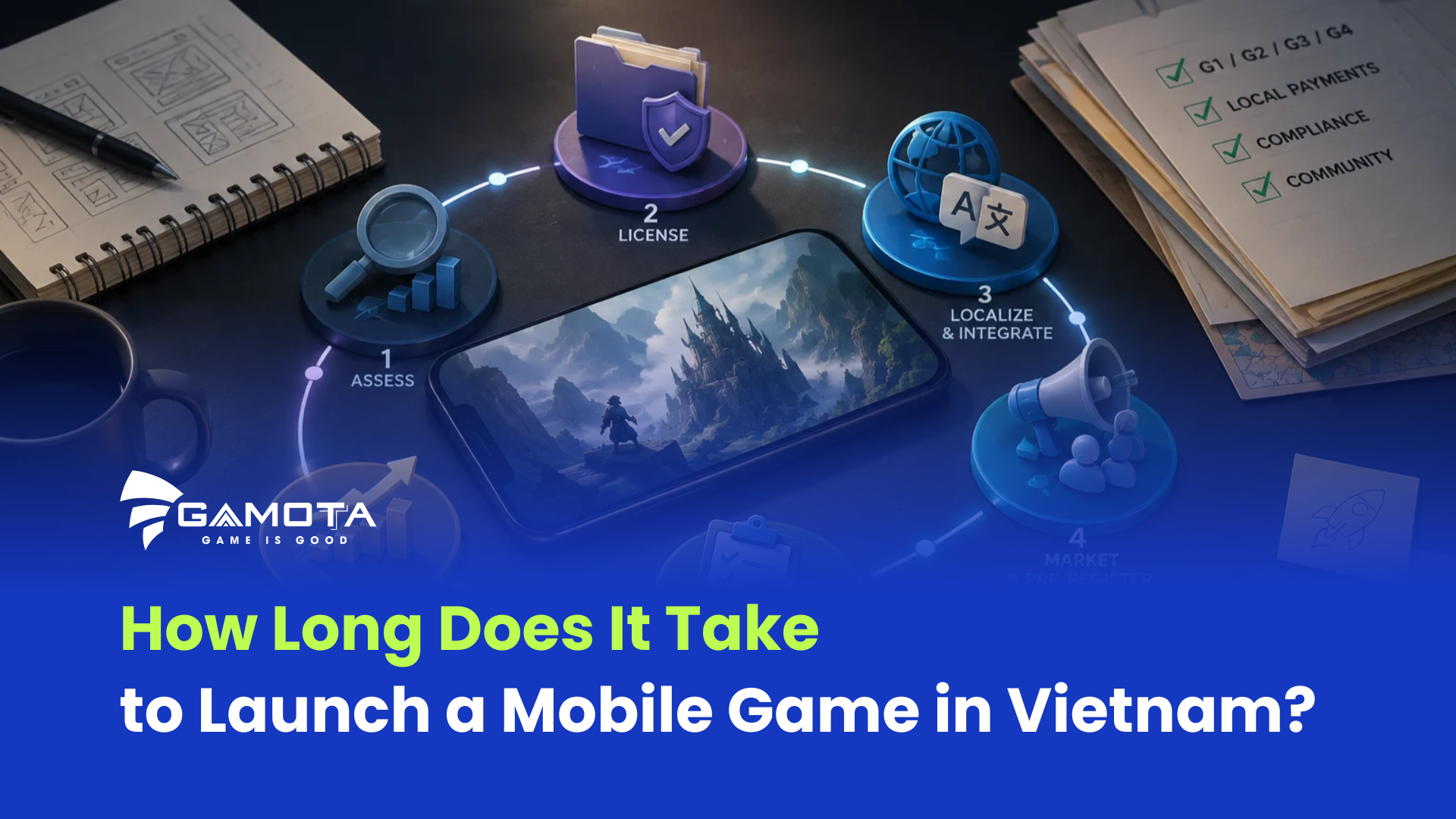
A Typical Mobile Game Launch Timeline in Vietnam
For a game with a stable build and a ready local publishing partner, a typical plan may look like this:
The timeline below is a planning framework based on Gamota’s experience publishing mobile games in Vietnam and working with regional partners. The 8–12 week estimate assumes that the publisher already holds the appropriate license or service certificate for the game category.
| Stage | Estimated Timing | Key Activities |
| Market and product assessment | Weeks 1–2 | Genre, audience, monetization, competition, G1/G2/G3/G4 classification |
| Licensing and documentation | Weeks 2–6+ | Legal documents, publishing rights, content review, age rating |
| Localization and technical integration | Weeks 2–7 | Vietnamese localization, accounts, payments, servers and technical requirements |
| Pre-launch marketing and pre-registration | Weeks 6–9 | Store pages, content, community, KOLs and creators |
| Final testing and launch | Weeks 9–12 | Final QA, store preparation and server opening |
| Post-launch operations | From Week 12 | LiveOps, community, player support and monetization optimization |
These stages do not need to happen one after another. Localization, technical integration and marketing preparation can often run while licensing documents are being processed.
How effectively these workstreams run in parallel is often what separates an 8–12 week launch from a much longer one.
Weeks 1–2: Assess the Product Before Setting a Launch Date
Before translating the game or announcing a release date, studios should answer a more important question: Is this product a good fit for Vietnam?
The assessment should cover genre, competitive landscape, monetization, retention potential, community requirements and the scale of localization required.
Gamota’s Vietnam Mobile Gaming Year-in-Review 2025 highlights MMORPG, 4X Strategy and Team Battle among notable revenue-generating segments in Vietnam, while also pointing to the operational demands of running these games over the long term [1].
This is also the stage to determine whether the game is classified as G1, G2, G3 or G4, because that classification shapes the licensing process that follows.
Research from Gamota can help studios assess genre size, revenue, downloads and market trends before committing to a Vietnam launch plan.
Weeks 2–6+: Licensing Can Become the Critical Path
For G1 games, the service provider must hold a G1 Online Game Service License. The published processing time is currently 20 days from receipt of a valid application [2].
Each individual G1 title must then obtain its own Game Release Decision, which also has a published processing period of 20 days from receipt of a valid application [2].
The important phrase here is “valid application.”
For a game licensed by a foreign partner, the application must include documents proving intellectual property rights and authorization to publish the game in Vietnam. Foreign documents may also need consular legalization, Vietnamese translation and certification [2].
So a 20-day administrative processing period does not mean a studio should budget only 20 days for licensing. Preparing, reviewing and correcting the documentation before it is accepted as valid must also be built into the timeline.
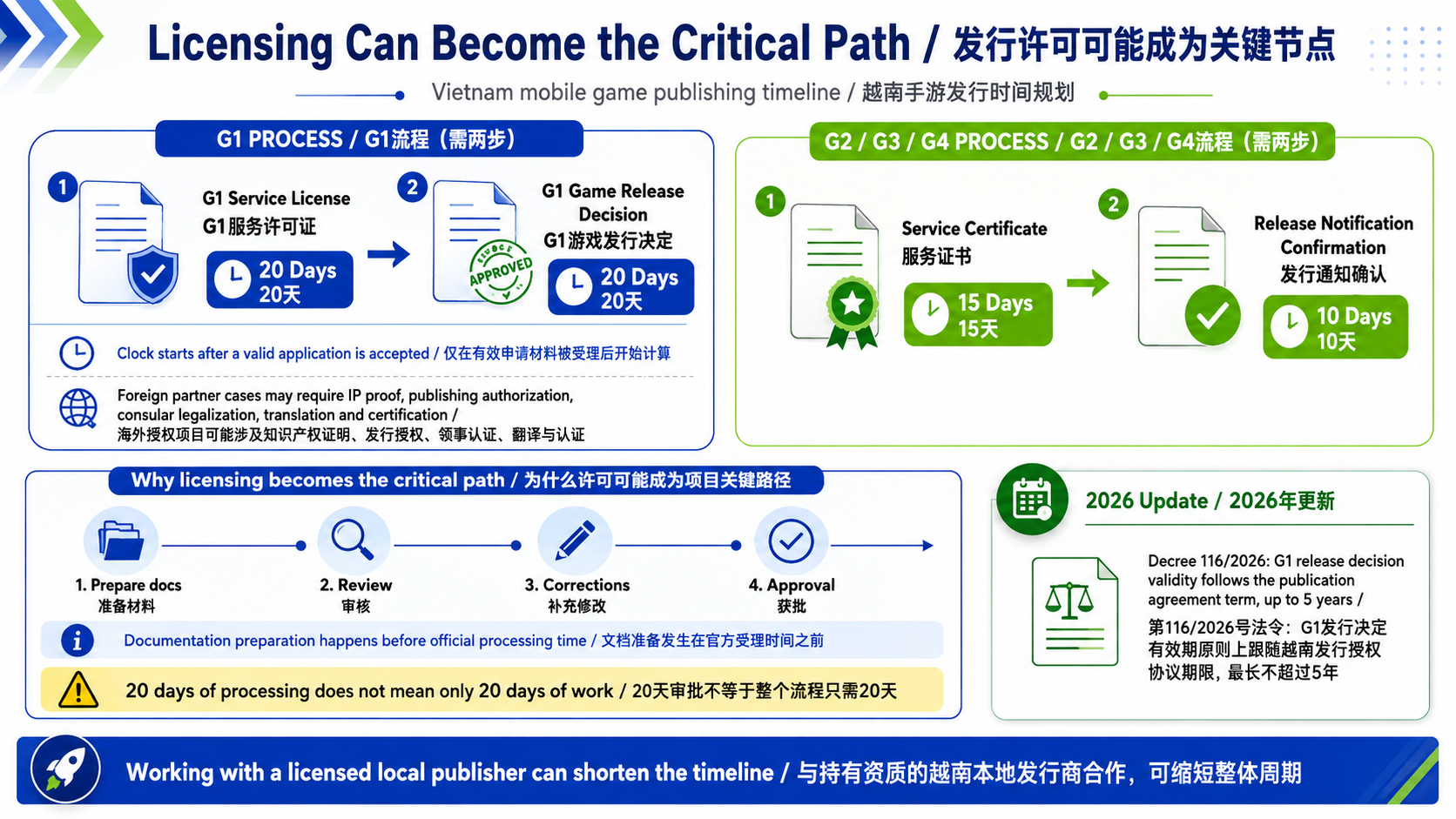
Working with a game publisher in Vietnam that already holds the appropriate service license can shorten the process because the studio may not need to go through company-level licensing from scratch.
For G2, G3 and G4 games, the process is different. The published processing period is 15 days for the service certificate and 10 days for the release notification confirmation, once a valid application has been received [3].
There was also an important regulatory update in 2026. Decree No. 116/2026/ND-CP, effective from April 8, 2026, amended several rules affecting game-related administrative procedures [4].
For G1 games, one notable change concerns the validity of the Game Release Decision. Its validity follows the term of the agreement authorizing publication in Vietnam, but cannot exceed five years.
This does not change the 20-day processing period for a G1 release application, but it matters when planning the long-term operation of a title.
Localization and Technical Integration Should Run in Parallel
Waiting for licensing to finish before starting localization can add unnecessary weeks to the project.
While applications are being prepared and processed, studios can work on the Vietnamese build, content adjustments, server testing and local technical integrations.
In Vietnam, technical readiness goes beyond servers and payments.
Current service requirements include storing player information, verifying accounts through Vietnamese mobile phone numbers, managing players under 16 and applying playtime limits to players under 18. These requirements apply within the service conditions for both G1 and G2/G3/G4 games [2][3].
For G1 titles, the release application also requires information such as the game version, age classification, domain names, IP addresses, distribution stores, payment methods and materials showing actual in-game activities [2].
This means the build submitted for licensing should already be reasonably close to the version intended for launch, rather than an early build still undergoing major changes.
Weeks 6–9: When Should Pre-Registration Begin?
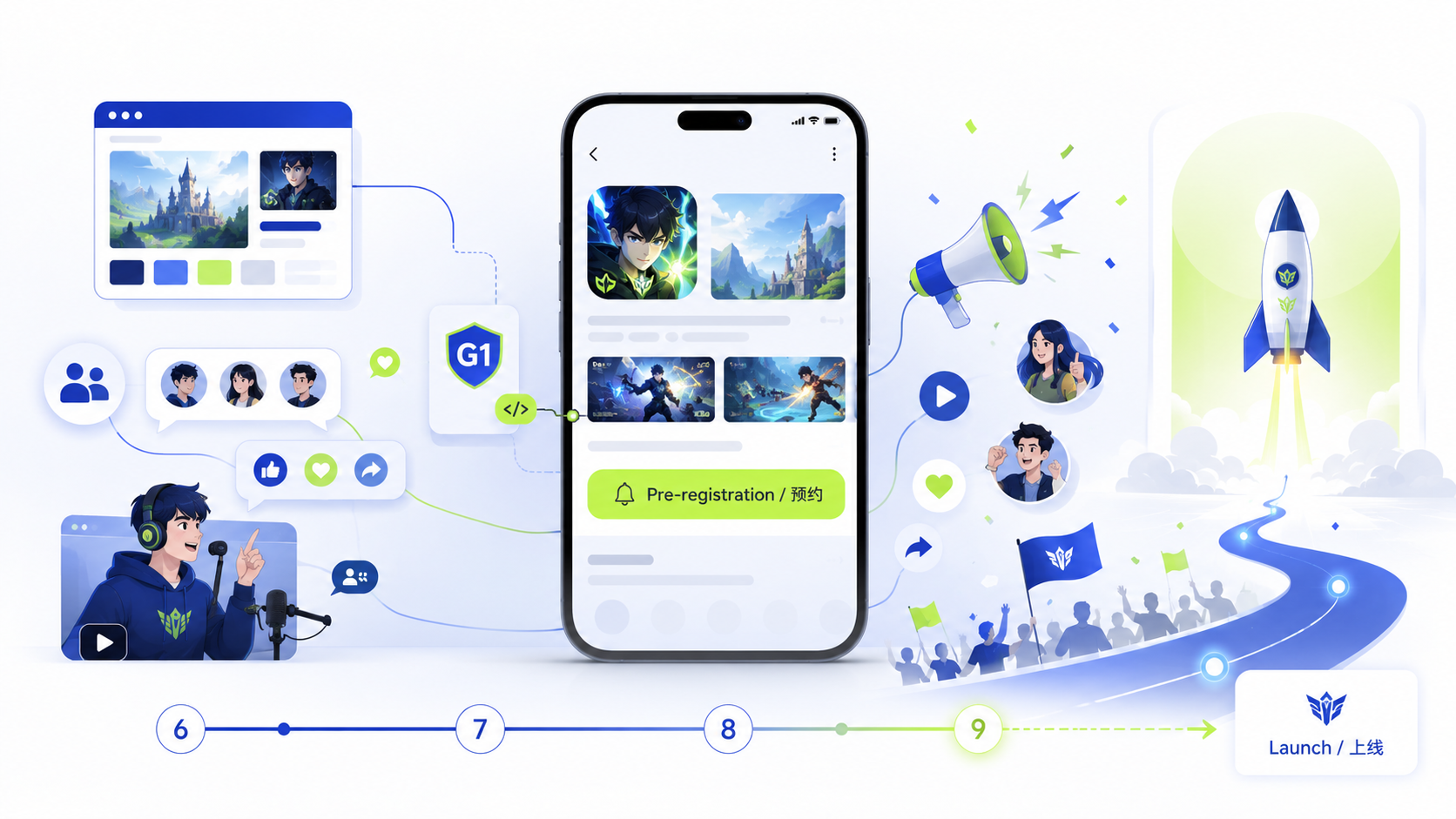
Pre-registration gives players a way to register interest before the official release, typically through Google Play, the App Store or a dedicated landing page.
At this stage, studios can prepare store listings, social channels, communities, KOL and creator campaigns while the final technical and content work is being completed.
What studios should avoid is announcing a firm release date before the regulatory and technical path is sufficiently clear.
If a major pre-registration campaign is already underway but the launch must be postponed because documents need revision, content requires changes or integrations are incomplete, the delay can disappoint early players and drive up marketing costs.
G1 games also have a Vietnam-specific requirement. After a Game Release Decision is granted, the regulator sends the company a code representing the licensed G1 game symbol. The company must place this code in the game description on the app store, where applicable, and on the website providing the game. The code links to the regulator’s licensing database [2].
For this reason, licensing, store-page preparation and launch communications should be managed as part of the same timeline rather than as separate workstreams.
Weeks 9–12: Launch Is Only the Beginning
Once licensing, the game build, technical systems and distribution channels are ready, the project can move into final testing and release.
For many RPG and strategy titles in Vietnam, however, the most important work begins after the servers open.
Gamota’s Vietnam Game Industry Monthly Report – May 2026 recorded 121 million mobile game downloads and US$23 million in IAP revenue during the month. Midcore downloads declined while overall revenue increased, which Gamota linked to the importance of stronger LiveOps, established player communities and effective monetization [6].
A Vietnam launch plan should therefore extend beyond release day. First-month events, community support, payment assistance, player feedback and retention activities should already be prepared before the game goes live.
Major updates may also trigger additional regulatory work.
For G1 games, changes to the game name or origin, age rating, content or scenario, service scope, distribution channels or server location may require an amendment to the Game Release Decision. The published processing period for this procedure is currently five working days from receipt of a valid application [5].
What Usually Delays a Game Launch in Vietnam?
The most common delays tend to come from incomplete intellectual property documentation, foreign documents that still require legalization or certified translation, content changes identified during review, account systems that do not yet meet local requirements, or a game build that continues to change while the application is being prepared.
Another risk is treating the launch date primarily as a marketing milestone before the regulatory timeline is sufficiently clear.
Instead of asking only “How many days does the license take?”, studios should ask a broader question:
When will the product, legal documentation, technical systems and marketing plan all be ready at the same time?
For a relatively mature game working with an established local publisher, 8–12 weeks is a useful starting point for planning a mobile game launch in Vietnam.
If the studio must build the publishing setup from scratch or make substantial product changes, additional buffer should be built into the schedule rather than locking in a release date too early.
Planning to launch a game in Vietnam? Talk to Gamota about market assessment, licensing, localization, technical integration, marketing and a launch timeline built around your game.
References
[1] Gamota, Vietnam Mobile Gaming Year-in-Review 2025. Market size, revenue and key mobile game segments in Vietnam.
[2] Authority of Broadcasting and Electronic Information. G1 service licensing and individual G1 Game Release Decision procedures.
[3] Authority of Broadcasting and Electronic Information. G2, G3 and G4 service and release procedures.
[4] Government of Vietnam, Decree No. 116/2026/ND-CP. Amendments to selected game-related regulations effective from April 2026.
[5] Authority of Broadcasting and Electronic Information. Procedure for amending or supplementing a G1 Game Release Decision.
[6] Gamota, Vietnam Game Industry Monthly Report – May 2026. Data on downloads, revenue and mobile game operations in Vietnam.