

Vietnam is a promising mobile gaming market, but bringing a game into the country involves much more than localizing the language, integrating local payment methods such as e-wallets, SMS payments and Vietnamese bank cards, and listing the game on app stores.
For foreign studios and developers, game publishing in Vietnam comes with a specific set of legal and regulatory requirements, covering the publishing entity, licensing, game classification, player account verification, playtime limits for minors and content management.
The key legal framework currently governing online games is Decree No. 147/2024/ND-CP, which took effect on December 25, 2024, together with related regulations and administrative procedures applicable in 2026.
So, what should a foreign studio prepare before publishing a game in Vietnam?
Publishing a Game in Vietnam Requires a Legally Qualified Local Entity
One of the first things foreign studios need to understand is that online game services in Vietnam must be provided through a company established under Vietnamese law that meets the applicable requirements for providing online game services.
This is why many international developers choose to work with a game publisher in Vietnam rather than handling the entire market entry process independently.
For G1 games licensed for publication by a foreign partner, the application must also demonstrate intellectual property rights and the right to publish the game in Vietnam. Under the procedure for obtaining a G1 Game Release Decision, the application must include documentation proving intellectual property rights and an agreement authorizing the Vietnamese company to publish the game in Vietnam.
Choosing a local publishing partner is therefore not only a marketing or operational decision. The right publisher can also help the studio navigate legal requirements, licensing procedures and the practical steps required to bring a game to the Vietnamese market.
G1, G2, G3 or G4: Your Game Category Determines the Licensing Process
Vietnamese regulations divide online games into four categories based on how players interact with each other and with the game server:
- G1: games in which multiple players interact simultaneously through the company’s game server.
- G2: games in which players interact with the company’s game server.
- G3: games in which multiple players interact with each other without interacting with the company’s game server.
- G4: games downloaded over the internet in which there is no interaction between players or between players and the company’s game server.
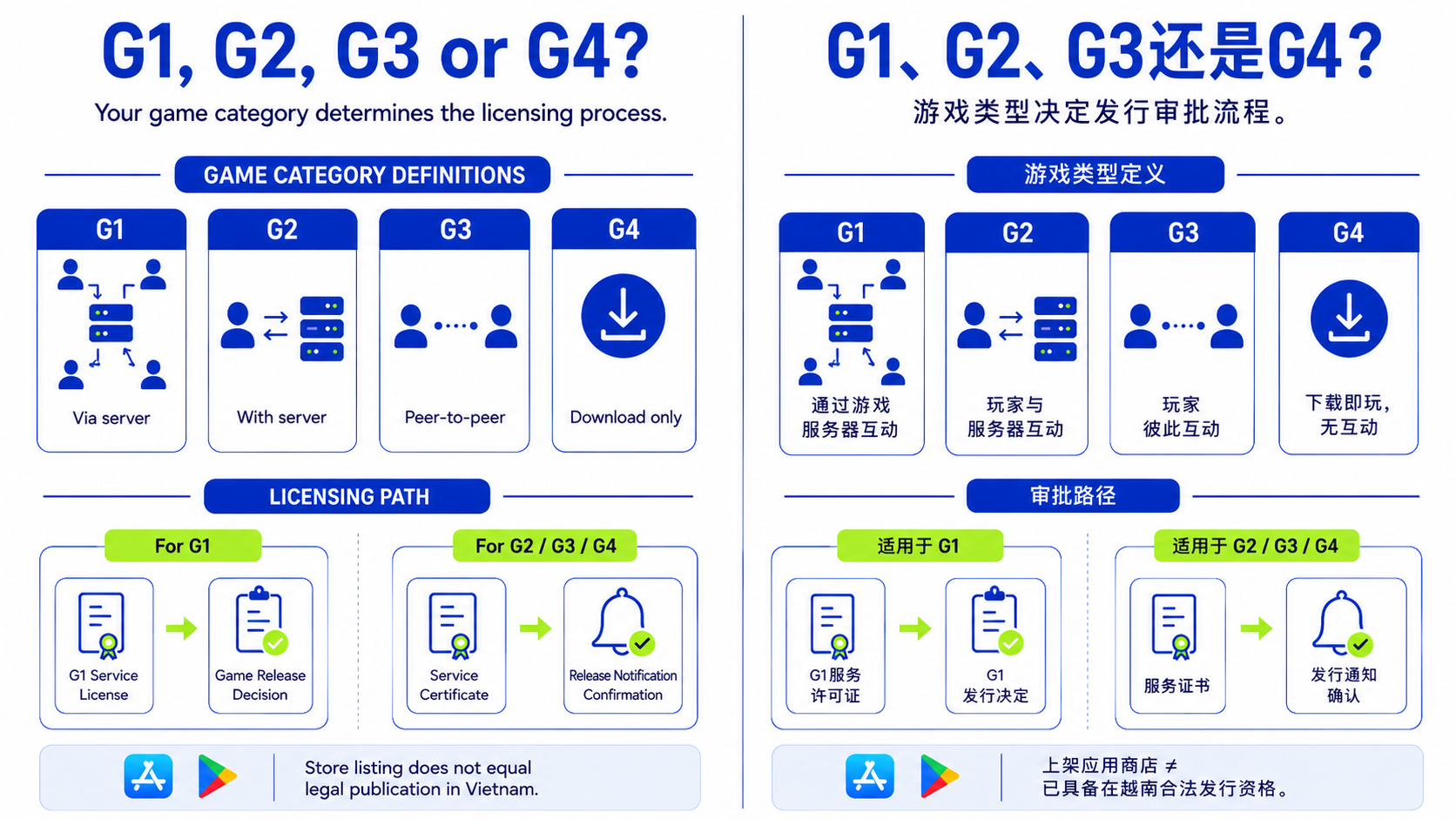
Correctly identifying the category from the beginning is important because each type of game is subject to different legal and administrative requirements.
For G1 games, the publisher must obtain a License to Provide G1 Online Game Services, while each individual title must also obtain a G1 Game Release Decision before entering the market.
For G2, G3 and G4 games, the company must obtain a Certificate for Providing G2, G3 and G4 Online Game Services and complete the process for obtaining a Release Notification Confirmation before officially providing the game.
In other words, publishing a game on Google Play or the App Store does not automatically mean that the game is legally eligible for distribution in Vietnam.
Decree 147 also places greater responsibility on app stores to require valid publishing documentation for games distributed to users in Vietnam. Vietnam’s regulatory authority has provided further information on the requirements for games distributed through app stores.
Game Content Must Be Reviewed Before Release
Compliance with Vietnam’s game publishing regulations does not stop at obtaining the necessary licenses. The game’s content and scenario are also part of the review process.
For G1 games, the release application may cover character systems, missions, maps, virtual items and virtual currencies, audio, visual assets, player interactions, combat mechanics and other elements of the game.
Restricted content can include material that violates cybersecurity or intellectual property regulations, simulations of casino-style gambling or certain uses of playing-card imagery, as well as content involving terrorism, violence, pornography, gambling, drugs, historical distortion, or violations of Vietnam’s sovereignty and territorial integrity.
Detailed requirements concerning game content, scenarios and application documentation are included in the review procedure for a G1 Game Release Decision.
This means that game localization for Vietnam should begin with a content review, rather than translation alone. Visual assets, maps, character names, dialogue, symbols, gameplay features and monetization mechanics should all be assessed before the final local version is prepared for release.
This is also an important part of game publishing and localization services in Vietnam, particularly for titles originally developed for other markets.
Games Must Also Be Classified by Age Rating
Under the framework currently established by Decree 147/2024/ND-CP, online games in Vietnam are classified into four age categories: 00+, 12+, 16+ and 18+, with different criteria relating to violence, character presentation, sensitive content and how certain themes are portrayed.
Publishers are responsible for classifying their games, declaring the classification in the relevant application and displaying the age rating when distributing and promoting the game.
For foreign studios, age classification should not be treated as something added only at the final stage before launch. A game’s age rating can directly affect content review, licensing documentation and how the product is presented to Vietnamese users.
Player Account Verification and Playtime Limits
Another distinctive element of Vietnam’s gaming regulations is the way player information and playtime are managed.
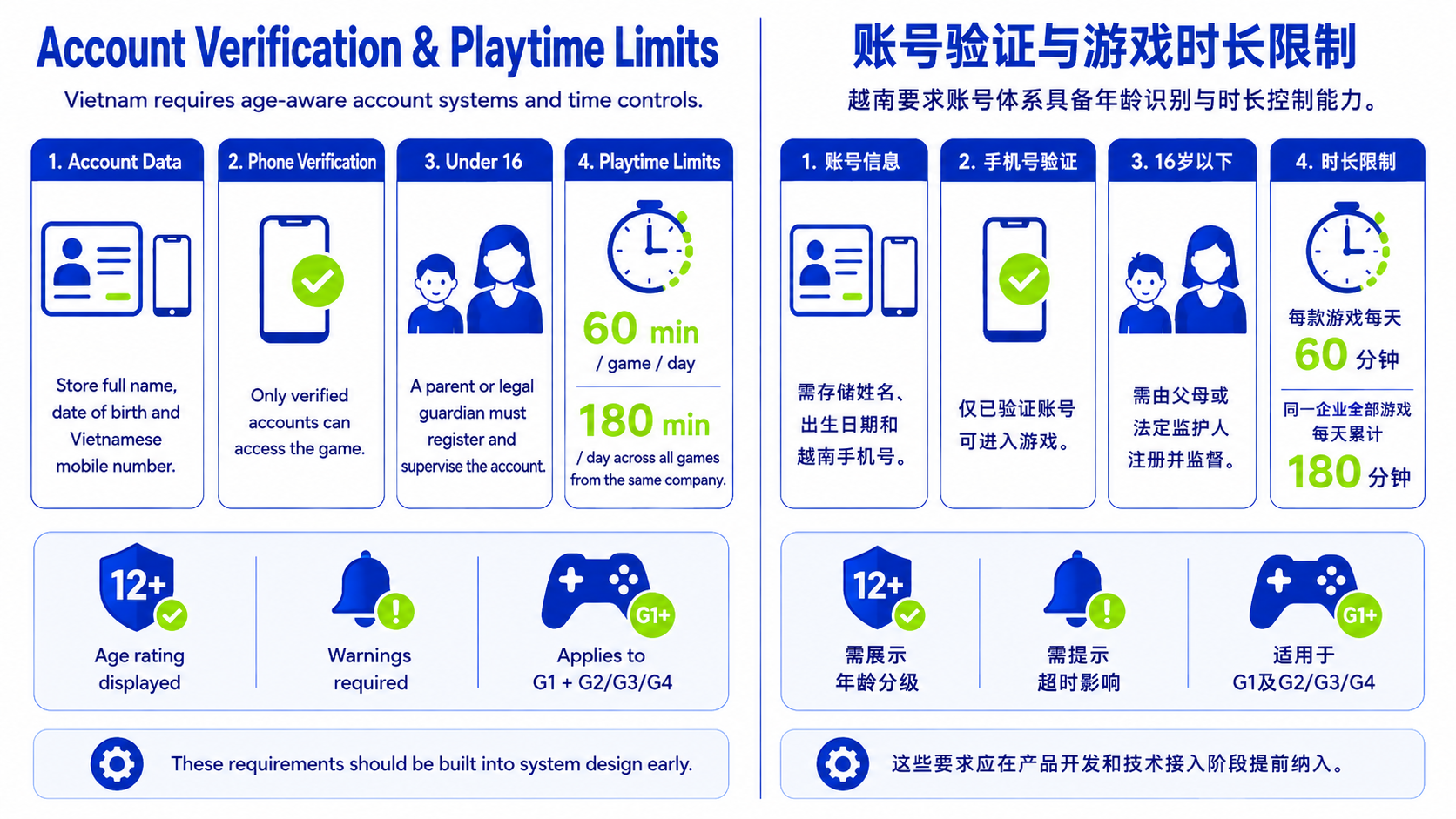
Under current requirements for online game service providers, technical systems must be able to fully store and update information about players in Vietnam, including their full name, date of birth and Vietnamese mobile phone number.
Player accounts must be verified through a Vietnamese mobile phone number, and only verified accounts may access games in accordance with the applicable regulations. For players under 16, a parent or legal guardian must register the account using their own information and is responsible for supervising and managing the child’s playtime and the game content they access.
Current regulations also require systems to control playtime for players under 18: no more than 60 minutes per day for each game and no more than 180 minutes per day across all games for players under 18 provided by the same company.
Publishers must also display the game’s age classification and warnings about the potential effects of playing beyond the prescribed time limits.
These requirements on player data storage, account verification and playtime management apply under the service conditions for both G1 games and G2, G3 and G4 games.
For developers, these requirements should be considered during system design and technical integration. Account verification, player information storage, child account management and playtime restrictions should not be left until only a few weeks before launch.
A Publisher’s Responsibilities Continue After Launch
Obtaining the necessary licenses does not mean that the publisher has completed all of its regulatory obligations.
Publishers must continue maintaining systems for player data management, payments, communications within games or forums, and information related to virtual items and virtual currencies. They must also maintain appropriate measures for information security, data backup, system operations and player protection.
Decree 147 also establishes requirements for virtual items, virtual currencies and reward points within games. This is particularly important for titles with complex in-game economies and monetization systems.
For games operated as long-term services with frequent content updates, developers and publishers should also assess whether major updates change any elements that have already been approved.
For G1 games, changes to areas such as the game title, origin, age classification, content or scenario, service method and scope, distribution channels, or the location of owned or leased servers may require the publisher to complete the procedure to amend or supplement the G1 Game Release Decision.
What Foreign Studios Should Prepare Before Entering Vietnam
For an international developer, the most effective approach is not to wait until the game is complete before starting the licensing process. Regulatory requirements should be incorporated into the Vietnam publishing plan from the beginning.
Before setting a launch date, studios should clarify whether the game is classified as G1, G2, G3 or G4; which legal entity will publish the game in Vietnam; which content may need to be adapted; whether account and payment systems meet local requirements; which age category applies to the game; and whether the necessary intellectual property and publishing authorization documents are ready.
Preparing these elements early allows licensing, localization, technical integration, marketing and operations to follow the same launch plan instead of becoming separate issues that emerge shortly before release.
Beyond legal requirements, foreign studios also need to understand local player behavior, payment preferences, popular game genres and the competitive landscape. Gamota’s research and reports on the Vietnam gaming market can provide additional data when evaluating opportunities before entering the market.
This is also where a local publishing partner in Vietnam can make a difference. Beyond bringing the game to market, a local publisher can help connect regulatory requirements with localization, operations, marketing, user acquisition, payments and customer support.
An Important Regulatory Update to Watch in 2026
Vietnam’s regulatory framework for online games continues to evolve.
In July 2026, Vietnam’s Ministry of Culture, Sports and Tourism opened consultations on a Draft Decree amending and supplementing Decree No. 147/2024/ND-CP, which includes a number of proposals that could directly affect online game publishing and operations.
Notably, the draft proposes strengthening game account verification, adjusting playtime restrictions for users under 16, and further developing requirements for health warnings and age-classification criteria.
The draft also provides greater detail on the proposed verification of game accounts using either a mobile phone number that has already been verified in accordance with applicable law or a personal identification number.
Rules concerning children and minors are another area worth monitoring. Under the proposed direction of the amendments, identifying and managing underage users would become more closely connected with account verification mechanisms and the responsibilities of parents or legal guardians.
For foreign studios, these changes could directly affect the design of account registration systems, age verification, playtime management and controls over content accessible to children.
As of August 10, 2026, these provisions remain in draft form and should not be interpreted as regulations already in force. Decree No. 147/2024/ND-CP and the current related regulations remain the applicable framework for studios preparing to publish games in Vietnam.
Studios planning to enter the Vietnamese market in the coming months should therefore monitor these developments closely, particularly before finalizing account systems, player verification mechanisms, minor account management, playtime controls and launch timelines.
Planning to publish your game in Vietnam? Talk to Gamota about licensing, localization, market entry strategy and game publishing solutions in Vietnam.
Disclaimer: This article provides a general overview of game publishing regulations in Vietnam and does not constitute legal advice for any specific case.