
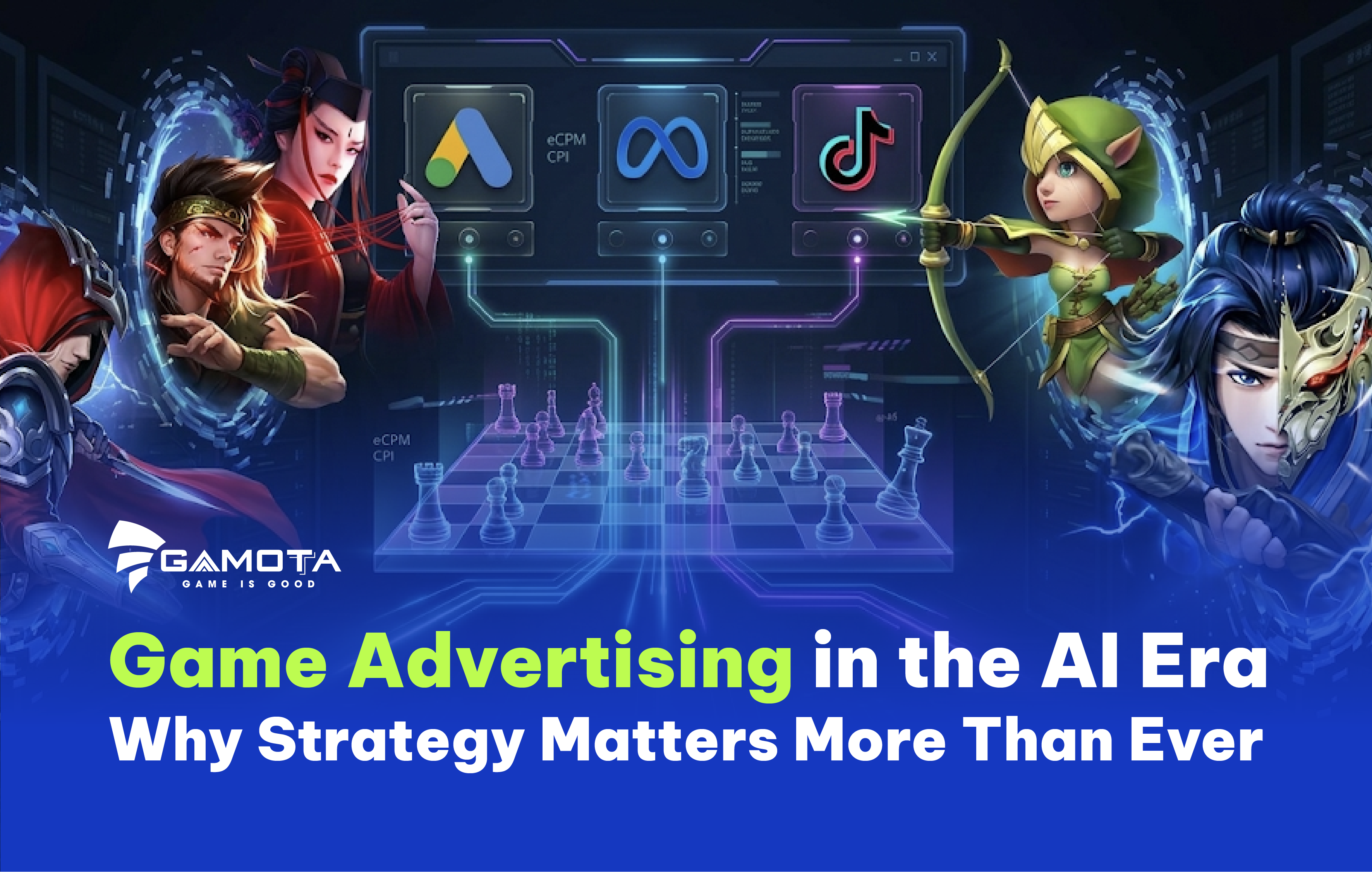
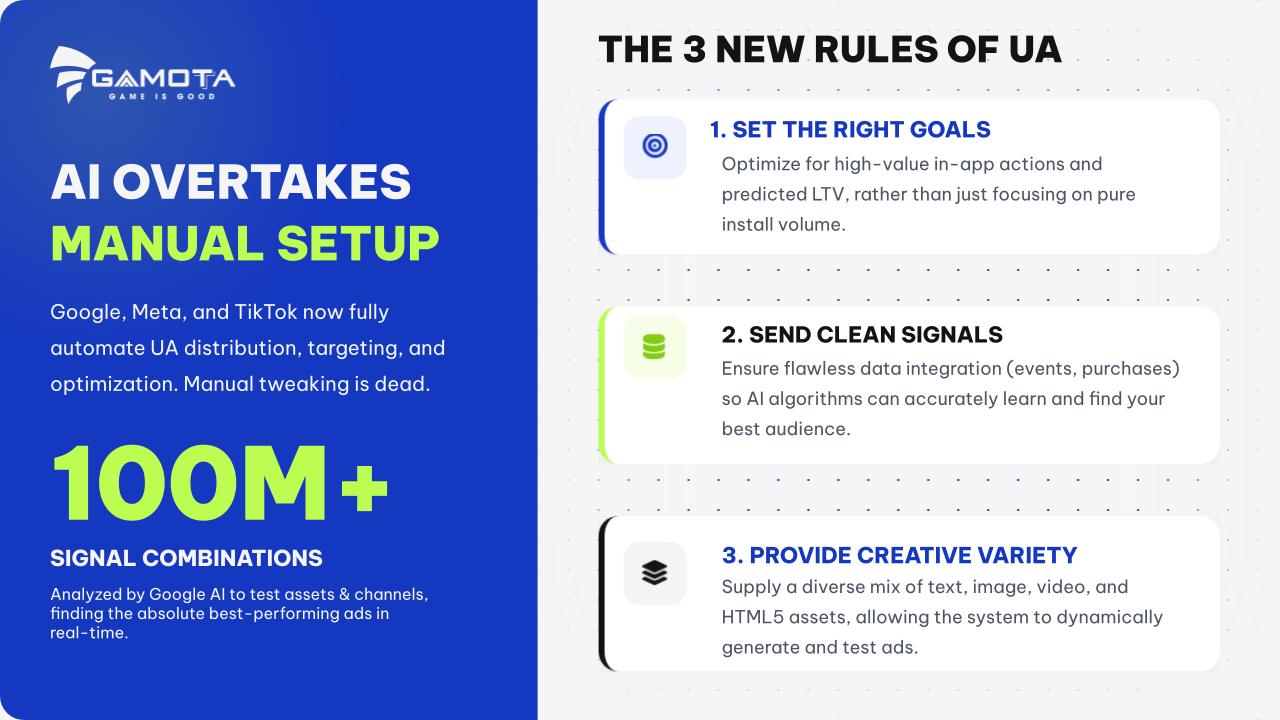
Game advertising is increasingly run by AI, not manual setup. Google says App campaigns automatically optimize ads across its inventory once advertisers provide bids, text, and creative assets [1].
TikTok and Meta position Smart+ and Advantage+ similarly, using AI to automate setup, audience finding, and optimization [2] [3] [4]. As a result, performance depends less on manual tweaking and more on setting the right goal, sending clean signals, and giving the system enough creativity to learn from.
Google says its App campaigns AI can analyze hundreds of millions of signal combinations and test different assets and channels to find the best-performing ads [5].
AI is taking over the operational layer
Three parts of user acquisition are now heavily automated.
Distribution. Google App campaigns automate optimization across Google inventory [1]. TikTok says Smart+ automates campaign setup, audience targeting, optimization, and creative processes [6]. Meta positions Advantage+ products around AI-supported audience and app campaign optimization [3] [4].
Creative handling. Google recommends uploading a diverse mix of text, image, and video assets. Mobile game marketers can also include HTML5 and playable formats. The system dynamically generates and tests ads across placements [5].
Google also offers generative AI tools to create new image assets and may suggest generated images for advertisers to review [7]. TikTok says Smart+ automates creative combinations and shifts budget toward higher-performing creatives over time [2] [6].
Optimization toward value, not just volume. Google’s Ads API confirms that App campaigns can support goals ranging from install volume to in-app actions and in-app action value [8]. For game publishers, this matters. Install volume alone is rarely the real business goal.
Creative now helps the system find users
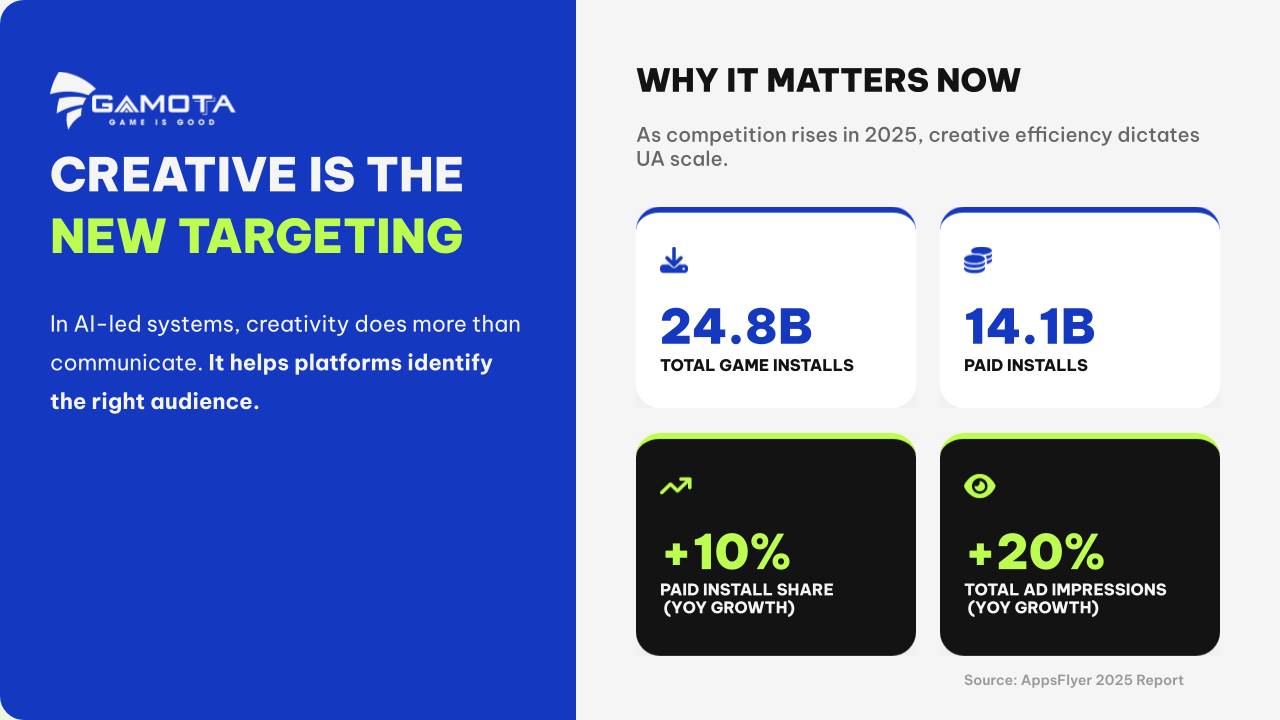
In AI-led systems, creativity does more than communicate. It also helps platforms identify the right audience. Google says App campaigns test asset combinations and serve the best-performing ads [1], while TikTok says Smart+ uses system learning to deliver the right ad to the right person [2] [6].
As competition rises, this matters more. AppsFlyer reports 24.8 billion total installs and 14.1 billion paid installs in 2025, with paid install share up 10% year over year and ad impressions up 20% [9].
More creative does not automatically mean better UA
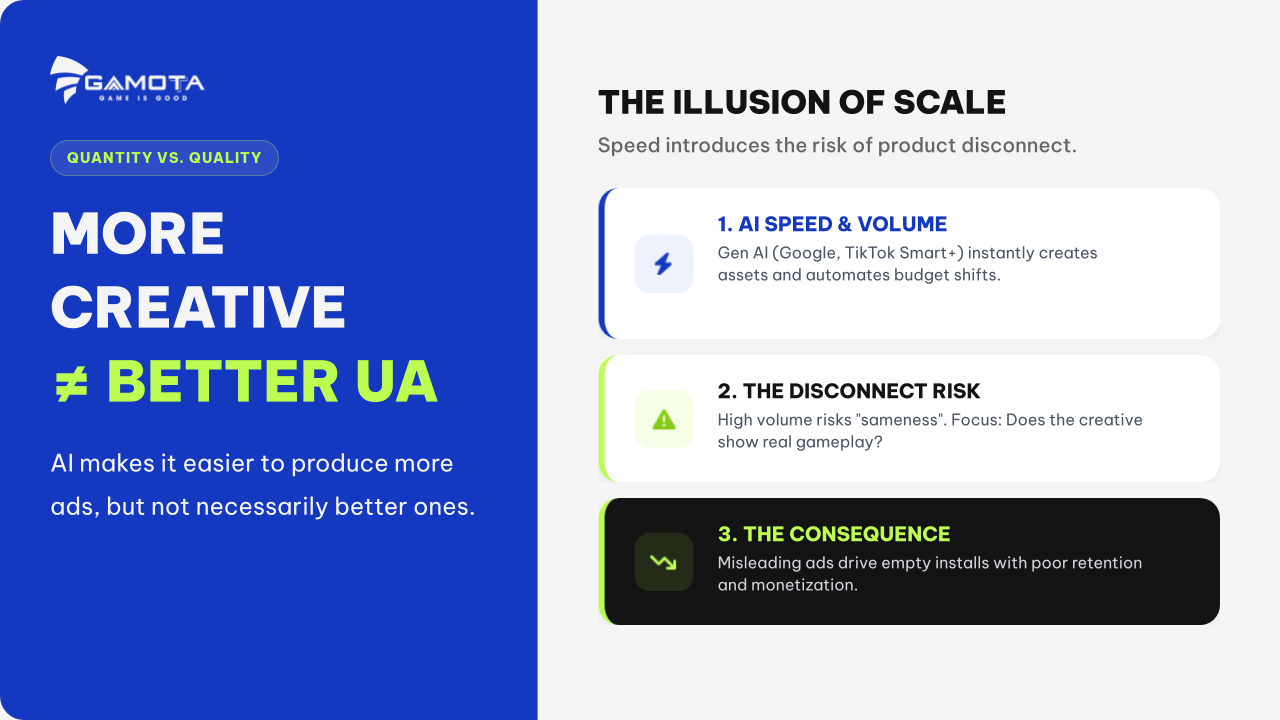
AI makes it easier to produce more ads, but not necessarily better ones.
Google says generative AI tools can create new image assets in seconds [7], while TikTok says Smart+ can automate creative combinations and shift budget toward stronger-performing assets [6].
That improves speed, but it also increases the risk of sameness and disconnect from the real product. For game publishers, the key question is whether the creative reflects actual gameplay. If it does not, campaigns may still drive installs, but those users are less likely to retain or monetize well.
Human review still matters
This is especially important in games, where characters and visual identity are part of the product itself.
Google says advertisers should review generated or suggested assets before publishing to ensure they are accurate, not misleading, and policy-compliant.
It also notes that generative AI content is subject to the same standards and enforcement as other ad content [7]. AI can help scale production, but final approval still needs human control, especially for character-led or brand-sensitive creative.
The Vietnam context: where the install-revenue gap is most visible
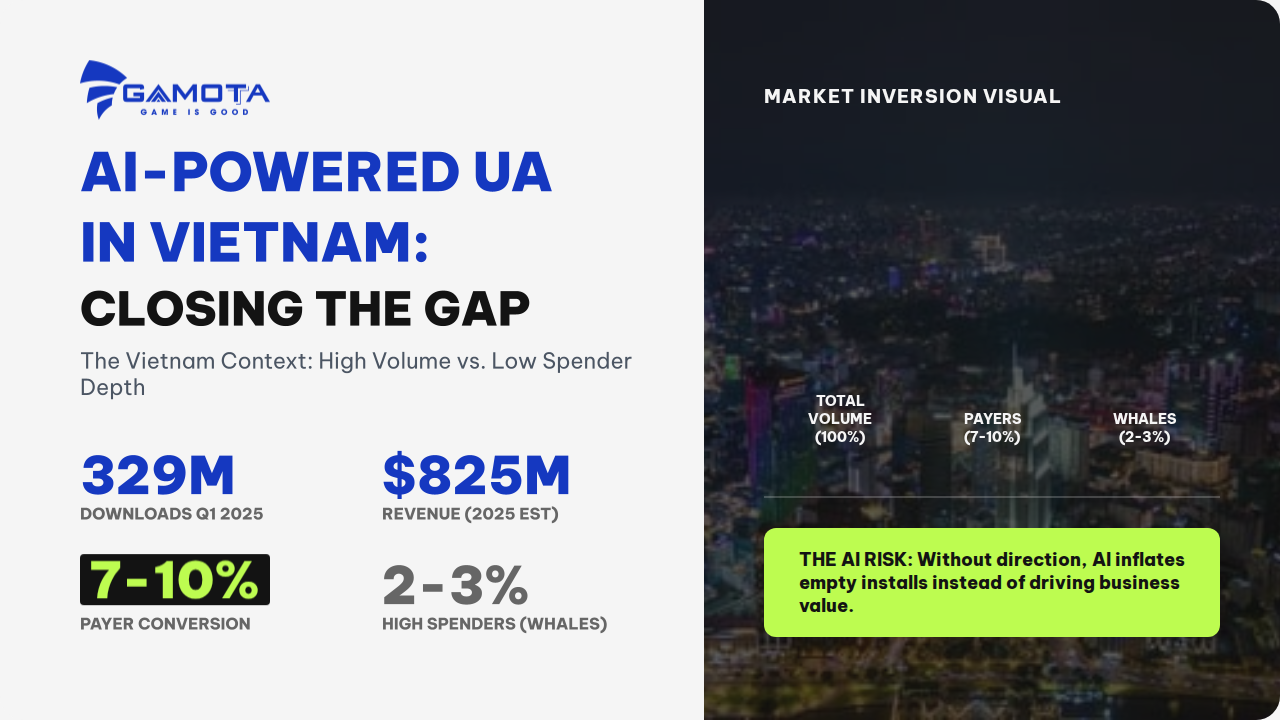
Vietnam shows this gap clearly. The country recorded 329 million mobile game downloads in Q1 2025, ranking among Southeast Asia’s largest download markets [10].
Yet Gamota’s Vietnam Mobile Gaming Year-in-Review 2025 says the market generated $825 million in revenue in 2025, with only 7% to 10% of players spending and just 2% to 3% classified as high spenders [11] [12].
This is where AI-powered UA can either create value or just inflate install volume.
What game teams should focus on now
As platforms automate more execution, the team’s role becomes more strategic. Three principles matter most.
- Set the right optimization goal first. Google says App campaigns optimize based on the goal advertisers choose, such as installs, in-app actions, or value-based outcomes [5] [8]. If the signal is installed, the system will find installs. If the signal is valuable, it has a reason to find spenders.
- Give the system enough creative breadth to learn. Google recommends using a diverse mix of text, image, and video assets [5]. For game publishers, that means covering different parts of the product, not repeating one hook in multiple formats.
- Avoid over-fragmentation. Meta says the system needs around 50 optimized conversion events per ad set before it can exit the learning phase [13]. Too many small ad sets can limit learning by splitting the data too thin.
The principle is simple: AI performs better when it has a clear goal, enough data, and enough creative variety to test meaningfully.
Conclusion
AI is changing how game advertising works, but not what drives performance.
Platforms now automate more of delivery, optimization, and creativity [1] [2] [3] [4], which makes strategy more important, not less.
The fundamentals remain the same: set the right goal, feed the system clean signals, and make sure creativity reflects the real product. In markets like Vietnam, where download scale is high but payer depth remains limited, those fundamentals determine whether AI-powered UA improves business outcomes or simply drives more installs.
References
[1] Google Ads Help, “About App campaigns”
[2] TikTok Ads Manager, “About Smart+ App Campaigns”
[3] Meta Business Help Center, “About Advantage+ Audience”
[4] Meta for Business, “Advantage+ app campaigns”
[5] Google Ads Help, “Best practices guide: Setting up your App campaigns”
[6] TikTok Ads Manager, “About Smart+ Campaigns”
[7] Google Ads Help, “About generated images in Google Ads”
[8] Google Ads API, “Create App Campaign”
[10] Sensor Tower, “Southeast Asian Mobile Game Market Insights 2025”
[11] PocketGamer.biz, “Vietnam’s mobile games market reached $825m in revenue in 2025”
[12] Gamota, “Vietnam Mobile Gaming Year-in-Review 2025”
[13] Meta Business Help Center, “Best Practices for Meta Ads Delivery”