
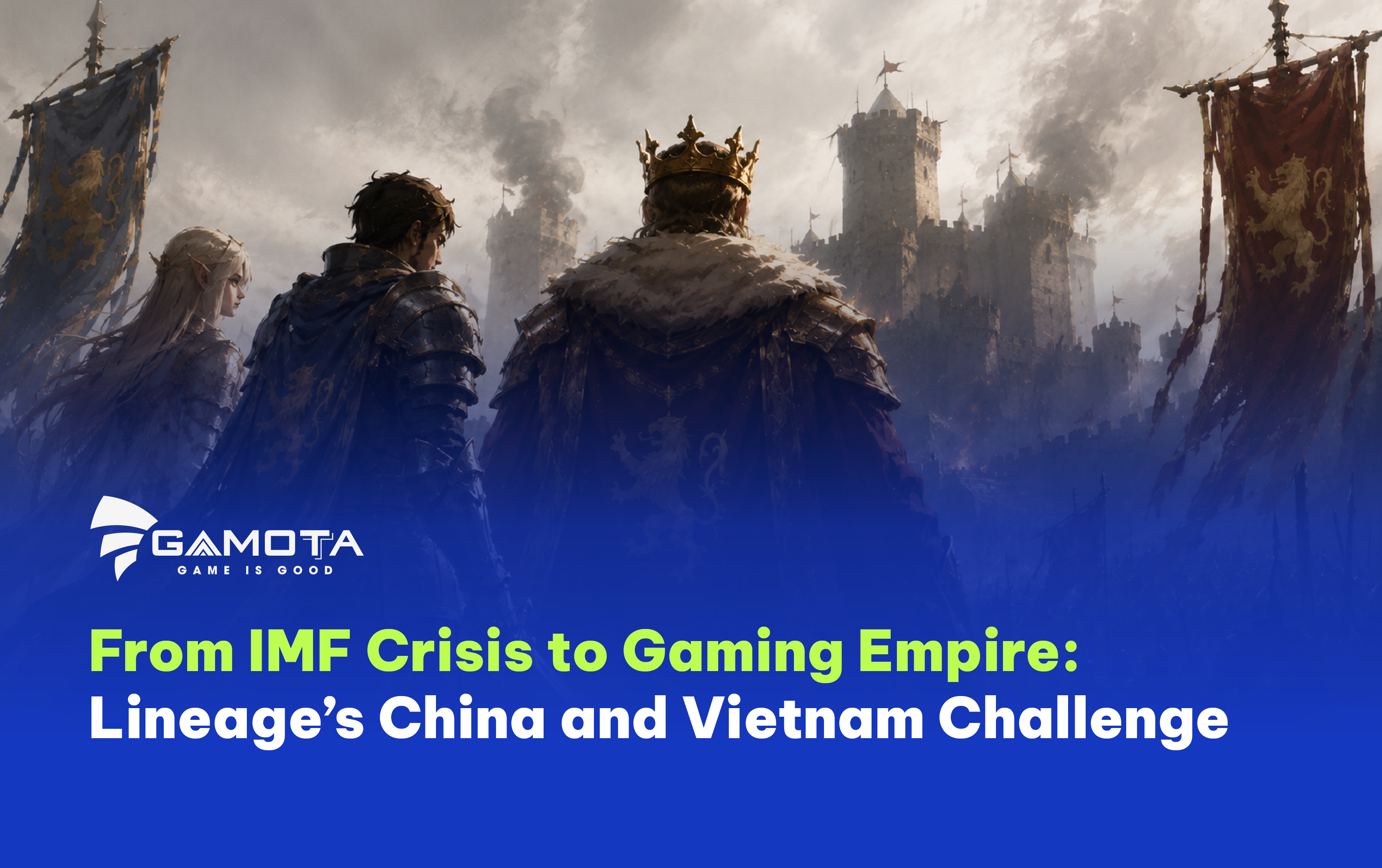
Few people know that one of the MMORPG franchises that helped define the genre was born out of the ashes of an economic crisis. In 1998, as South Korea was still recovering from the shock of the 1997 IMF crisis, NCSoft launched Lineage, a game where players built their own political and economic virtual society, one defined by fierce competition, exploitation, and betrayal.
28 years later, the four mobile entries in the series alone have generated over $7.4 billion in combined revenue. Yet the same brutal design that built Lineage’s reputation is exactly what made it struggle in the West, and kept it from ever matching its billion-dollar global stature in the Vietnamese market.
Born From Crisis, Raised in Internet Cafés
Lineage‘s origin story is more unusual than most games of its era.
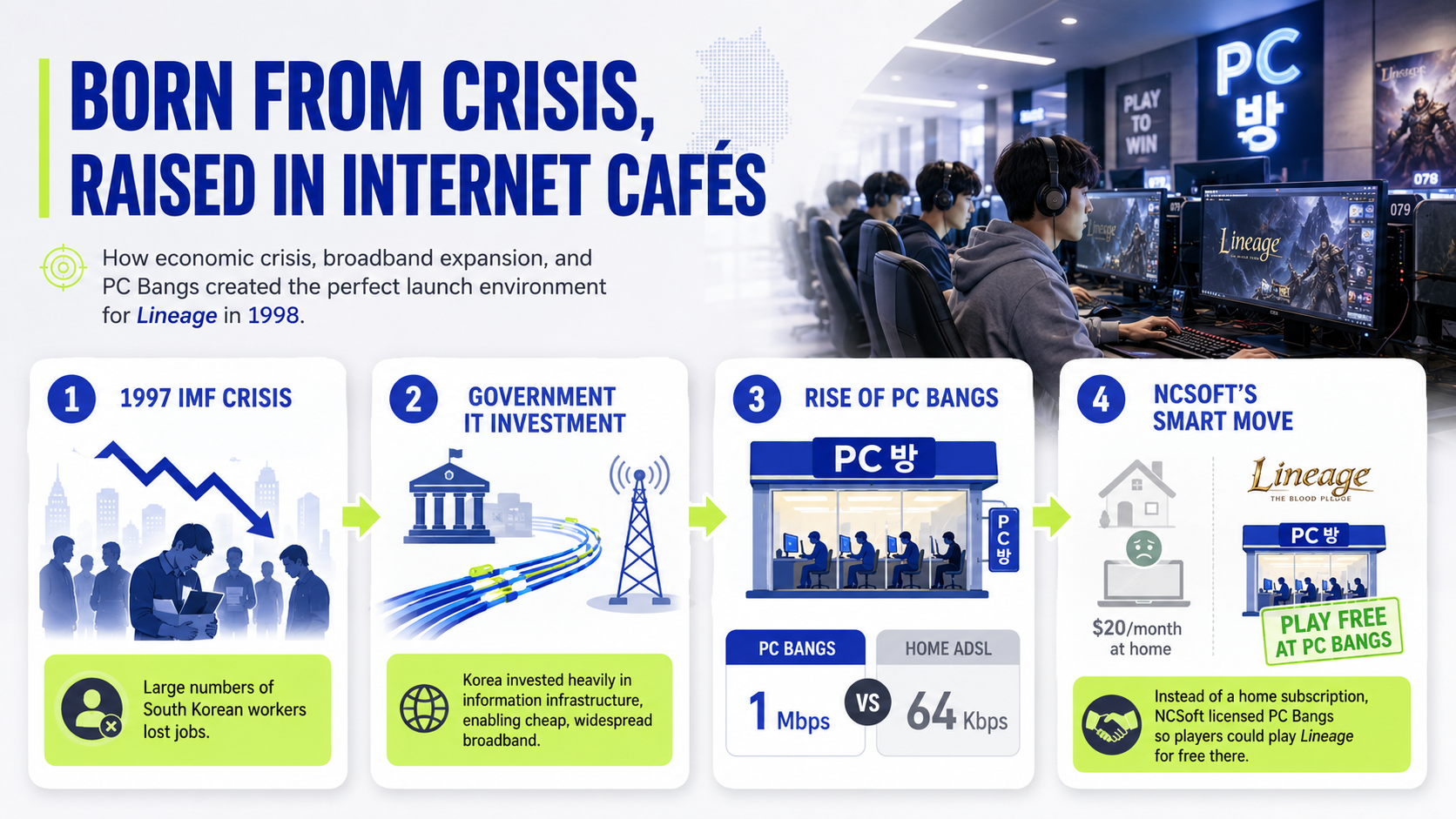
The 1997 IMF crisis threw large numbers of South Korean workers out of jobs. But it also pushed the government to invest heavily in information technology infrastructure, laying the groundwork for a cheap, widespread broadband ecosystem.
Seizing the opportunity, entrepreneurs quickly opened up PC Bangs, the precursor to the “internet café” model familiar in Vietnam. PC Bangs ran on cable modems reaching speeds of 1Mbps, far outpacing the roughly 64Kbps of household ADSL connections at the time.
NCSoft timed its move perfectly: instead of charging players a monthly subscription (around $20 to play from home), it charged PC Bangs a licensing fee, letting players experience Lineage for free at these venues. Combined with the fact that most Korean games of the era were single-player titles imitating foreign hits, a homegrown Korean multiplayer product like Lineage was a bold move that landed at exactly the right time and place.
Lineage: Born From Crisis, Raised in PC Bangs
A “Brutal Society” Built on Blood, Taxes, and Betrayal
What set Lineage apart from RPGs of its era like Diablo wasn’t combat. Instead of letting players develop freely as independent units, Lineage turned them into raw material for a massive machine known as the Blood Pledge.
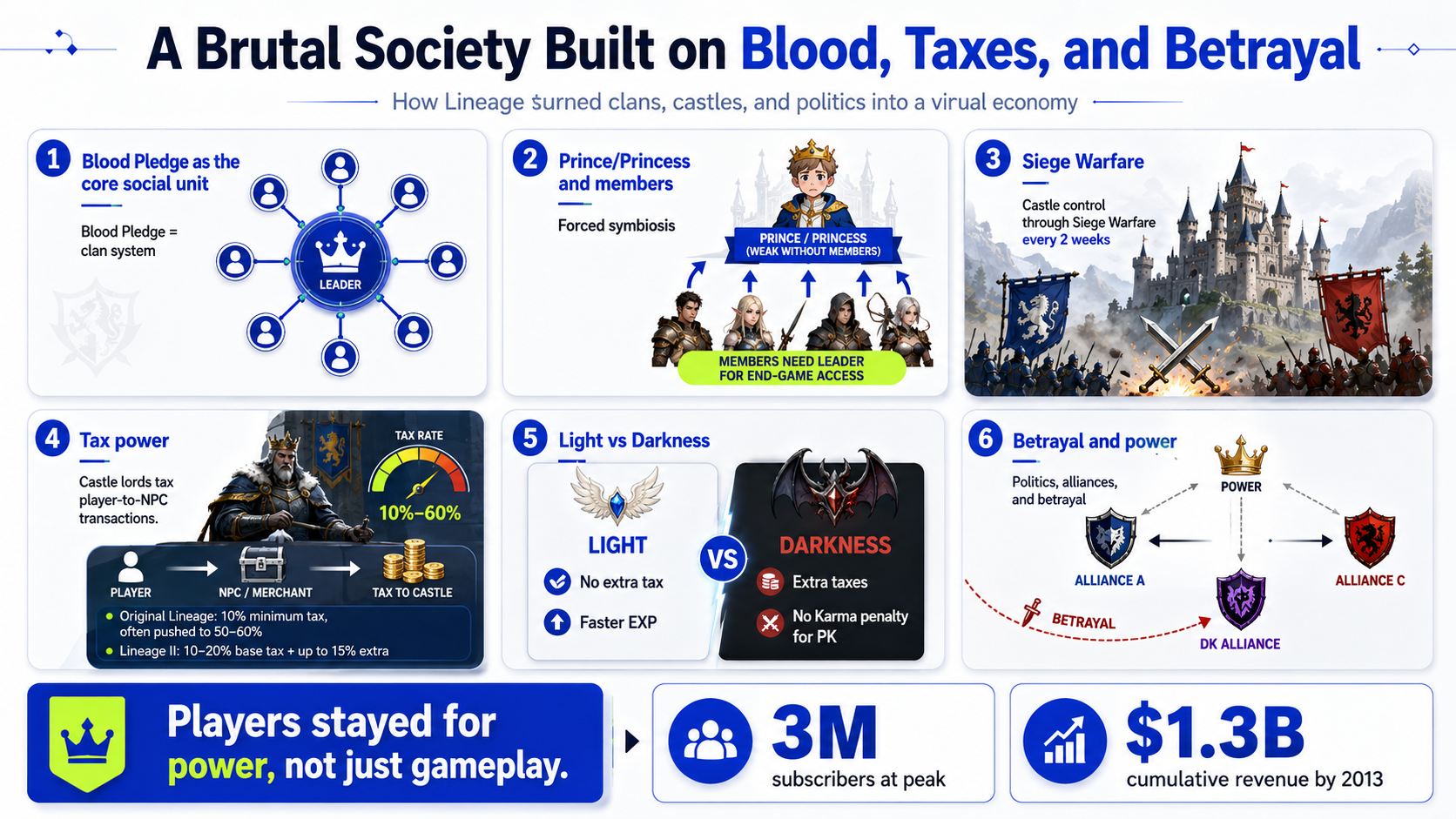
As Lineage’s fundamental social unit, the Blood Pledge (its clan system) could only be founded by the Prince/Princess class, the only class with a special Charisma stat. This created a forced symbiotic relationship:
- Princes/Princesses were weak in combat, so they depended on members to fight.
- Members depended on their Prince/Princess to access end-game content.
Blood Pledges then threw themselves into Siege Warfare, mandatory battles held every two weeks to seize control of castles. The winner became the Castle Lord.
In the original Lineage, which had no tax cap, Castle Lords could impose a minimum 10% tax on every player-to-NPC transaction in their territory. Many pushed rates as high as 50-60% to crush the competitiveness of smaller Blood Pledges just entering the server.
Lineage II (2003) fixed this design flaw with a more controlled tax system: each region had a fixed base tax rate (10-20%, depending on the region), and Castle Lords could add no more than 15% on top. Running a castle, then, was essentially running a business: price too high and you lose customers, price too low and you can’t afford an army for the next Siege Warfare.
Lineage II also introduced the Light and Darkness mechanic, forcing Castle Lords to pick one of two paths:
- Castle of Light: no extra tax, but all citizens get faster experience point (EXP) gains.
- Castle of Darkness: an extra 30% player tax and 10% NPC tax, but Darkness-aligned members are exempt from the Karma penalty for PKing opponents.
This choice deepened the divide between two political camps: those who prioritized the community’s interest to attract broad alliances, and those who prioritized their own faction’s gain through resource monopolies.
This political system produced betrayal stories that are now etched into Lineage community history. On the Bartz server, DK Alliance ruled as a tyrant until it was overthrown by an alliance that originated from the Red Revolution clan. But after the victory, Red Revolution received no fair reward, not even a single castle. DK Alliance, the very faction that had just been overthrown, recruited Red Revolution back to help it retake power.
The name Red Revolution became infamous within the community, not for having “liberated” the server, but for betraying the very allies who had fought alongside them to win that freedom.
Players stuck with Lineage for the long haul not because the gameplay itself was especially fun, but for the sense of power that came with controlling a virtual economy. At its peak, Lineage reached 3 million subscribers, and by 2013, its cumulative revenue had crossed roughly $1.3 billion.
How Lineage Built a Virtual Power Economy
East Asia’s Golden Child, a Reluctant Guest in China and the West
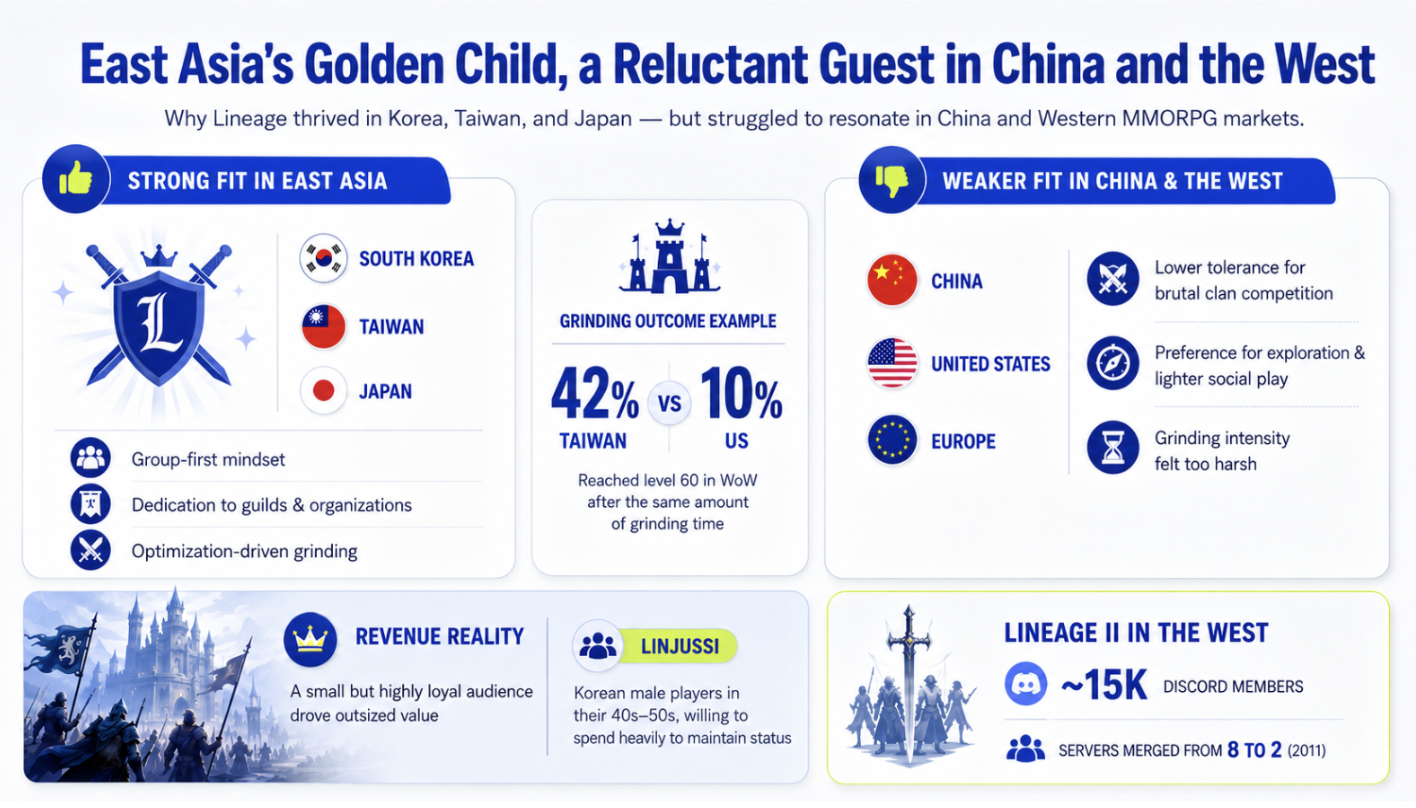
Lineage’s massive appeal in South Korea, Taiwan, and Japan stood in sharp contrast to the far more lukewarm reception it received in China, the US, and Europe, despite all being highly active MMORPG markets.
A study from National Chiao Tung University in Taiwan illustrated the cultural gap clearly: given the same amount of grinding time in World of Warcraft, 42% of Taiwanese players reached level 60, compared to only about 10% of American players.
This divergence traces back to cultural differences:
- East Asian players tend to prioritize group interests, dedication to an organization, and personal achievement, exactly the values that Lineage’s Blood Pledge and Siege Warfare systems were built to exploit.
- Western players more often treat MMORPGs as platforms for exploration and relaxed social connection rather than fierce competition over resources.
As a result, even though hardcore MMORPGs have found mainstream success in Western markets, their “hardcore” identity rarely comes from the kind of disciplined, optimization-driven grinding that defines Lineage. China falls into a similar camp: despite being a massive MMORPG market, Lineage’s level of grinding and its brutal Clan/Guild competition go well beyond local player preferences.
Lineage II still exists in the West today, but with a fairly modest active player base (its official Discord has only around 15,000 members), forcing the publisher to consolidate from 8 servers down to 2 back in 2011 just to keep the remaining community large enough to interact with itself.
Even within South Korea, Lineage remains a niche title. While many later-generation Korean MMORPGs chose to soften the harsh zero-sum competition between factions (rewarding the winning side rather than granting it total control), Lineage stuck with its original, unforgiving formula.
The series’ massive revenue comes largely from a small, extremely loyal group of players the Korean community calls “Linjussi”: men in their 40s and 50s willing to spend hundreds of dollars a month to maintain their standing in the game.
Lineage Across Markets: East Asia vs. China and the West
A $7.4 Billion Mobile Empire: One Brand, Four Different Formulas
Lineage’s first steps into mobile produced four versions, each targeting a completely different type of player:
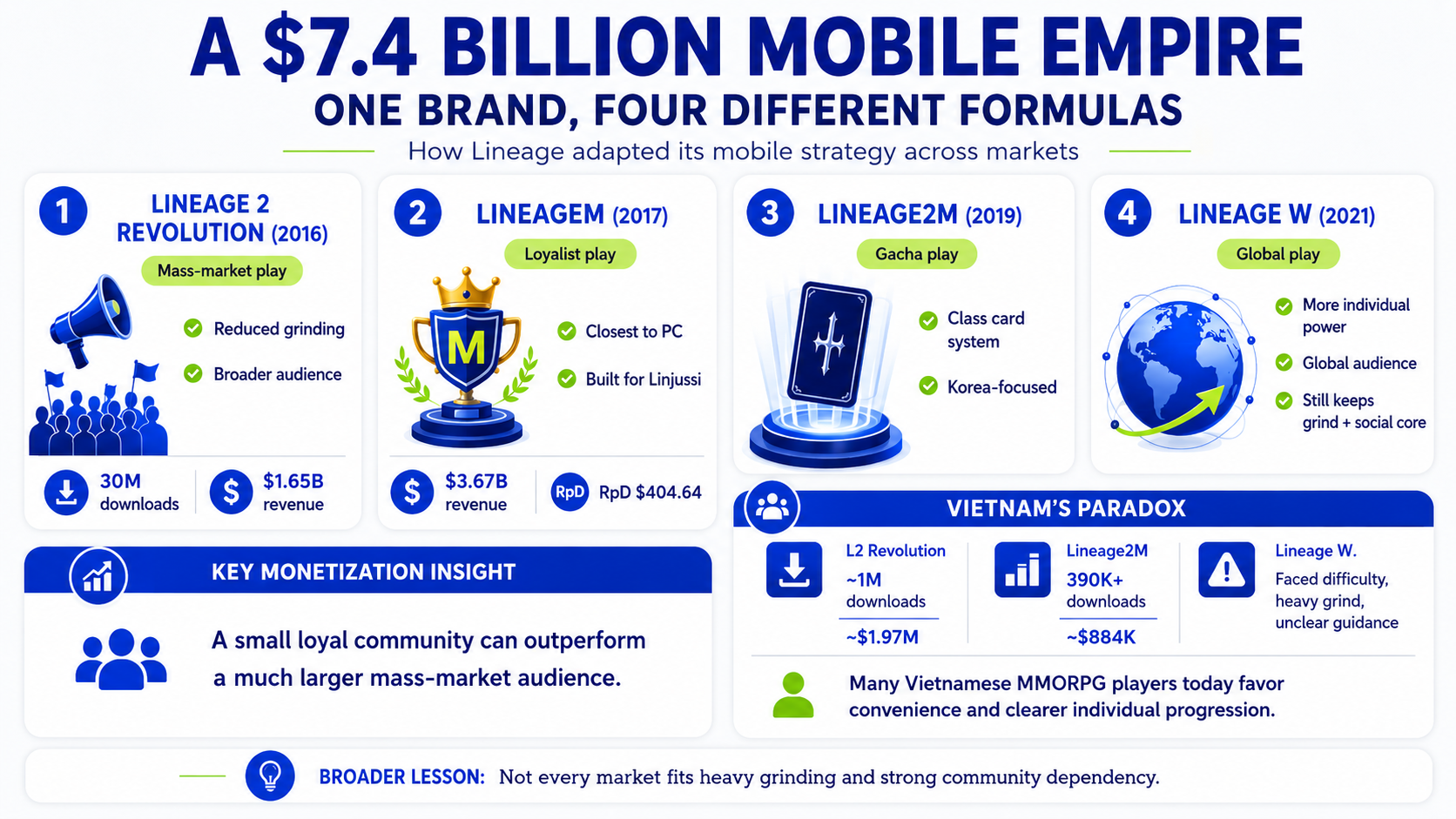
- Lineage 2 Revolution (2016) – the mass-market play: reduced grinding, leaned into action and individual progression rather than Clan dependency, reaching the series’ widest player base yet. Result: 30 million downloads, $1.65 billion in lifetime revenue.
- LineageM (2017) – the loyalist play: went against the mass-market trend, recreating the original PC experience almost exactly to serve the Linjussi who had stuck with the franchise since day one. Downloads were only about a third of Lineage 2 Revolution’s (9 million), yet it became the highest-grossing entry in the series: $3.67 billion, with an average revenue per download (RpD) of $404.64, more than seven times higher than Lineage 2 Revolution’s.
- Lineage2M (2019) – the gacha play: returned to Lineage II’s signature grinding gameplay and added a Class Card system allowing flexible class-switching. This new monetization layer only really worked in the Korean market.
- Lineage W (2021) – the global play: the newest entry, leaning more heavily into individual power progression to appeal to international players, while still keeping the grinding and social-dependency traits core to the series’ identity.
The RpD gap between Lineage 2 Revolution and LineageM is clear proof of a monetization principle: a small, extremely loyal community can generate commercial value that far outstrips a large but shallow, mass-market one.
Vietnam’s Paradox: When the Craving for “Individual Glory” Beat Out “Serving the Collective”
Even though Vietnam is generally a market that favors grind-heavy games, Lineage’s footprint there has been dwarfed by the series’ global scale.
- Lineage 2 Revolution, published in 2018 by VTC Mobile, is the only entry with solid figures: close to 1 million downloads and roughly $1.97 million in lifetime revenue, before it was shut down in 2020.
- Lineage2M performed even more modestly in Vietnam: just over 390,000 downloads and $884,000 in revenue, most of it coming from players who joined in the launch month, with little room to grow beyond that.
Lineage W was built for the global market, but it faced mixed reviews in Vietnam right from launch due to its high difficulty, heavy grinding requirements, and lack of clear guidance. Players dropped off early, leaving the game short on the interactive community that a title like Lineage, built to run on social connection, depends on.
The deeper cause lies in Vietnam’s already-established gaming habits: most Vietnamese MMORPG players today are used to titles that prioritize convenience and clear individual progression, such as the MU franchise or the Xianxia/Wuxia-themed MMORPGs that have been popular there for years.
This isn’t a problem unique to Vietnam. It’s a broader barrier in any market whose gaming culture doesn’t mesh well with heavy grinding or community dependency, including China and parts of the US and Europe.
Lineage Mobile Empire: Four Formulas, One Brand
A Series That Never Tried to Please Everyone
Lineage never set out to be a game everyone would enjoy. For 28 years, the series has held onto its hardcore core identity, accepting the tradeoff of becoming a niche product even in its own home market.
That harshness has made it difficult for Lineage to win over Western or Vietnamese players. But for its loyal base in key markets, it remains an irreplaceable addiction, one that players are willing to pay a premium to keep being part of, inside a brutal virtual society they themselves helped build.
Source: This article is based on an analysis of the internal case study report “Lineage Series – 28 Years of Global Expansion,” produced by Gamota’s R&D team.