
This article was edited based on professional insights shared by Quang, Head of Publishing at Gamota.
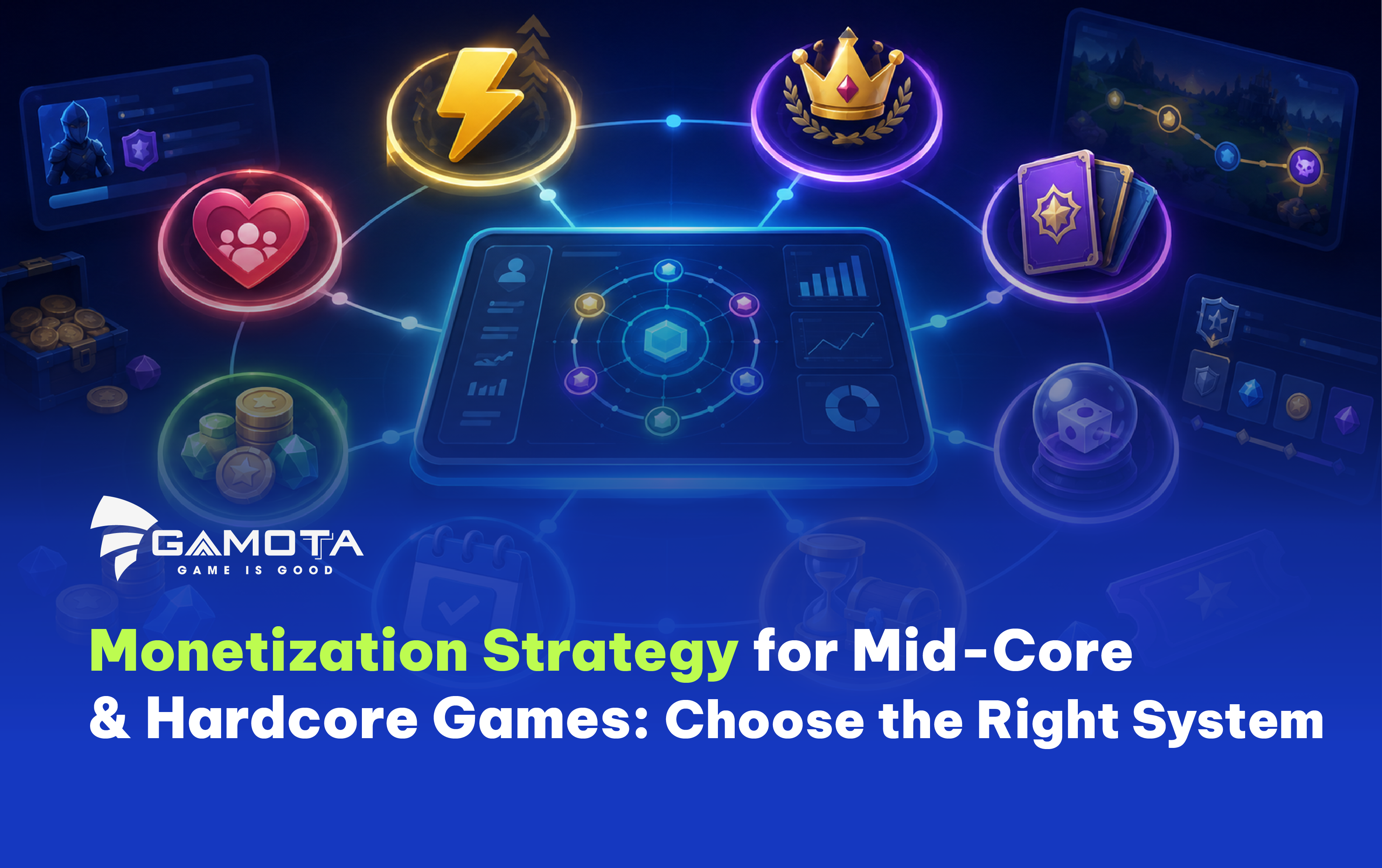
In game operations, monetization is often misunderstood as simply stacking familiar features into a game, such as Battle Pass, Gacha, Flash Sales, or event-based offers. These models are extremely common in mid-core and hardcore games.
According to Quang, Head of Publishing at Gamota, the core issue behind many underperforming monetization efforts usually isn’t a lack of offers, it’s that the game never chose the right monetization strategy in the first place.
Put simply, for monetization to work, don’t rush to ask: “What should we sell next?” Start with the underlying question instead: “What monetization system is this game actually built on?”
Copying Features Isn’t the Same as Understanding Monetization Thinking
Many development and LiveOps teams look to top-grossing titles and replicate whatever monetization model is trending. Battle Pass, Gacha, and VIP systems get cloned over and over.
But copying someone else’s features doesn’t mean your game will generate the same revenue results. Those features are just tools. The real differentiator lies in the monetization philosophy behind them.
A Battle Pass only drives meaningful revenue when the game has a compelling daily-quest loop, valuable rewards, and a stable player community. Dropping a Battle Pass into a game with thin content and low retention is unlikely to deliver the results teams hope for.
Gacha works the same way, it’s more than a lucky spin. A successful Gacha system has to create genuine anticipation, use a sensible rarity structure, and preserve player trust. Treat Gacha purely as a short-term revenue extraction tool, and the game risks eroding fairness and struggling to retain players long-term.
Monetization philosophy is about understanding player behavior and designing the right incentives for spending, ultimately connecting features, events, and systems into a coherent whole.
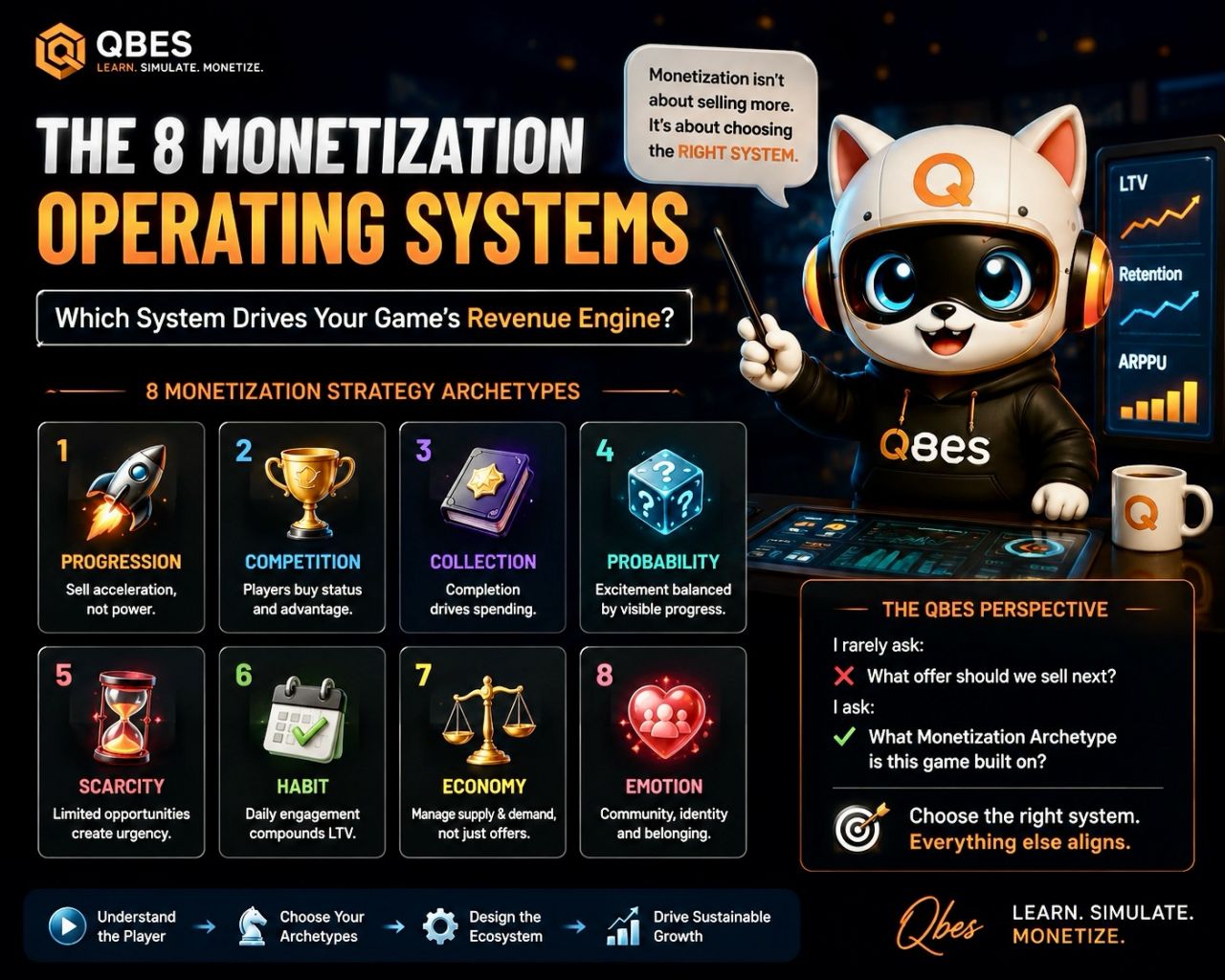
Infographic of the 8 monetization strategy archetypes in games.
Source: Quang Pham.
8 Core Monetization Strategies in Mid-Core & Hardcore Games
Quang groups mid-core and hardcore games into 8 core monetization strategy archetypes. These aren’t isolated features, they’re a mental map that explains why players actually decide to spend.
1. Progression — Sell speed, not raw power
This model centers on optimizing grind time. Players pay to progress faster and unlock content more smoothly.
Avoid pushing this into blunt Pay-to-Win territory. If spending creates too large a power imbalance, it erodes community trust and balance. Instead, design a progression path compelling enough that paying to “speed up” feels genuinely worth it.

2. Competition — Paying for status and competitive advantage
This strategy taps into the drive to top the leaderboard, climb rankings, and assert status in PvP, SLG, or MMORPG games. Spending here becomes a way for players to reinforce their status, defend what they’ve earned, or dominate tournaments and guild wars. Revenue from this group is tightly tied to public recognition of rank within the community.
3. Collection — Motivation from completing a set
Sometimes players spend not for power, but for the feeling of “just one piece missing.” Card sets, limited character skins, and rare mounts drive strong revenue when a game builds a sensible rarity tier system and ties it to aesthetic or sentimental value.
4. Probability — Balancing randomness with visible progress
This is the hallmark of Gacha or loot box systems, where revenue comes from anticipation. Pure randomness easily breeds frustration, so an effective system needs a pity mechanism so players always feel they’re getting closer to their goal, even when luck hasn’t been on their side.
5. Scarcity — Driving spend through limited availability
Using time limits or capped quantities on exclusive items creates urgency (FOMO) and pushes players to spend faster. Slapping a “Limited” label on everything without real differentiation eventually drains scarcity of its value. This strategy needs to be timed carefully within the LiveOps event calendar.
6. Habit — Turning login routines into revenue
For hardcore players, value accumulates through long-term grinding: daily logins, completing quests, farming resources, joining guilds, and keeping a consistent play rhythm. Once that habit is established, it’s the right moment to sell Battle Passes or monthly cards.
7. Economy — Managing supply and demand in the in-game economy
Monetization is not only about creating purchase touchpoints; it is also about regulating internal resources within the game economy. If a game generates too many resources with nowhere to spend them, the system inflates. If resources are too scarce, players get discouraged. Offers, event rewards, and resource sinks need to be designed as part of the mechanism that keeps the in-game economy balanced.
8. Emotion — Revenue from emotional attachment and community identity
Once a community is strong enough, spending moves beyond ordinary item utility. Players spend because they love a character, take pride in their guild, or want to express their identity. This is where a financial transaction becomes an emotionally driven investment.

LiveOps: The Art of Combining Multiple Strategies
The best LiveOps teams rarely rely on a single strategy. They know how to flexibly combine multiple models within the same game.
For example: use Progression to guide new players, Habit to sustain daily engagement, Competition to drive excitement during major seasons, and Scarcity to create revenue peaks around major holidays.
At that point, the Event Calendar stops being a scattered list of events with no shared purpose. It becomes a deliberate script that shapes player behavior, optimizing experience, revenue, and long-term LTV all at once.
Conclusion: Monetization Is a Behavioral Design System
It’s time to drop the short-term question: “What offer should we sell next?” Instead, ask: “What monetization system is this game actually running on?”
Only once that system is clear do decisions around store design, Battle Pass structure, or pricing strategy actually deliver results, and that impact carries through to LTV growth and ROAS efficiency downstream. Monetization isn’t simply the art of selling, it’s the art of understanding and designing player behavior.
A properly built system creates a stronger foundation for sustainable revenue, rather than relying purely on short-term offer pushes. As Quang put it: “Every successful LiveOps strategy starts with choosing the right system.”
Source: This article was edited based on professional insights shared by Quang, Head of Publishing at Gamota. Some illustrative examples in this piece are extended interpretations from a LiveOps operational perspective.
References
- Source: Quang Pham, LinkedIn post, available at: https://www.linkedin.com/posts/qbespham_gamemonetization-liveops-gameeconomy-activity-7477664874194530304-t-fA