
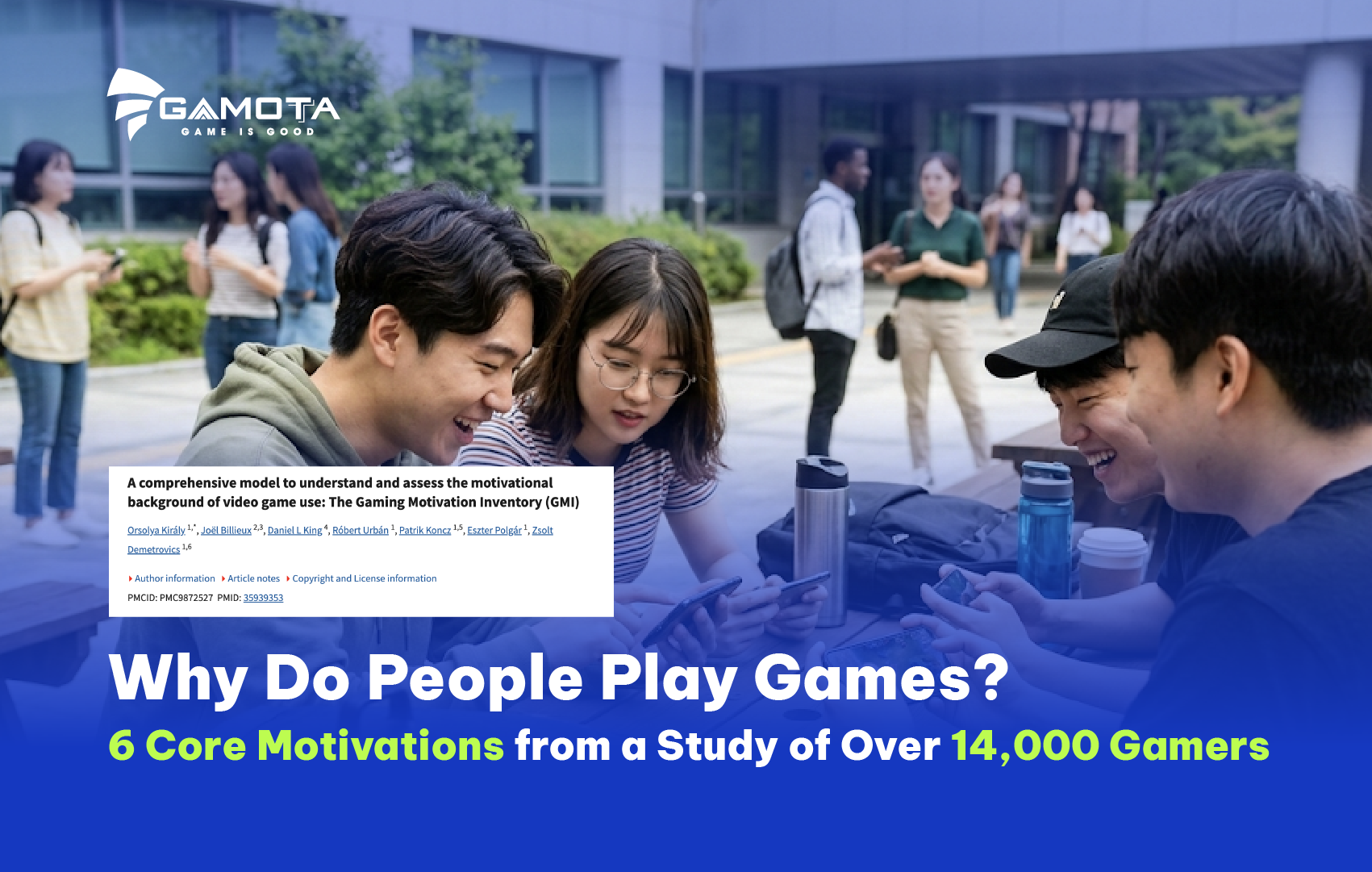
Why do people play video games? Usually, people mention entertainment, competition, or social time. However, industry veterans know a simple reality. The same game retains many different gamer groups. This happens because it satisfies their distinct psychological needs.
Therefore, authors of a recent study created a new measurement scale. This study is called the Gaming Motivation Inventory (GMI). Specifically, it addresses the core question of why players turn to games. It also explains the true structure of these motivations.
Why is this study credible?
This research brings high practical value to developers and marketing professionals. Additionally, behavioral analysts benefit greatly from it. This value comes from three core factors:
-
Comprehensiveness and flexibility: First, it overcomes the limits of old scales. As a result, it creates an accurate tool for all game genres.
-
Large-scale, real-world data: Second, researchers surveyed 14,740 core gamers. Consequently, the results achieve high representativeness and reliability.
-
Rigorous validation process: Finally, the tool went through multiple screening stages. In short, this is a highly scientific and systematic tool.
Research content: 6 core motivations that make people play games [1]
The study reveals an important finding. Specifically, 26 distinct motives fall into six main dimensions. Consequently, these six dimensions provide a comprehensive framework. This framework helps us understand modern player behavior.
Mastery
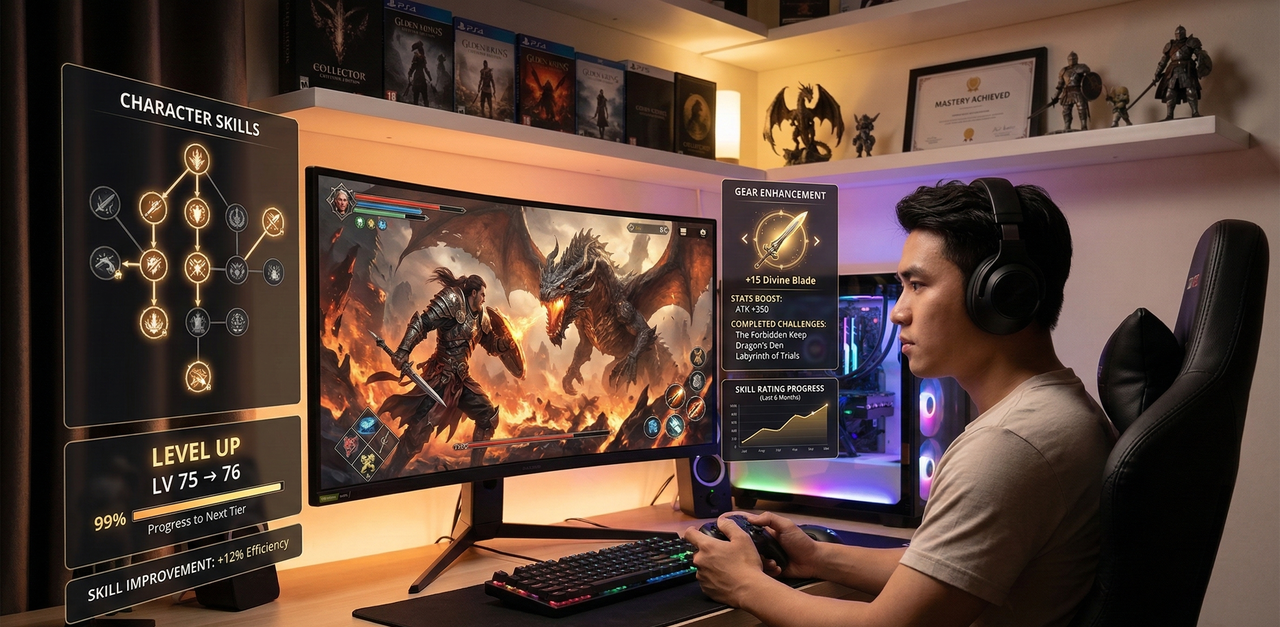
First, this motivation links to improving skills and understanding systems. Players want to overcome challenges and feel personal progress.
Therefore, this group responds well to deep designs. For instance, they like clear progression systems and long-term goals.
Furthermore, data shows that role-playing game (RPG) players often have a higher Mastery index.
Immersion and Escapism


Competition
Furthermore, this motivation focuses on winning and comparison. Players want high ranks and recognition.
Therefore, clear competitive loops strongly attract this group. They also enjoy calculated meta changes. Interestingly, MOBA players often record higher Competition scores than RPG players.

Stimulation
Social

Habit and Boredom

Game genre does not fully determine player motivation
Often, developers categorize players by genre to deduce motivation. However, the study points out a flaw here.
The relationship between motivation and genre is actually quite weak. Therefore, genre is only a suggestive factor.
In reality, one game genre attracts many player groups. Conversely, a single motivation appears across many genres. Ultimately, the gameplay loop maintains player engagement. System mechanics matter much more than simple genre classification.
Perspective from the reality of the Vietnamese game market
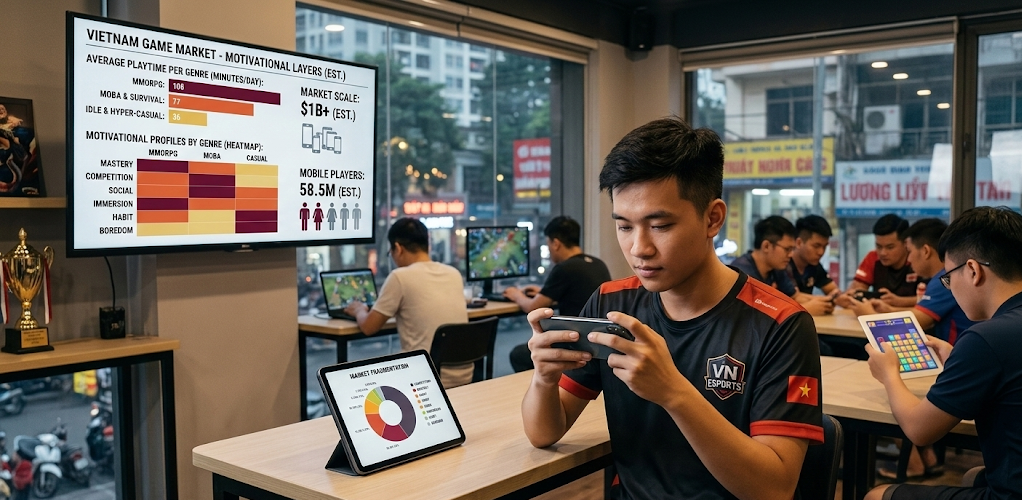
Currently, the Vietnamese game market is growing rapidly. It has an estimated 58.5 million mobile players. [2] Furthermore, this fragmented market proves a key point. Each motivation group has a separate gamer segment. Therefore, applying these six groups explains the domestic industry.
-
MOBA and Survival Games: These games explode in popularity. They perfectly combine Competition and Social motivations. As a result, daily playtime reaches 74 to 77 minutes. [3]
-
MMORPGs: These games own the highest playing time. They reach up to 108 minutes daily. This happens because they deeply satisfy Mastery and Immersion. [3]
-
Idle and Hyper-casual Games: These reflect Habit and Boredom. They help fill empty time in busy lifestyles. Therefore, they average about 36 minutes daily. [3]
Applied lessons for the game industry
From these groups, the industry can draw practical lessons. Therefore, teams can improve product development and marketing.
Segment players by motivation instead of genre
A single game satisfies multiple motivations. Therefore, teams should not just rely on favorite genres. Instead, they should ask about core needs. This approach brings a much more accurate perspective.
Design systems based on emotional needs
Each motivation corresponds to a desired emotion. For instance, Mastery needs a clear sense of progress. Similarly, Competition needs fairness.
Consequently, this approach helps developers focus on core feelings. It prevents them from adding features rampantly.
Shape marketing messages and content
Effective marketing must aim directly at player motivation. For example, the Mastery group cares about tactical depth.
Meanwhile, the Immersion group likes stories. Therefore, ads must match these specific desires.
Balance between experience and behavioral health factors
Finally, development teams must design products responsibly. They should optimize notification systems carefully. Additionally, they must control play session lengths. This balance helps maintain a sustainable experience.
Conclusion
In conclusion, the study identifies six core motivations. These create a solid analytical framework. Furthermore, they give industry workers a common language.
Customers are not merely playing a game. Instead, they seek a specific psychological experience. Ultimately, grasping these motivations supports better product development. It also helps teams understand players deeply.
-
Király, O., Billieux, J., King, D. L., Urbán, R., Koncz, P., Polgár, E., & Demetrovics, Z. (2022). A comprehensive model to understand and assess the motivational background of video game use: The Gaming Motivation Inventory (GMI). Journal of Behavioral Addictions.
-
Antom. (2025, November 12). Vietnam Gaming & Payment Trends Report: Unlocking Growth in a Young, Dynamic, Mobile-First Gaming Market
-
Funtap Games. (2026, February 6). Vietnam Mobile Gaming 2025: The Next Billion-Dollar Frontier in Southeast Asia.