

AI is helping game studios streamline many stages of development and operations, from market research and advertising automation to data analysis. This was one of the key shifts discussed at Vietnam Game Connect 2026, an annual B2B event for Vietnam’s gaming industry under the theme “Meet. Connect. Create.”
Attending the event in person, the Gamota team captured some of the most notable insights, case studies, and trends currently shaping the gaming industry.
Vietnam Game Connect 2026 brought together industry experts, studios, and major platforms including Google, Sensor Tower, Moloco, Habby, Playable Labs, as well as companies from Vietnam and international markets. The event was divided into two main tracks:
- Scale Track: Focused on User Acquisition (UA), Monetization, Creative, and AI strategies.
- Build Track: Focused on Product, Retention, Level Design, and the operational challenges of scaling a game studio.
While the sessions covered a wide range of topics, they pointed to a clear shift in how studios are building and growing games. Instead of waiting until a product is fully developed before taking it to market, gameplay ideas can now be tested much earlier. At the same time, data across UA, Monetization, and Product is becoming increasingly connected to help studios better understand and optimize player lifetime value.
The AI Era in 2026: Automating the Game Growth Pipeline
AI in gaming was once primarily associated with visible applications such as image generation, coding assistance, and content production. At Vietnam Game Connect 2026, however, its role was presented on a much broader scale: AI is becoming increasingly integrated across the entire growth pipeline.
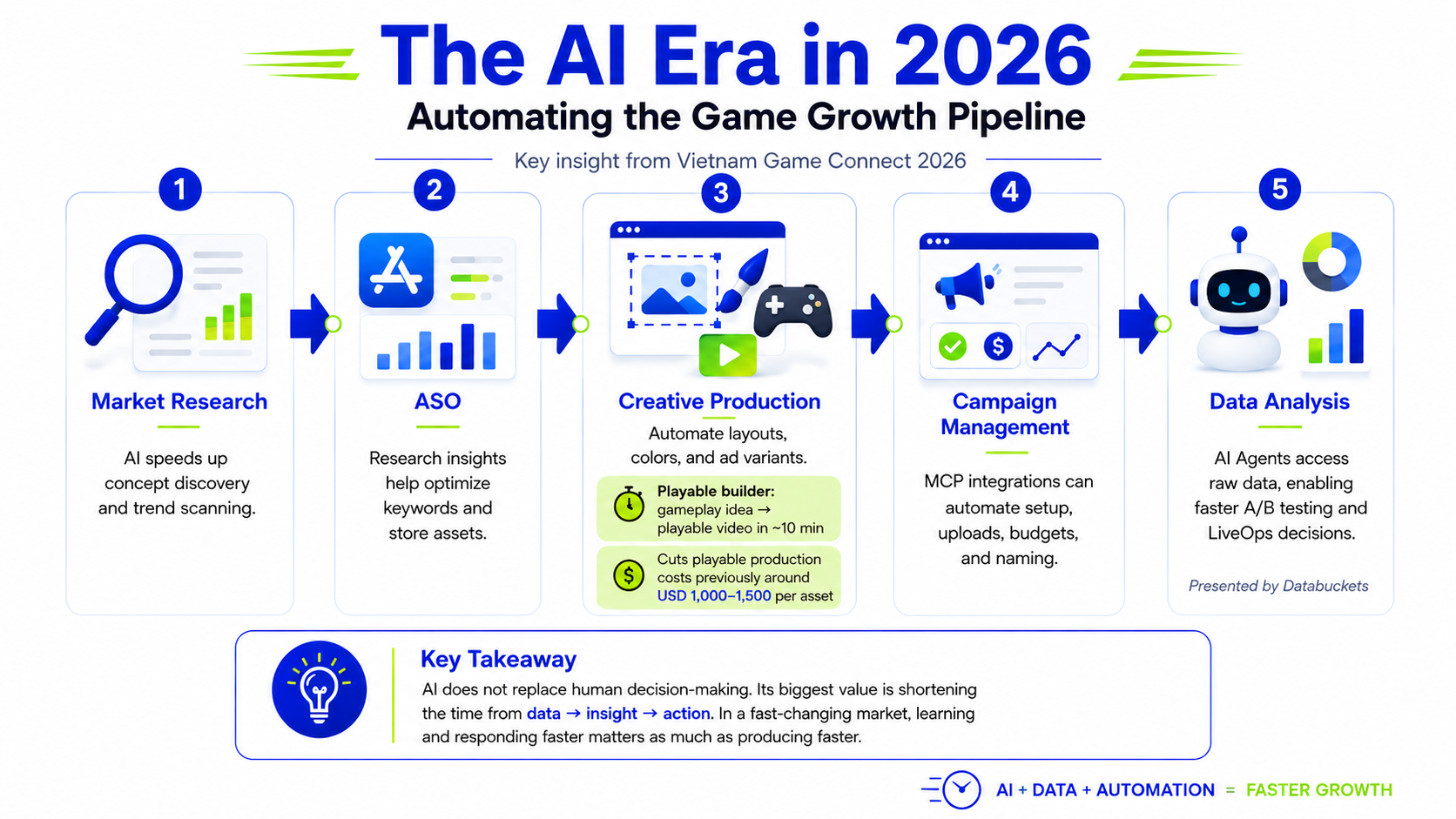
According to Super Banana Studio, AI is now being applied across five core operational stages:
- Market Research: AI can help aggregate information and identify potentially promising game concepts faster than traditional research workflows.
- App Store Optimization (ASO): Insights gathered during market research can be reused to optimize keywords and support the preparation of store assets.
- Creative Production: Studios can use AI to automate changes in layouts, colors, and other creative elements, then generate multiple ad variants for testing. One example presented at the event was a “playable builder” capable of turning a gameplay idea into a playable video in around 10 minutes.
This can significantly reduce both production time and the cost associated with externally produced playables, which could previously reach approximately USD 1,000–1,500 per asset.
- Campaign Management: Through MCP (Model Context Protocol) integrations with advertising networks, repetitive tasks such as campaign setup, creative uploads, budget configuration, and naming conventions can increasingly be automated.
- Data Analysis: From a product development perspective, Databuckets introduced AI Agents capable of accessing raw data directly. Instead of waiting several days for reports, Game Design, Product, and Monetization teams can monitor A/B Testing and LiveOps performance closer to real time and respond more quickly.
The key takeaway is that AI does not replace human decision-making. Its greatest value lies in shortening the time between data generation, understanding what is happening, and taking action.
In a rapidly changing market, the ability to learn and respond faster is becoming just as important as the ability to produce faster.
Creative: No Longer Just an Advertising Asset
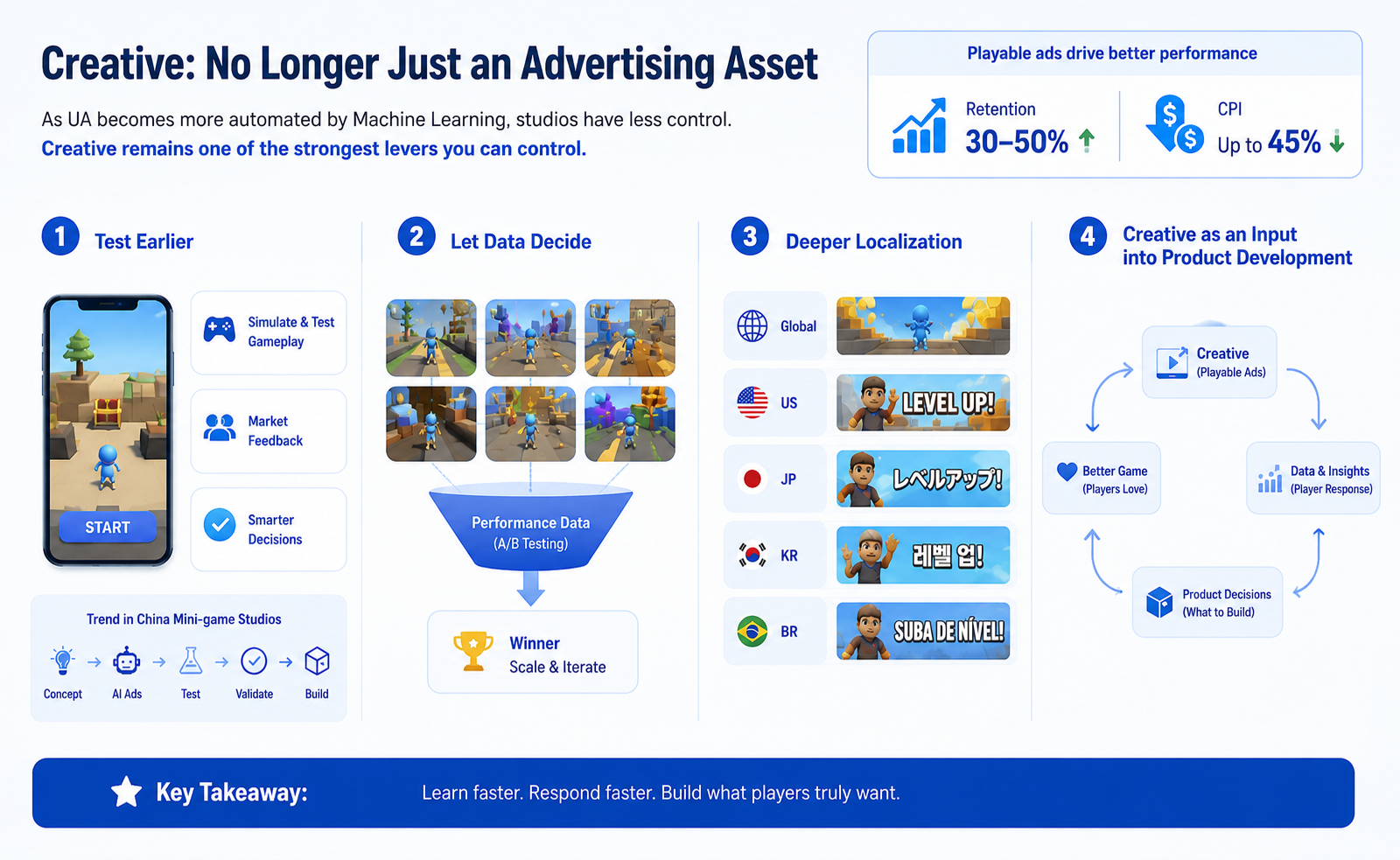
As User Acquisition becomes increasingly automated by Machine Learning, studios have less direct control over targeting and how ad networks distribute campaigns. In an environment where algorithms make more of these decisions, Creative remains one of the strongest levers that studios can actively control.
Playable ads are one of the clearest examples. According to data presented at the event, playables in some cases can improve retention by 30–50% while reducing CPI by up to 45%.
More importantly, leading global studios are no longer using playables only to promote games that are already complete. They are introducing them much earlier to validate product ideas and gather market signals before committing to full development.
Testing Earlier in Product Development
With playable ads, certain gameplay mechanics can be simulated and tested before being moved into full production. This gives Product teams an additional source of market feedback when deciding which ideas are worth developing further.
A separate trend can be seen among mini-game studios in China, where AI-generated ads are being used to validate broader product concepts through a process such as:
- Concept → AI Ads → Test → Validate → Build
By moving validation earlier, studios can reduce the risk of investing significant resources into ideas that may not resonate with the market.
Letting Data Identify the Winner
Global studios rarely create a single playable and wait for the result. Instead, they produce multiple variants across gameplay, art style, Level Design, layout, CTA placement, and other elements, then use performance data to determine which versions work best.
This changes Creative production from a one-off task into a continuous testing process.
Deeper Localization
Playable localization is also moving beyond text translation. Visuals, audio, cultural references, and even the way gameplay is presented can be adapted to better match the preferences of individual markets.
The key takeaway is that Creative is no longer positioned only at the end of the pipeline to promote an existing game. It is increasingly becoming an input into product development, helping studios understand players and validate what is truly worth building.
User Acquisition: Moving Beyond the Race for Lower CPI
One recurring theme throughout the Scale Track was the growing gap between download volume and the actual value generated by players.
A game may achieve millions of installs without generating proportional revenue. Conversely, a smaller player base with stronger Retention and higher spending potential may create significantly greater long-term value.
This is forcing studios to rethink their User Acquisition strategies.
Multi-Channel UA
Instead of relying on only two or three familiar acquisition sources, many studios are expanding to 10–15 channels simultaneously, ranging from SDK networks and social platforms to Connected TV (CTV) and reward networks.
However, expanding the number of channels does not automatically lead to better growth.
Moving Beyond Low CPI
A user acquired at a low CPI who leaves the game on Day 1 may ultimately be less valuable than a more expensive user who remains active for weeks and continues generating revenue through IAP or advertising.
This means acquisition efficiency can no longer be evaluated by CPI alone.
Connecting Data Across UA, Monetization, and Product
Historically, teams have often operated with separate datasets. UA teams focus on CPI and ROAS, Monetization teams track eCPM and revenue, while Product teams monitor Retention.
In reality, all of these metrics describe different aspects of the same player.
By connecting these data streams, studios can use Monetization signals to improve UA optimization and target users based on LTV (Lifetime Value) rather than acquisition cost alone.
Reward UA and the Shift Toward User Quality
The growing focus on player quality is particularly visible in the rise of Reward UA.
According to survey data presented at the event, approximately 90% of surveyed developers had already allocated budget to Reward UA, while 61% expected to increase their spending on the channel in 2026.
One of the model’s key characteristics is self-selection: users actively choose to complete tasks in exchange for rewards, which can create a more intentional level of engagement than conventional traffic sources.
As a result, studios are increasingly extending measurement windows beyond D7 or D30 to D60 and D90 in order to understand which user groups actually generate the highest LTV over time.
The key question in UA is therefore shifting from:
“How can we generate the most installs at the lowest CPI?”
to:
“How can we acquire the right users and maximize their value throughout the game lifecycle?”
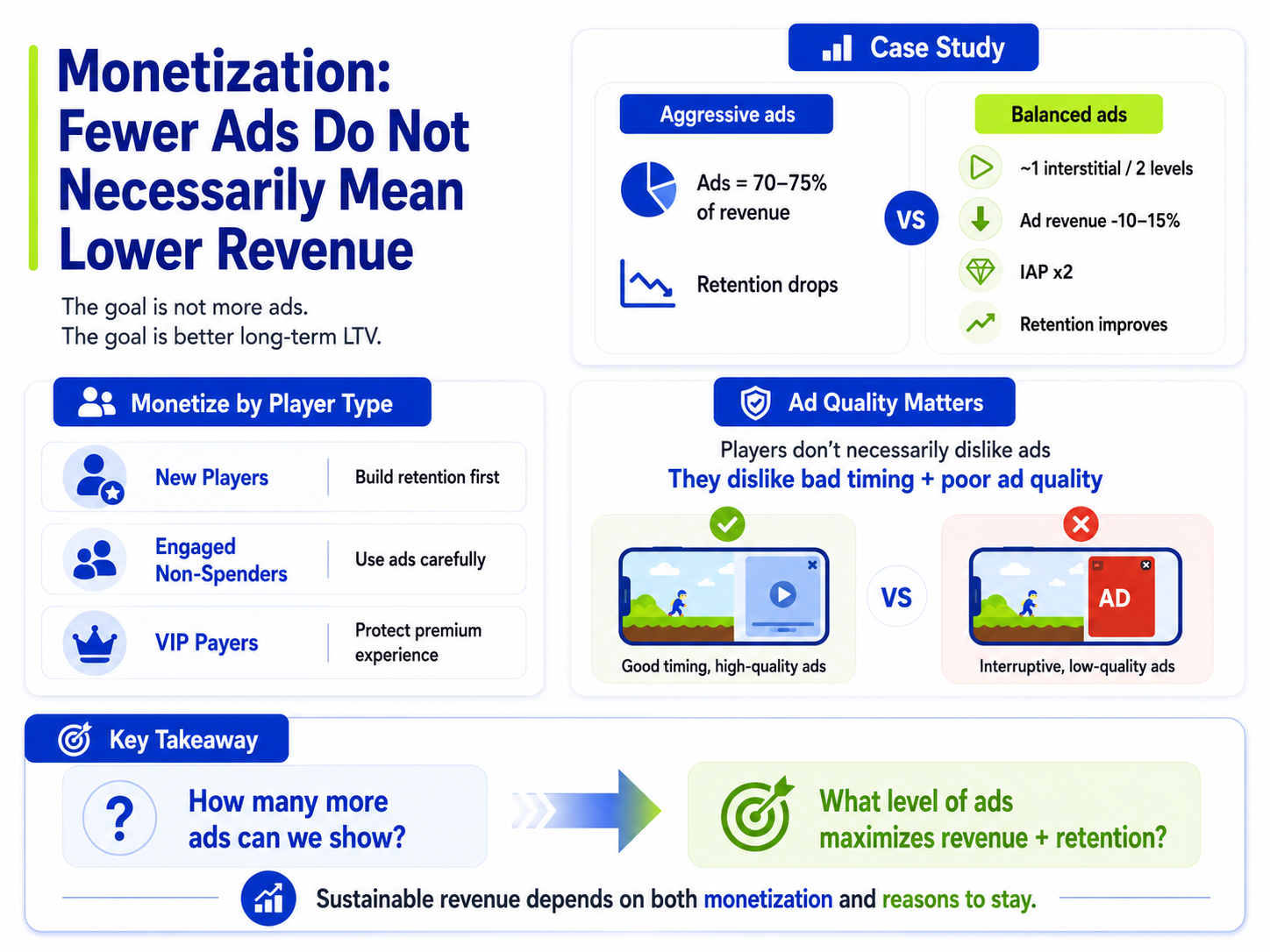
Monetization: Fewer Ads Do Not Necessarily Mean Lower Revenue
One of the notable case studies shared at the event focused on a familiar challenge for many studios: how to balance Monetization with Retention.
In an experiment presented by Sava Meta, introducing aggressive advertising relatively early resulted in ads contributing approximately 70–75% of total revenue, but Retention declined significantly.
In another scenario, the studio reduced frequency to approximately one interstitial every two levels. Ad revenue declined by 10–15%, but Retention improved and IAP revenue doubled.
The case demonstrates that stronger short-term revenue does not necessarily translate into better long-term LTV. Instead of applying the same Monetization approach to every player, strategies increasingly need to reflect differences in player behavior and engagement.
- For new players, the priority should be delivering a strong enough experience to support Retention before increasing ad pressure.
- For engaged non-spenders, ads should be integrated carefully to generate revenue without unnecessarily disrupting the experience.
- For VIP payers, the focus should be on protecting a high-quality experience that encourages continued engagement and spending.
Google representatives also emphasized that players do not necessarily dislike advertising itself. The problem often lies in poor-quality ads or placements that appear at the wrong moment, disrupt gameplay, and increase the risk of churn.
The question is therefore no longer simply:
“How many more ads can we show?”
Instead, studios need to ask:
“What level of advertising can optimize revenue while maintaining Retention?”
Monetization and Product can no longer be treated as separate considerations. Sustainable revenue depends not only on how many ads players see, but also on whether the game gives them enough reasons to stay.
Retention: Keeping Players Starts With a Strong Product
No matter how quickly AI, Creative, or User Acquisition evolves, one principle remains unchanged: if the game itself is not engaging enough, players will not stay.
At the Build Track, Moment Games presented Retention across three key stages.
- D1 depends on the Hook: whether the initial experience creates enough interest for players to return.
- D7 depends more heavily on the Core Loop: once the initial novelty fades, the core gameplay must remain engaging enough to keep players involved.
- D30+ depends on depth: progression, strategy, meta systems, and variety become increasingly important in sustaining long-term engagement.
One notable principle discussed was “One More Try.”
A well-designed difficult level should make players feel that they were close to winning, understand why they failed, and believe the next attempt could succeed. By contrast, if players cannot understand the reason for failure or feel that the game is creating artificial difficulty, challenge can quickly turn into frustration and lead to churn.
Level Design therefore affects not only Retention but also Monetization.
A level with the right degree of challenge can make boosters, extra moves, or IAP feel more valuable. But if the pressure becomes excessive, players may feel pushed into spending and lose motivation to continue.
The key takeaway is that Monetization works best when it is built on top of a strong Core Loop. The more sustainable sequence remains:
Core Loop → Retention → Monetization
rather than prioritizing revenue first and forcing gameplay to adapt around it.
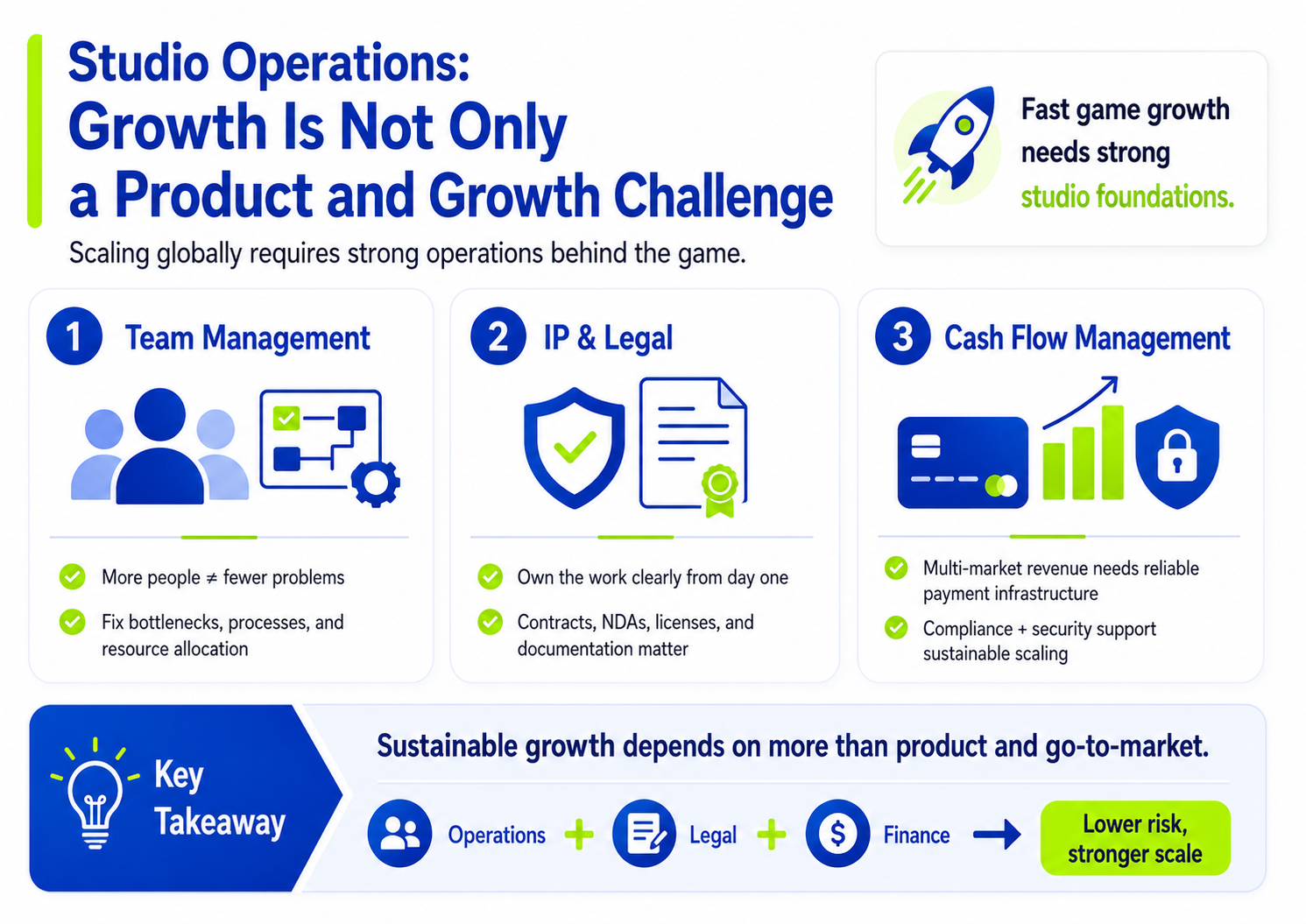
Studio Operations: Growth Is Not Only a Product and Growth Challenge
Beyond Product and Growth, Vietnam Game Connect 2026 also highlighted the foundations required for studios to scale sustainably across international markets.
A game may grow quickly through strong gameplay or an effective marketing strategy, but maintaining that momentum over the long term requires the operational structure behind the studio to grow with it.
Three areas received particular attention:
- Team Management: As a studio expands, simply adding more people does not necessarily solve existing problems if the real bottlenecks in the operating system have not been identified. Choosing the right direction, building appropriate processes, and allocating resources effectively are essential to sustainable organizational growth.
- Intellectual Property (IP): Studios need to establish a solid legal foundation early. Work produced by freelancers or external partners does not automatically become the studio’s property unless ownership is clearly defined in the contract. NDAs, contracts, design documentation, licenses, and evidence of the development process should be properly maintained to reduce risk in the event of copyright or IP disputes.
- Cash Flow Management: As studios expand into multiple markets, revenue may come from different app stores, ad networks, and business partners. This requires reliable payment infrastructure, financial compliance, and enterprise-level security.
The growth of a game does not depend only on Product or go-to-market strategy. To scale sustainably and reduce operational risk, studios also need strong foundations across operations, legal, and finance.
Vietnam Game Connect 2026: Toward a More Connected Game Growth Model
AI, playable ads, User Acquisition, Monetization, Retention, and Level Design may appear to be separate areas. However, one of the clearest themes at Vietnam Game Connect 2026 was how closely these functions are becoming connected throughout game development and growth.
AI can shorten experimentation and data analysis cycles. Playables can help validate gameplay ideas before full development. Monetization data can help User Acquisition teams better understand the value of different player segments, while Level Design and Retention continue to shape long-term revenue potential.
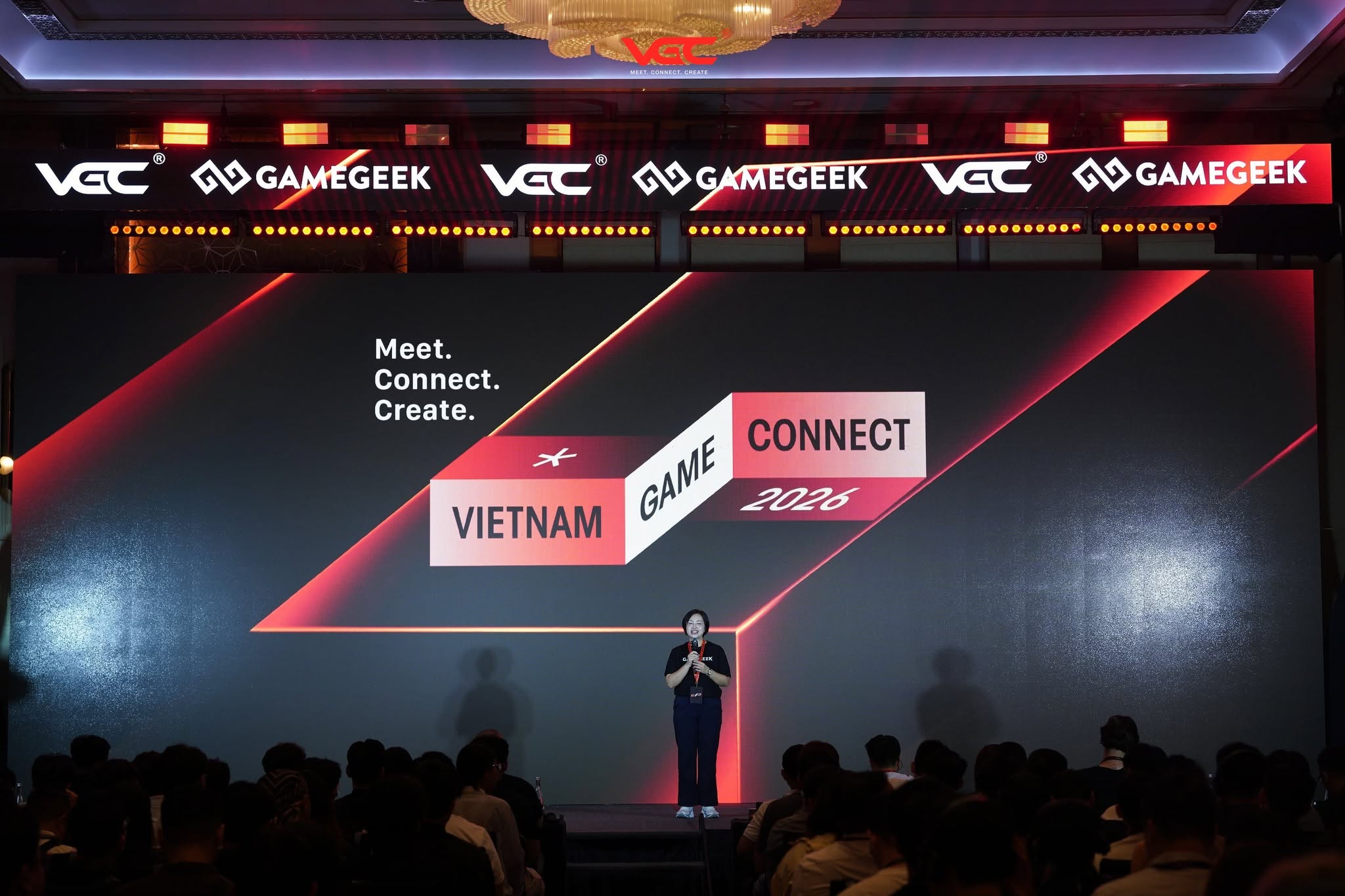
Source: Vietnam Game Connect
This suggests a broader shift in how games are developed and scaled. Rather than treating product development, player acquisition, and revenue optimization as separate stages, studios are increasingly testing, measuring, and adjusting continuously based on real-world data.
According to data shared by Sensor Tower at the event, Vietnamese studios rank among the global leaders in download volume, while Vietnam ranks only around 17th in game revenue. This gap highlights the next challenge for Vietnamese game studios: not only generating large-scale installs, but also retaining players for longer, improving LTV, and building business models that can scale sustainably across international markets.
As AI and data continue to shorten the distance between an idea and a decision, the advantage will increasingly belong to studios that can experiment faster, understand their players more clearly, and identify which products, features, and markets are truly worth further investment.