

Introduction: SEA is Massive, But Not a Monolith
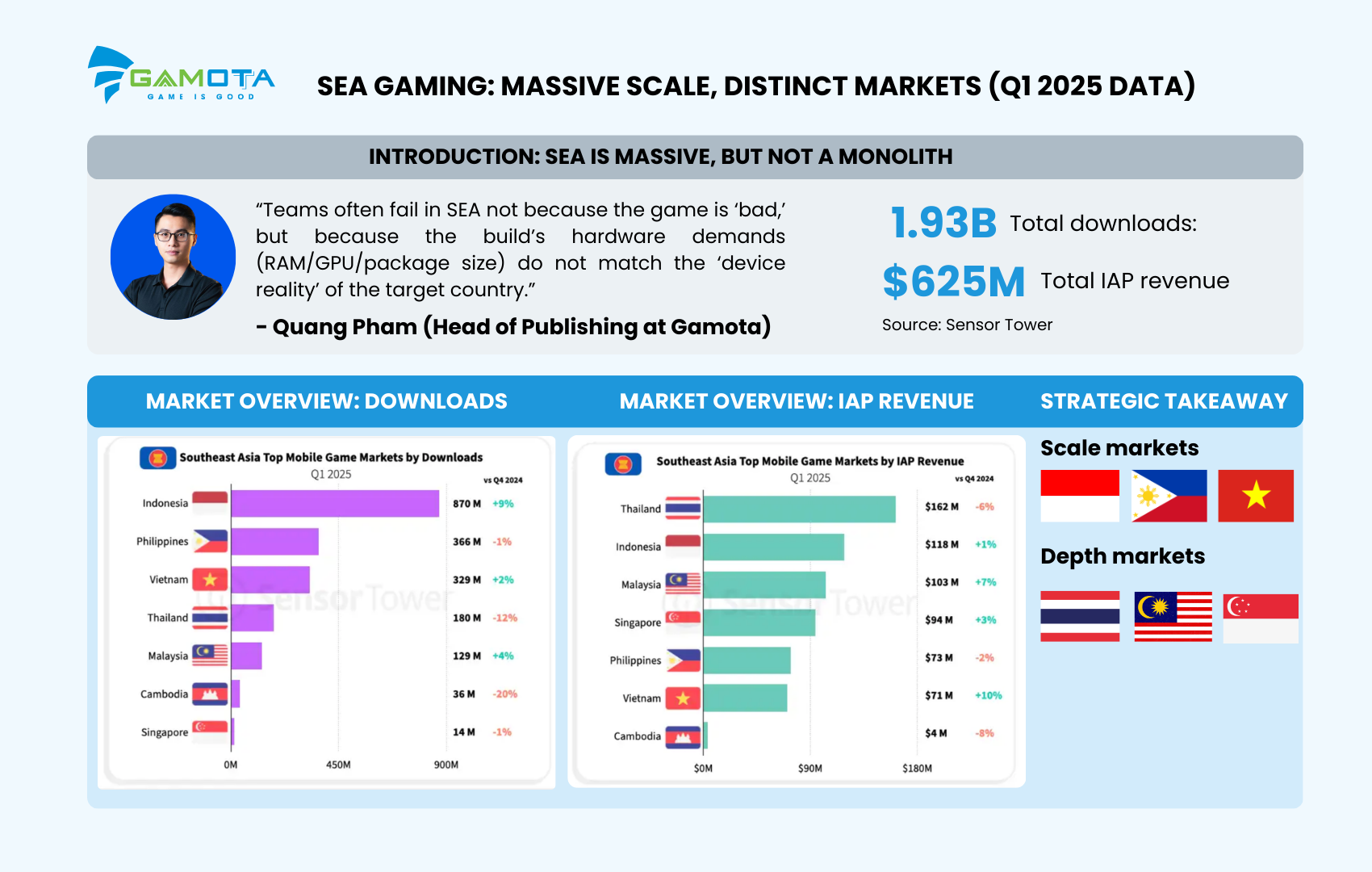
Southeast Asia (SEA) is rapidly cementing its position as one of the most dynamic regions on the global gaming map. According to the latest data from Sensor Tower [1], in Q1 2025 alone, the region recorded 1.93 billion downloads (+3% QoQ), ranking SEA as a top-2 global region for player volume. Beyond scale, monetization is maturing, with In-App Purchase (IAP) revenue hitting $625 million (ranked #7 globally).
However, these dazzling top-line numbers often mask a strategic trap. Quang Pham (Head of Publishing at Gamota) warns: “Teams often fail in SEA not because the game is ‘bad,’ but because the build’s hardware demands (RAM/GPU/package size) do not match the ‘device reality’ of the target country.” [3]
This article dives deep into a market entry strategy for SEA, analyzing the intersection of market data, infrastructure constraints, and genre feasibility.
Market Overview: Downloads vs. Revenue
To conquer SEA, developers must recognize the distinct divergence between user acquisition volume and revenue generation. Q1 2025 data [1] reveals that the leaderboards for downloads and IAP are two entirely different stories.
Top Markets by Downloads (Q1 2025) – The Growth Engine
-
Indonesia: 870M downloads (+9% QoQ) – Absolute dominance in scale.
-
Philippines: 366M downloads (-1% QoQ).
-
Vietnam: 329M downloads (+2% QoQ).
-
Thailand: 180M downloads (-12% QoQ).
-
Malaysia: 129M downloads (+4% QoQ).
Insight: The engine for User Acquisition (UA) lies firmly along the Indonesia – Philippines – Vietnam axis. These nations offer massive populations of young digital natives, driving immense install volumes.
Top Markets by IAP Revenue (Q1 2025) – The Monetization Leaders
-
Thailand: $162M (-6% QoQ) – The leader in willingness-to-pay.
-
Indonesia: $118M (+1% QoQ).
-
Malaysia: $103M (+7% QoQ).
-
Singapore: $94M (+3% QoQ).
-
Vietnam: $71M (+10% QoQ).
Insight: While Vietnam and Indonesia lead in downloads, Thailand, Singapore, and Malaysia remain the heavyweights for IAP. Notably, Vietnam is showing a positive shift with +10% QoQ IAP growth – the highest in the region.
Strategic Takeaway:
Hardware & Infrastructure: Why “Device Reality” Dictates Strategy
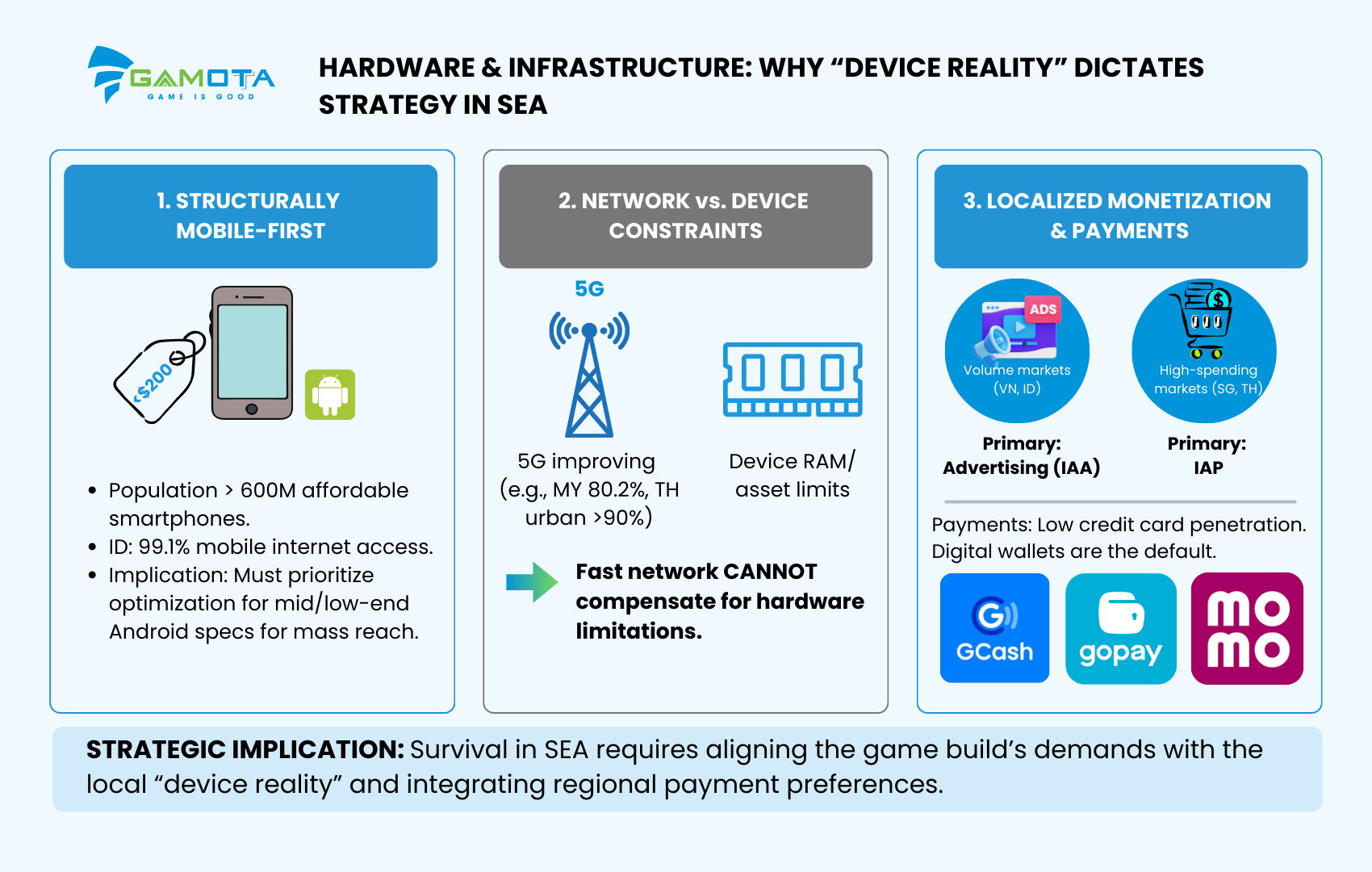
Based on the regional infrastructure report by Antom [2], technical barriers in SEA are not theoretical – they are the primary constraint for survival.
SEA is Structurally Mobile-First
With a population exceeding 600 million, gaming growth is powered almost exclusively by affordable smartphones. In Indonesia, 99.1% of internet users access the web via mobile [2]. The proliferation of entry-level Android devices (under $150) forces publishers to prioritize optimization for mid- and low-end specs if they wish to achieve mass market reach.
Network improvements vs. Device constraints
While 5G rollout is improving (Malaysia reached 80.2% coverage; major Thai urban centers exceed 90% with <30ms latency), this benefits connectivity for MOBAs and shooters but does not erase hardware limitations [2]. A fast network cannot compensate for a device that lacks the RAM to load high-fidelity assets.
Monetization must be Localized
-
Volume Markets (Indonesia, Vietnam): Advertising (IAA) is a primary revenue path to monetize scale [2].
-
High-Spending Markets (Singapore, Thailand): IAP remains the dominant revenue source [2].
-
Payments: Credit card penetration is low. Digital wallets are the default (GCash in Philippines; GoPay/OVO in Indonesia; MoMo/ZaloPay in Vietnam). Launching without local payment integration leaves revenue on the table [2].
Device landscape & Genre feasibility: The Gamota heuristic
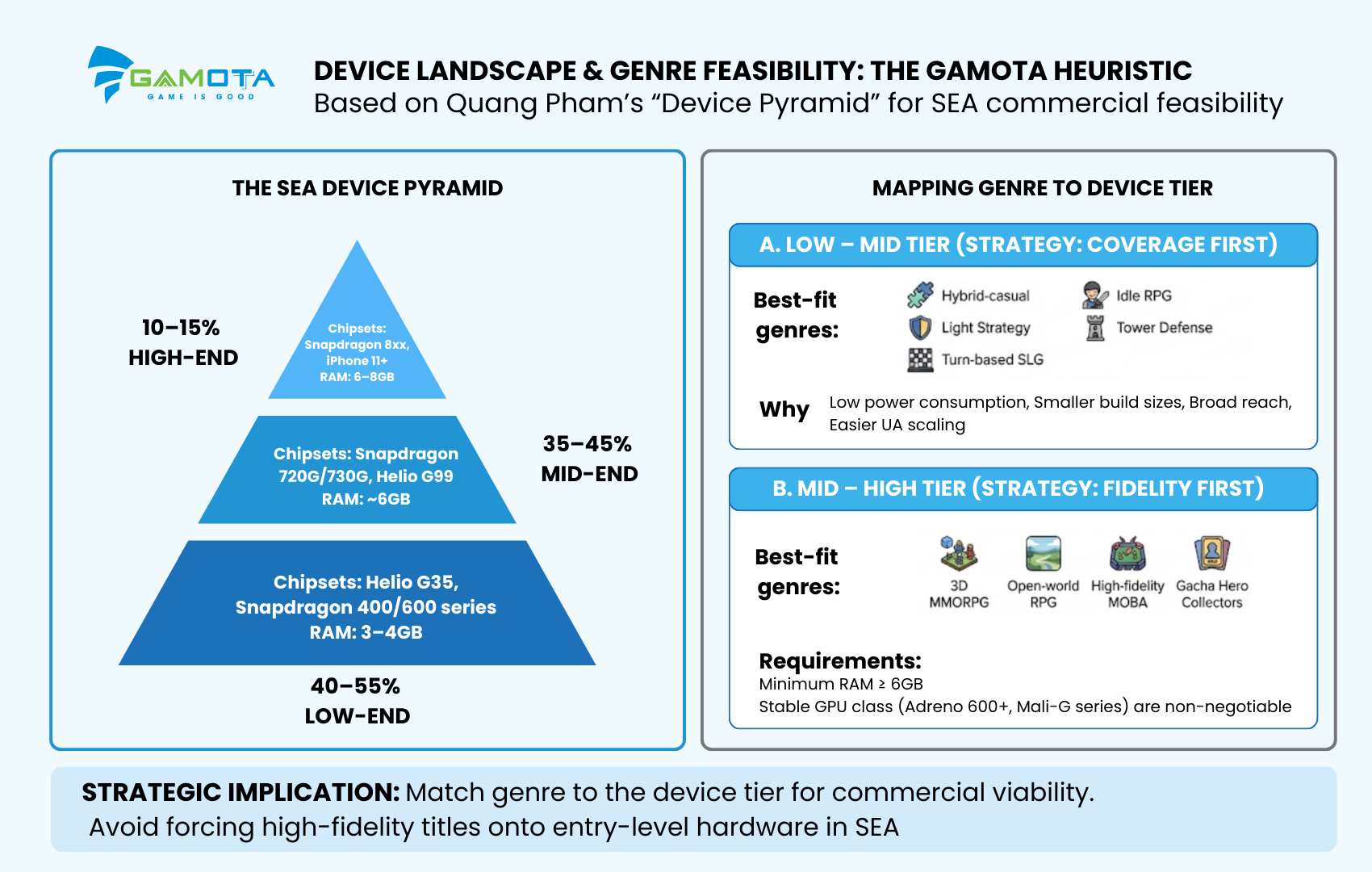
Drawing from operational experience, Quang Pham outlines a “Device Pyramid” for SEA to determine the commercial feasibility of specific genres [3].
The SEA Device pyramid (heuristic)
-
40–55% Low-end: Chipsets like Helio G35, Snapdragon 400/600 series, 3–4GB RAM.
-
35–45% Mid-end: Chipsets like Snapdragon 720G/730G, Helio G99, ~6GB RAM.
-
10–15% High-end: Chipsets like Snapdragon 8xx, iPhone 11+, 6–8GB RAM.
Mapping Genre to device tier
Instead of forcing an AAA title onto an entry-level device, Gamota recommends a pragmatic approach:
A. Low – Mid Tier (Strategy: Coverage First)
-
Best-fit Genres: Hybrid-casual, Idle RPG, Light Strategy, Tower Defense, Turn-based SLG.
-
Why: These require low power consumption and smaller build sizes, allowing for broad reach and easier UA scaling [3].
B. Mid – High Tier (Strategy: Fidelity First)
-
Best-fit Genres: 3D MMORPG, Open-world RPG, High-fidelity MOBA, Gacha Hero Collectors.
-
Requirements: Minimum RAM ≥ 6GB and a stable GPU class (Adreno 600+, Mali-G series) are non-negotiable for these experiences [3].
Regional Strategy: Right Genre × Right Hardware × Right Market
Synthesizing data from Sensor Tower [1], Antom [2], and Gamota [3], the following table outlines the optimal strategy for each key market:
| Market | Market Reality (Q1 2025) | Strategic Recommendation |
| Indonesia | The Scale King: 870M downloads, $118M IAP. | Prioritize lightweight builds. utilize a hybrid monetization playbook (strong IAA focus) to convert the massive user volume. |
| Vietnam | The Rising Star:329M downloads, +10% IAP growth. | Maintain optimization for mid-range devices. The market can support deeper Midcore titles (RPG/Strategy) if the design balances fidelity with infrastructure constraints. |
| Philippines | Volume Market: 366M downloads. | Focus on Hybrid-casual, Idle, or Light Strategy. Use this market to optimize UA workflows and iterate on gameplay mechanics at low cost. |
| Thailand | IAP Capital: Regional leader with $162M IAP. | Focus on Depth. High-fidelity RPGs, Collectors, or Strategy games work well here. Invest heavily in LiveOps to drive spending. |
| MY & SG | Premium Segment:High IAP (MY $103M, SG $94M). | Suitable for High-fidelity experiences. Malaysia’s strong 5G foundation is a specific advantage for real-time competitive genres. |
You can explore more of the key insights shared by Quang Pham here
Conclusion: Execution Checklist for Game Teams
If you are planning to enter SEA, treat “hardware alignment” as a first-class publishing constraint, not an afterthought.
-
Define your target tier: Decide if you are building for “Coverage” (Low/Mid) or “Fidelity” (High). Only then select the genre that can survive on those devices [2][3].
-
The Two-Build Strategy: Consider maintaining two profiles: a “Reach” build (optimized for low specs) and a “Depth” build (tuned for high specs). This is a common operational response to SEA’s fragmentation [2].
-
Payment Localization: Integration with local PSPs and wallets is essential, not optional [2].
References:
[1] Sensor Tower – Southeast Asian Mobile Game Market Insights 2025.
[2] Antom – Southeast Asia Gaming & Payment Trends Report.
[3] Quang Pham (Gamota) – Expert Brief: Choosing the Right Game Genre for the Right Hardware.