
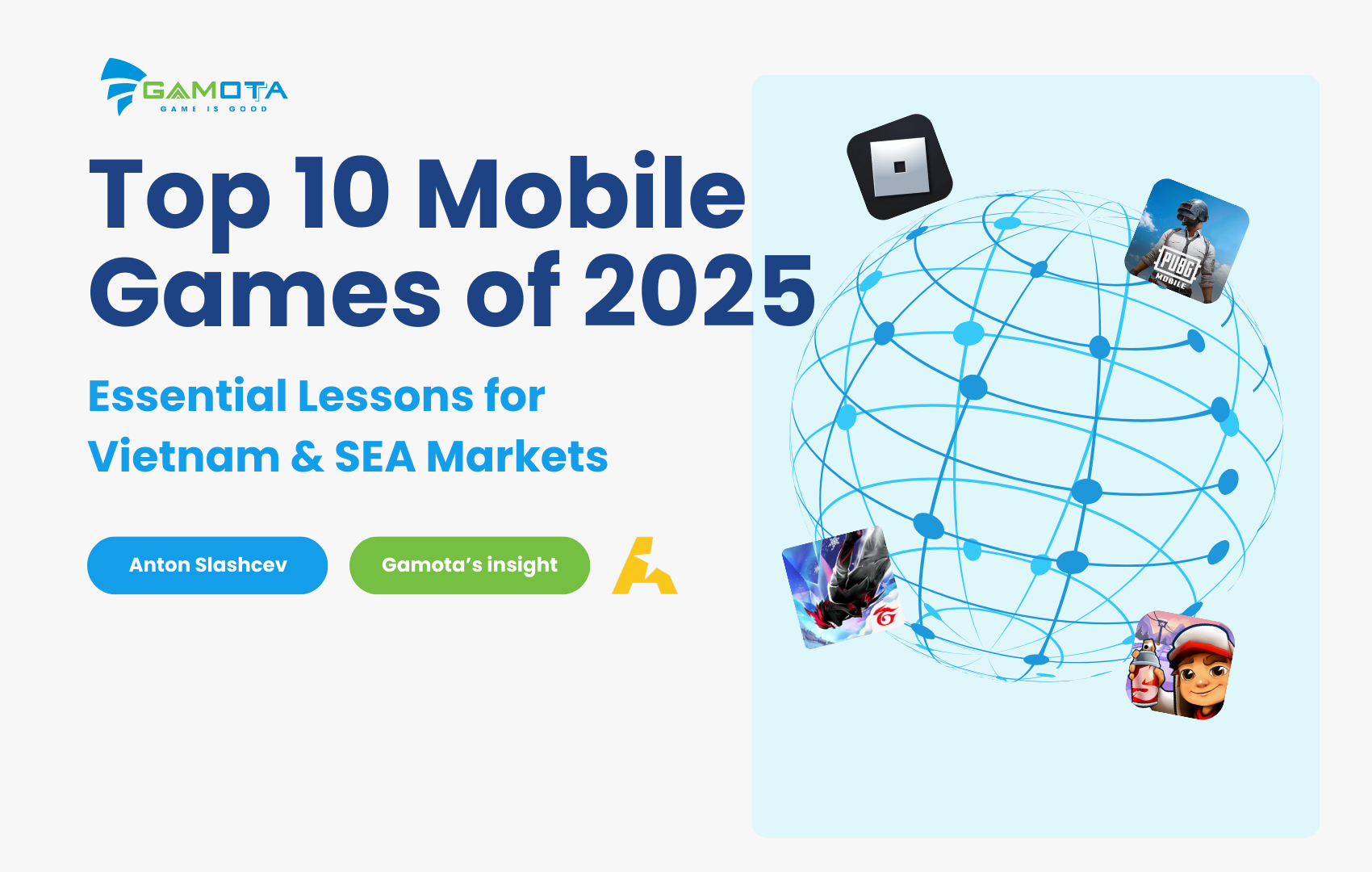
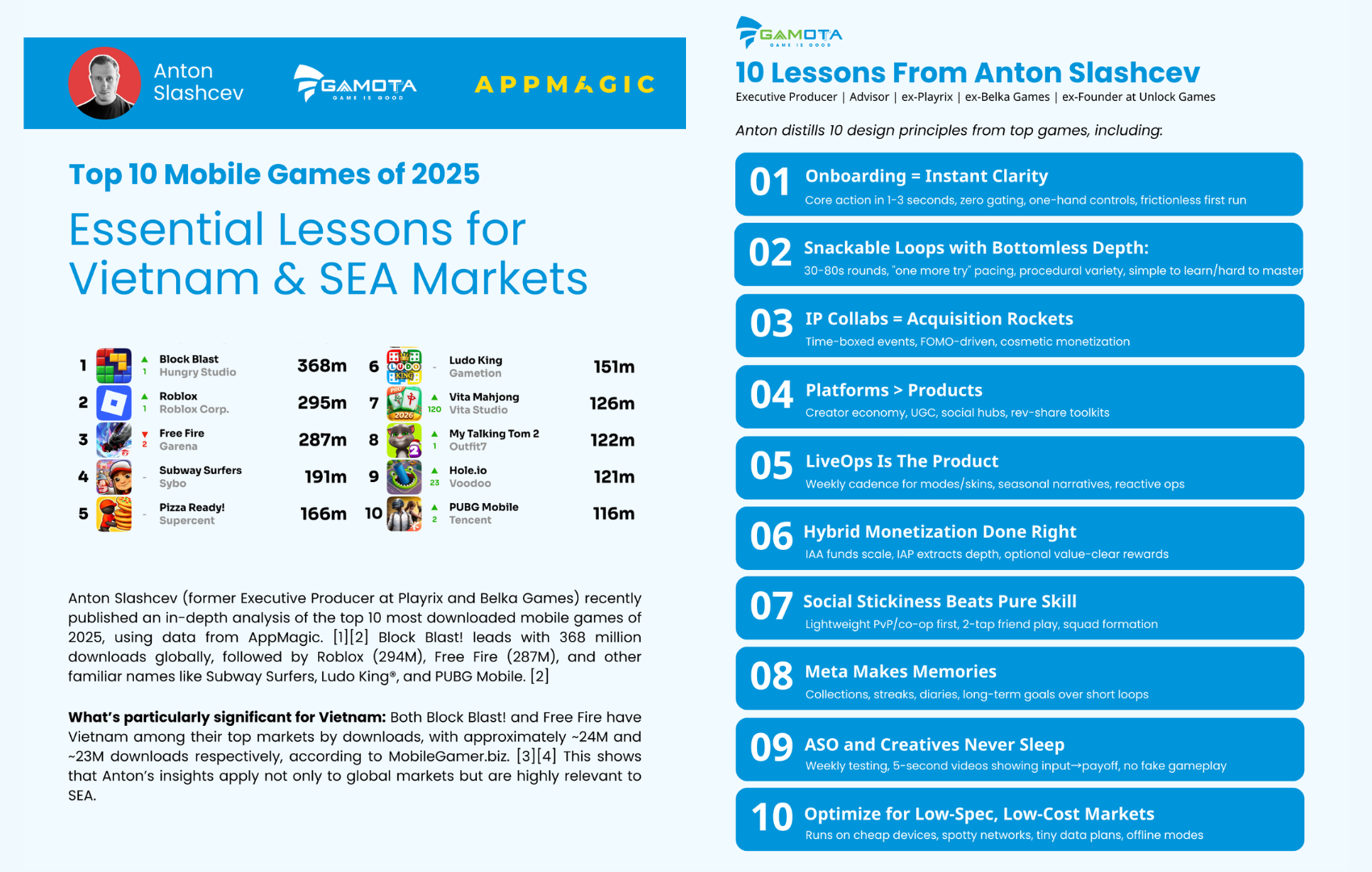
Anton Slashcev (former Executive Producer at Playrix and Belka Games) recently published an in-depth analysis of the top 10 most downloaded mobile games of 2025, using data from AppMagic. [1]
Block Blast! leads with 368 million downloads globally, followed by Roblox (294M), Free Fire (287M), and other familiar names like Subway Surfers, Ludo King®, and PUBG Mobile. [2]
What’s particularly significant for Vietnam: Both Block Blast! and Free Fire have Vietnam among their top markets by downloads, with approximately ~24M and ~23M downloads respectively, according to Mobile Gamer Biz. [3] This shows that Anton’s insights apply not only to global markets but are highly relevant to SEA.
10 Lessons From Anton Slashcev
Anton distills 10 design principles from top games, including: [1]
-
Onboarding = Instant Clarity: Core action in 1-3 seconds, zero gating, one-hand controls, frictionless first run
-
Snackable Loops with Bottomless Depth: 30-80s rounds, “one more try” pacing, procedural variety, simple to learn/hard to master
-
IP Collabs = Acquisition Rockets: Time-boxed events, FOMO-driven, cosmetic monetization
-
Platforms > Products: Creator economy, UGC, social hubs, rev-share toolkits
-
LiveOps Is The Product: Weekly cadence for modes/skins, seasonal narratives, reactive ops
-
Hybrid Monetization Done Right: IAA funds scale, IAP extracts depth, optional value-clear rewards
-
Social Stickiness Beats Pure Skill: Lightweight PvP/co-op first, 2-tap friend play, squad formation
-
Meta Makes Memories: Collections, streaks, diaries, long-term goals over short loops
-
ASO and Creatives Never Sleep: Weekly testing, 5-second videos showing input→payoff, no fake gameplay
-
Optimize for Low-Spec, Low-Cost Markets: Runs on cheap devices, spotty networks, tiny data plans, offline modes
Gamota’s Perspective: When Global Insights Meet SEA Reality
Below is how we connect Anton’s principles with Vietnam and SEA market realities, supported by data:
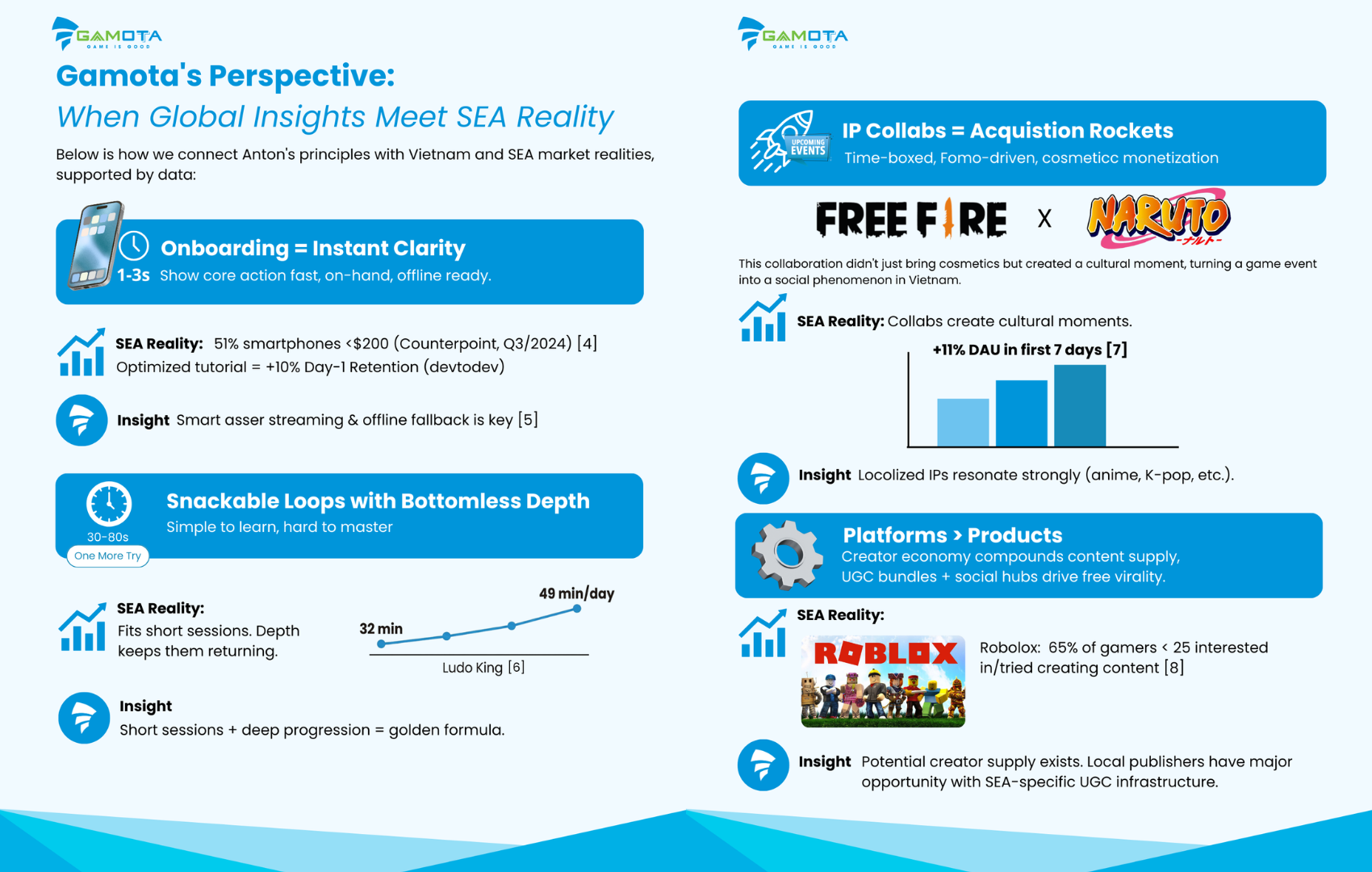
Onboarding = Instant Clarity
-
Anton emphasizes: Show core action in 1-3 seconds, no popups or text walls, design for one-hand controls and offline-ready first session. [1]
-
SEA Reality: In Vietnam, where smartphones under $200 account for 51% of sales (Counterpoint, Q3/2024), optimizing onboarding isn’t just best practice – it’s survival. [4] A case study from devtodev shows that optimizing tutorial/FTUE can increase Day-1 retention by +10% – a modest number but with significant impact at scale. [5]
-
Gamota Insight: In an environment with diverse devices and unstable bandwidth, “frictionless first run” demands smart asset streaming and offline fallback. Successful SEA games typically have tutorials that don’t depend on network connectivity.
Snackable Loops With Bottomless Depth
-
Anton analyzes: 30-80 second rounds, “one more try” pacing, simple to learn but hard to master. [1]
-
SEA Reality: This format perfectly fits player behavior – playing while waiting, on the bus, between tasks.
-
Take Ludo King® as an example: according to AppsFlyer (cited by Economic Times), Ludo King playtime increased from ~32 minutes to ~49 minutes per day during its boom period. [6] Simple gameplay with depth – exactly as Anton describes – is the retention key.
-
Gamota Insight: “Snackable” doesn’t mean “shallow.” Games like Block Blast! and Ludo King® prove that short sessions + deep progression = golden formula for SEA markets.
IP Collabs = Acquisition Rockets
-
Anton points out: Time-boxed events turn fans into players, FOMO drives spikes, cosmetic-led monetization avoids pay-to-win backlash. [1]
-
SEA Reality: IP collaborations have a particularly strong impact on SEA. According to Newzoo’s IP & Brand Collaboration Report, collab-related content drops can increase DAU by an average of +11% in the first 7 days. [7]
-
Free Fire x NARUTO is a classic case study. This collaboration didn’t just bring cosmetics, but created a cultural moment, turning a game event into a social phenomenon in Vietnam.
-
Gamota Insight: In SEA, IP collabs need deep localization. Choosing IPs that resonate with local culture (anime, K-pop, local celebrities) matters more than choosing the “biggest” global IP.
Platforms > Products
-
Anton observes: Creator economy compounds content supply, UGC bundles + social hubs drive free virality, rev-share keeps builders shipping. [1]
-
SEA Reality: Roblox is the living proof of this principle. In Vietnam, according to Lao Dong (citing Newzoo), 65% of gamers under 25 are interested in or have tried creating game content. [8]
-
Gamota Insight: This is the biggest gap in SEA. There’s a potential creator supply (young, engaged, creative) but lacking platforms and supporting tools. Local publishers have a major opportunity if they build UGC infrastructure suited to SEA languages and culture.
LiveOps Is The Product
-
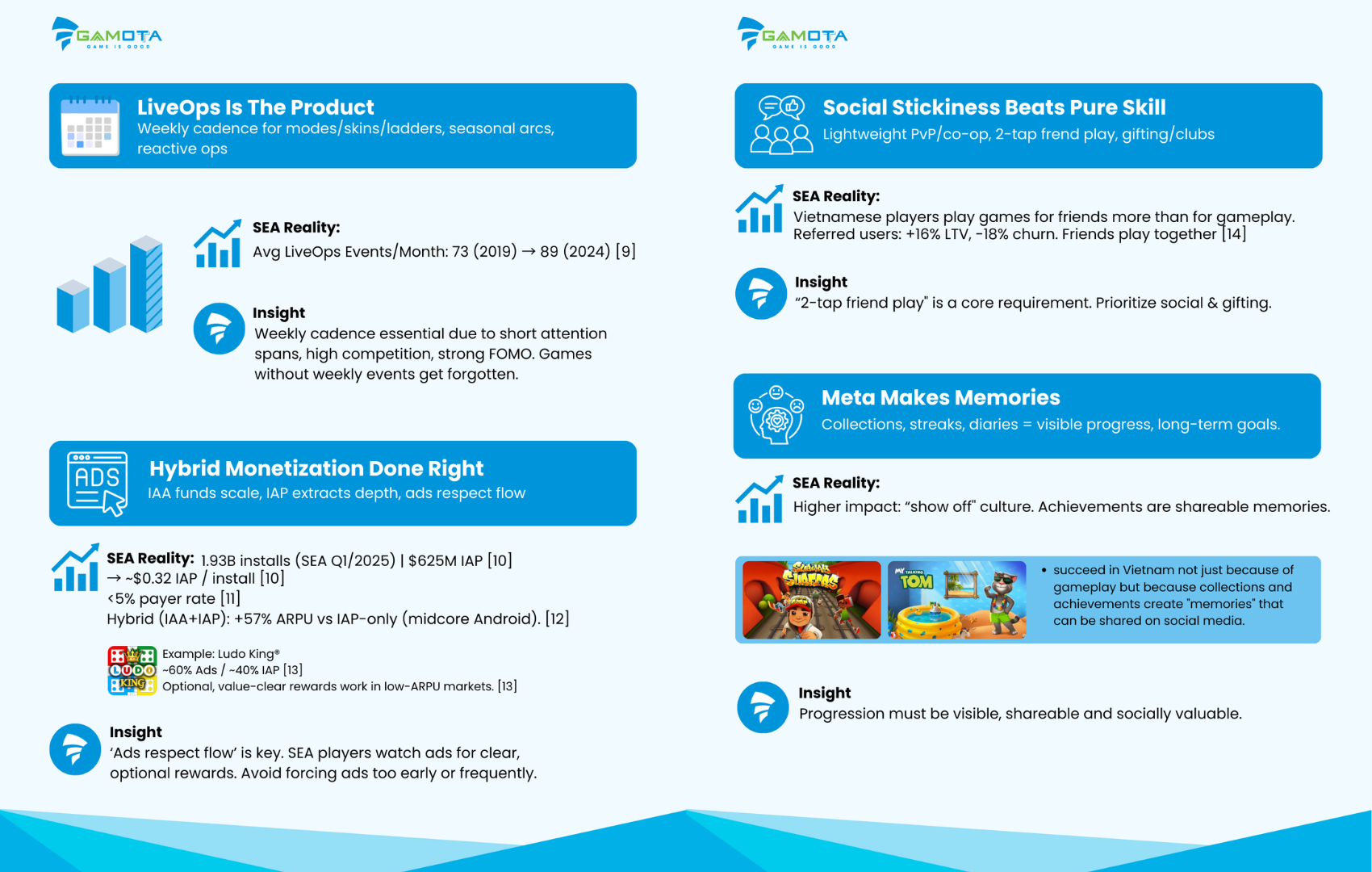
Anton affirms: Weekly cadence for modes/skins/ladders/quests, seasonal arcs tie cosmetics to narrative, reactive ops buff/nerf fast. [1]
-
SEA Reality: LiveOps has become the operational standard. According to AppMagic LiveOps Report 2025, the average number of LiveOps events per month increased from 73 (2019) to 89 (2024)—showing the “always-on content” trend dominating. [9]
-
Gamota Insight: In Vietnam, weekly cadence matters even more because: (1) shorter attention spans, (2) higher content competition from social media, (3) stronger FOMO culture. Games without weekly events will quickly be “forgotten.”
Hybrid Monetization Done Right
-
Anton explains: IAA funds scale, IAP extracts depth, ads respect flow, price ladders map to cohorts/regions/ARPPU tiers. [1]
-
SEA Reality: This is the critical point for SEA. According to Sensor Tower data, SEA Q1/2025 had 1.93B installs but only $625M IAP revenue → approximately $0.32 IAP revenue per install. [10] Payer rate is also extremely low: AppsFlyer reports only <5% of users are spenders. [11]
-
However, according to AppsFlyer’s State of App Monetization, hybrid model (IAA+IAP) can create significantly higher ARPU than IAP-only, especially for midcore Android games (+57% returns). [12]
-
Ludo King® is the perfect example: ads account for ~60% of revenue, IAP ~40% – proving hybrid model when done right (optional, value-clear rewards) can succeed in low-ARPU markets. [13]
-
Gamota Insight: “Ads respect flow” is key. SEA players are willing to watch ads if rewards are clear and don’t break the core loop. The biggest mistake is forcing ads too early or too frequently in sessions.
Social Stickiness Beats Pure Skill
-
Anton emphasizes: Lightweight PvP/co-op first, play with friends in 2 taps, friction kills squads, gifting/emotes/clubs create rituals. [1]
-
SEA Reality: Vietnamese players play games for friends more than for gameplay. Ludo King® and Free Fire succeeded massively in SEA precisely because of this.
-
According to Extole’s referral marketing statistics, referred customers have 16% higher LTV and 18% lower churn than other users – clear evidence of social acquisition value. [14]
-
Gamota Insight: In SEA culture where relationships and social proof are extremely important, “play with friends in 2 taps” isn’t a marketing slogan but a core design requirement. Squad formation, gifting, and social features must be prioritized at the same level as core gameplay.
Meta Makes Memories
-
Anton analyzes: Collections, streaks, diaries = progress you can show off; long-term goals layered over short loops prevent churn. [1]
-
SEA Reality: Meta progression has much greater impact in SEA than Western markets due to “show off” culture and social status.
-
Subway Surfers and My Talking Tom succeed in Vietnam not just because of gameplay but because collections and achievements create “memories” that can be shared on social media.
-
Gamota Insight: “Soft sinks” (as Anton mentions) are especially important in low-ARPU markets. Progression must be visible, shareable, and have social value—not just numbers in a database.
ASO And Creatives Never Sleep
-
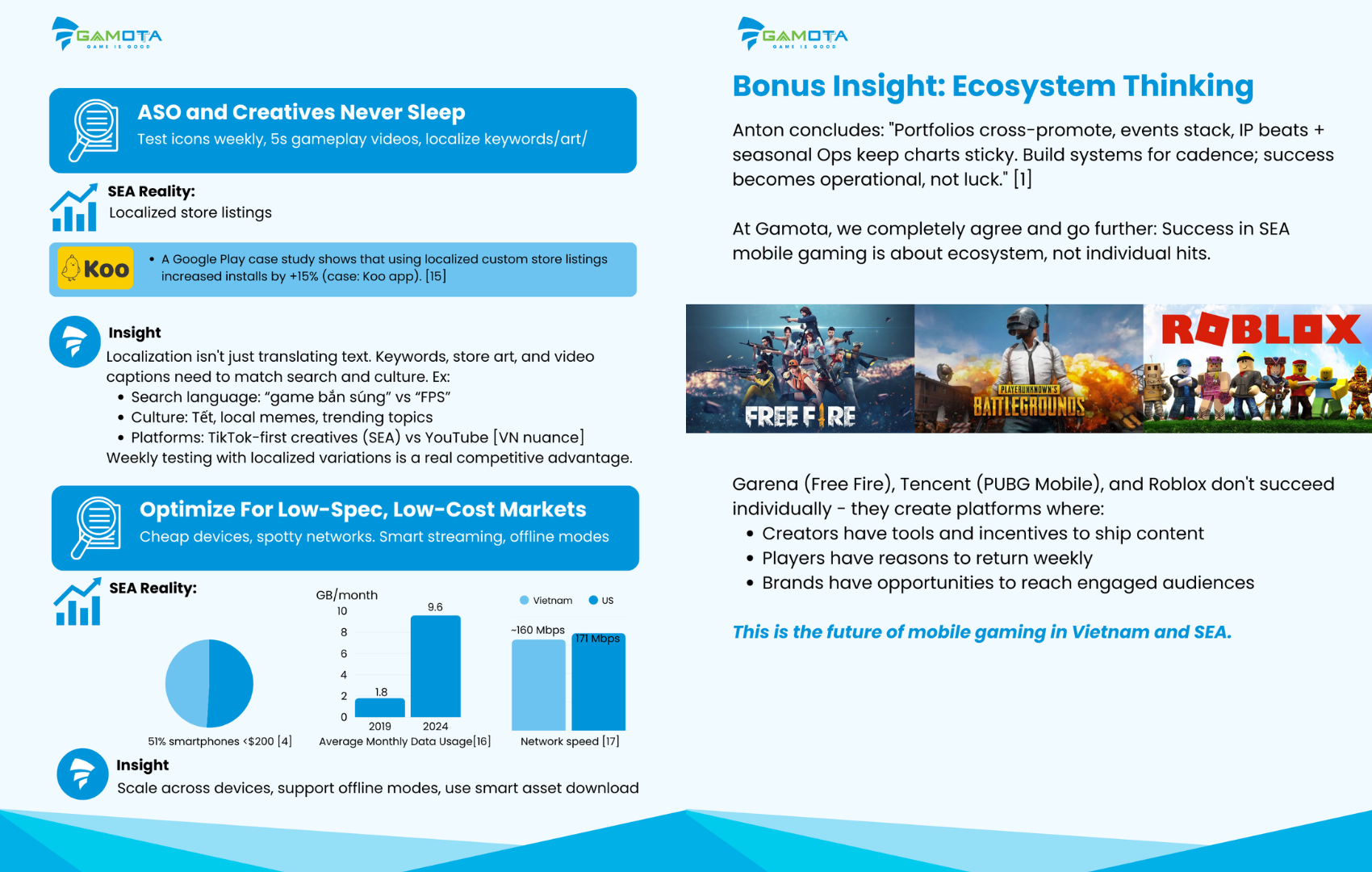
Anton advises: Test icons/titles weekly, 5-second videos show input→payoff, no fake gameplay, localize keywords/art to match intent. [1]
-
SEA Reality: Localization has enormous impact. A Google Play case study shows that using localized custom store listings increased installs by +15% (case: Koo app). [15]
-
Gamota Insight: In Vietnam, “localization” isn’t just translating text. Keywords, store art, and video captions need to match: Local search behavior (e.g., “game bắn súng” vs “FPS”); Cultural references (Tet, local memes, trending topics); Platform preferences (TikTok > YouTube for SEA)
Weekly testing with localized variations is a real competitive advantage.
Optimize For Low-Spec, Low-Cost Markets
-
Anton concludes: Runs on cheap devices, spotty networks, tiny data plans; smart asset streaming, scalable VFX, offline modes widen reach and retention. [1]
-
SEA Reality: This is the MOST IMPORTANT lesson for SEA and also the point Anton grasps most accurately about emerging markets.
-
Vietnam reality data: Device segment: Smartphones <$200 account for 51% of sales (Counterpoint Q3/2024) [4] Data usage: Increased from 1.8GB/month (2019) to 9.6GB/month (2024) – but optimization still needed as many users have small data plans [16] Network speed: Significantly improved- average mobile download speed reaches ~160 Mbps (Speedtest Global Index, Oct 2025), nearly equal to US (~171 Mbps) [17] Free Fire and Free Fire MAX are perfect case studies: optimization for low-spec devices + offline training mode + tiny updates are the main reasons for SEA dominance.
-
Gamota Insight: Despite network speed improvements, device diversity remains a major challenge. Games must: Scale from 2GB RAM to 8GB RAM; Support from mid-range to flagship; Have offline modes for onboarding and practice
Implement smart asset download (download on-demand, not force full download)
Bonus Insight: Ecosystem Thinking
-
Anton concludes: “Portfolios cross-promote, events stack, IP beats + seasonal Ops keep charts sticky. Build systems for cadence; success becomes operational, not luck.” [1
-
At Gamota, we completely agree and go further: Success in SEA mobile gaming is about ecosystem, not individual hits.
Garena (Free Fire), Tencent (PUBG Mobile), and Roblox don’t succeed individually—they create platforms where:
-
Creators have tools and incentives to ship content
-
Players have reasons to return weekly
-
Brands have opportunities to reach engaged audiences
This is the future of mobile gaming in Vietnam and SEA.
Key Takeaways For Vietnam & SEA Markets
For Game Developers:
-
Mobile-first ≠ Feature-rich: Optimization for device diversity is must-have, not nice-to-have
-
Social > Solo: Squad formation, gifting, and social rituals must be designed from day one
-
Hybrid monetization: IAA + IAP with ads respecting flow is the formula suited to SEA’s low-payer-rate, high-engagement profile
-
Weekly LiveOps: Not an option, but an operational standard
For Publishers & Platforms:
-
Invest in creator economy: 65% of young gamers interested in UGC but lack tools—this is a major gap [8]
-
Localization beyond translation: Keywords, art, meta, events need true cultural adaptation
-
Infrastructure matters: Asset streaming, offline support, and cross-device sync determine retention in low-spec markets
For Marketers:
-
ASO is continuous: Weekly testing with localized variations > monthly big-bang campaigns
-
5-second rule: Video creatives must show input→payoff instantly, no fake gameplay
-
IP collabs: Choose IPs with cultural resonance, not just the “biggest” IP
Conclusion
Anton Slashcev’s analysis is not just a compilation of best practices but a blueprint for mobile gaming success. For Vietnam and SEA markets – where engagement is high, growth potential is massive, but with unique constraints around monetization and infrastructure- applying these principles with appropriate adjustments will be the key to success.
Most importantly: Success isn’t about luck but operational excellence. Build systems, test relentlessly, and optimize for your local context.
What do you think about these insights? Which lesson from the top 10 games resonates most with your experience in SEA markets?
References
-
Anton Slashcev – LinkedIn post: “10 Lessons from 10 Most Downloaded Games in 2025” (using AppMagic data).
-
MobileGamer.biz – AppMagic charts: Block Blast (368M), Roblox (294M), Free Fire (287M) + top 10 downloads list.
-
MobileGamer.biz – Vietnam as a top market by downloads for Block Blast (~24M) and Free Fire (~23M).
-
Counterpoint Research – Vietnam smartphone market (Q3/2024): sub-$200 segment share 51%.
-
devtodev – Case study: improving tutorial/FTUE increased Day-1 retention by ~10%.
-
The Economic Times (citing AppsFlyer) – Ludo King: time spent increased from ~32 to ~49 minutes/day.
-
Newzoo – IP & Brand Collaboration report: collab drops can lift DAU ~+11% in first 7 days (avg).
-
Lao Dong (citing Newzoo) – 65% of Vietnamese gamers under 25 are interested in / tried creating game content (UGC).
-
AppMagic LiveOps Report 2025 (as covered by Mobidictum) – avg LiveOps events/month: 73 (2019) → 89 (2024).
-
Sensor Tower SEA Q1/2025 (as summarized by GameDevReports) — 1.93B installs; ~$625M IAP spend.
-
AppsFlyer – Benchmarks: spenders are typically <5% of users.
-
AppsFlyer – State of App Monetization: hybrid IAA+IAP can deliver +57% returns vs IAP-only (midcore Android example).
-
GameInfluencer – Ludo King revenue mix example (~60% ads / ~40% IAP).
-
Extole – Referral stats: referred customers +16% LTV, -18% churn.
-
Google Play Console – Koo case study: localized custom store listings → +15% organic installs (non-English).
-
(Mobile data usage) Summary source referenced in your draft for 1.8GB/month (2019) → 9.6GB/month (2024).
-
Speedtest Global Index (Oct 2025) via compiled table (Vietnam ~160 Mbps; US ~171 Mbps).