Over the last decade, the mobile game industry has mastered the art of retention. We’ve perfected habit loops, optimized push notifications, and engineered “unmissable” events.[
1][
2][
3][4]
But looking at the rising churn rates and shifting player sentiment between 2024-2025, we need to confront an uncomfortable truth: Players aren’t leaving games because they are bored. They are leaving because they are tired.[5][10][12]
Below is
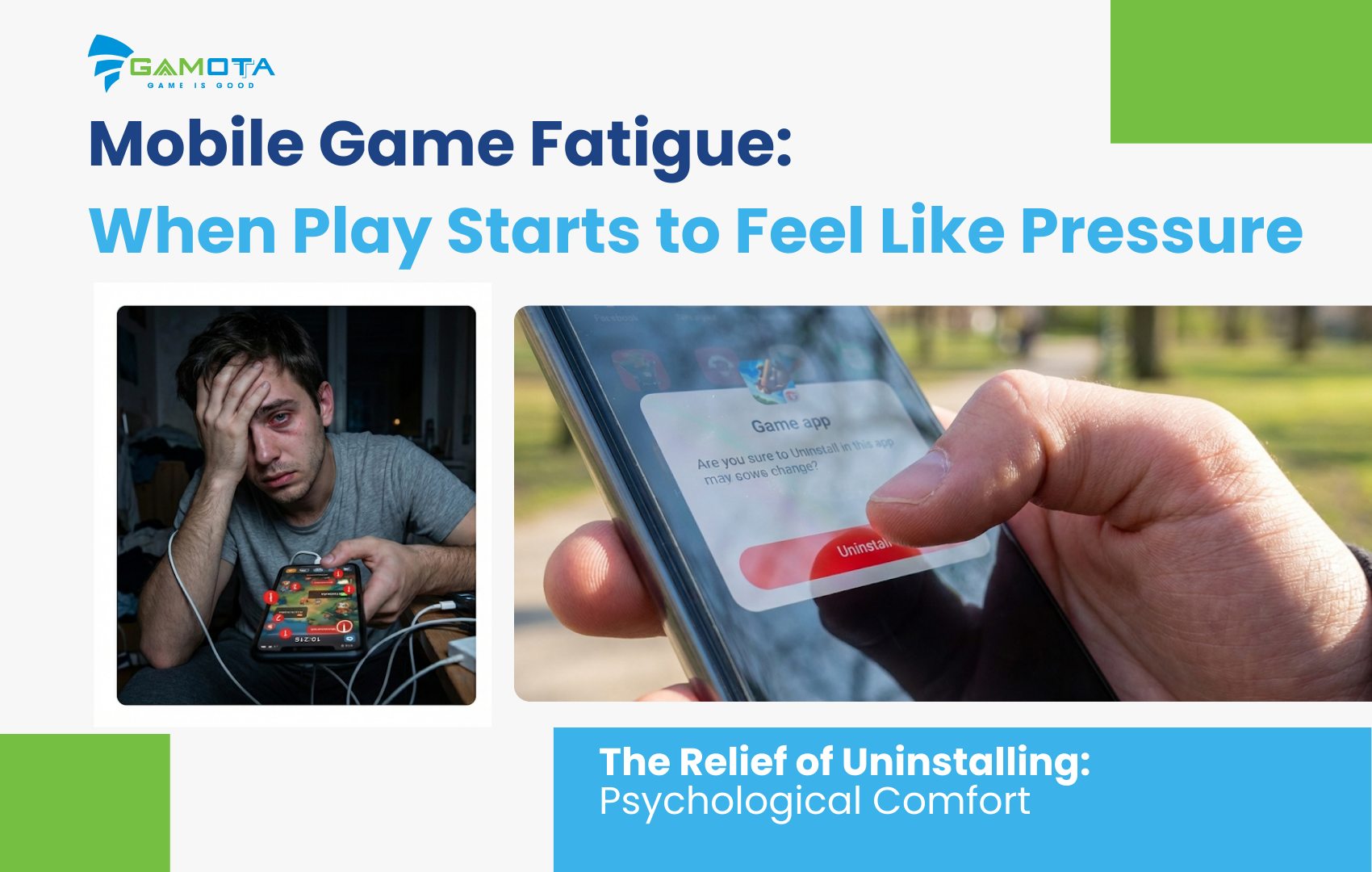
Gamota’s analysis of “Mobile Game Fatigue” – the phenomenon where entertainment mutates into obligation.
Mobile games aren’t boring – players are exhausting
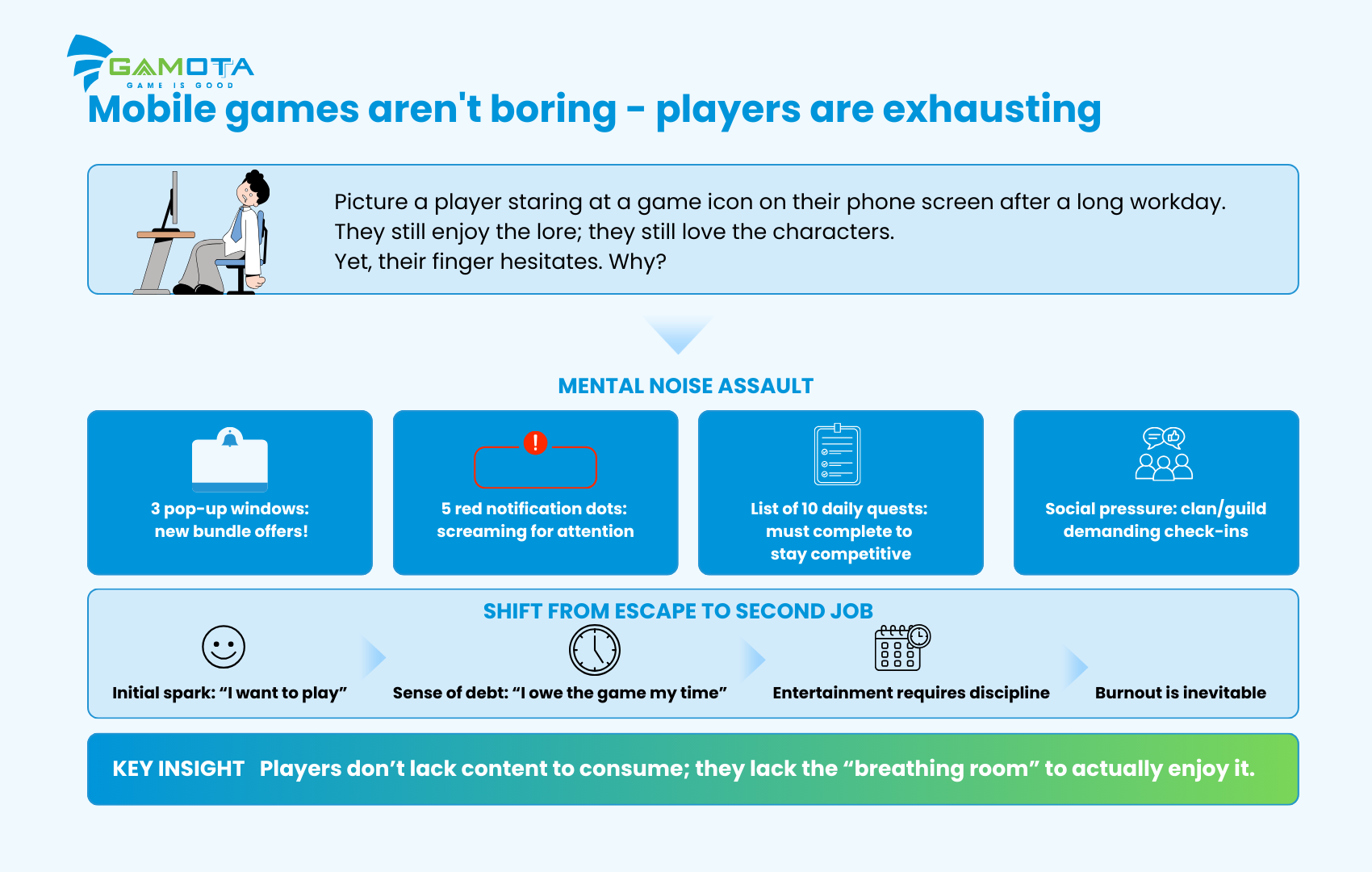
Picture a player staring at a game icon on their phone screen after a long workday. They still enjoy the lore; they still love the characters. Yet, their finger hesitates. Why? Because they know that the moment they log in, they won’t be “playing.” Instead, they will be assaulted by a barrage of “mental noise”:
-
Three pop-up windows advertising new bundle offers.
-
Five red notification dots screaming for attention in the UI.
-
A list of 10 Daily Quests that must be completed to stay competitive.
-
Social pressure from the Clan/Guild demanding check-ins.
Modern mobile games have inadvertently shifted from being an escape to becoming a Second Job. The initial spark of desire (“I want to play”) has been replaced by a sense of debt (“I owe the game my time”). When entertainment requires the same level of discipline and schedule management as actual work, burnout is inevitable.[5][12]
Key Insight: Players don’t lack content to consume; they lack the “breathing room” to actually enjoy it.
The pressure isn’t in mechanics – it’s in the system
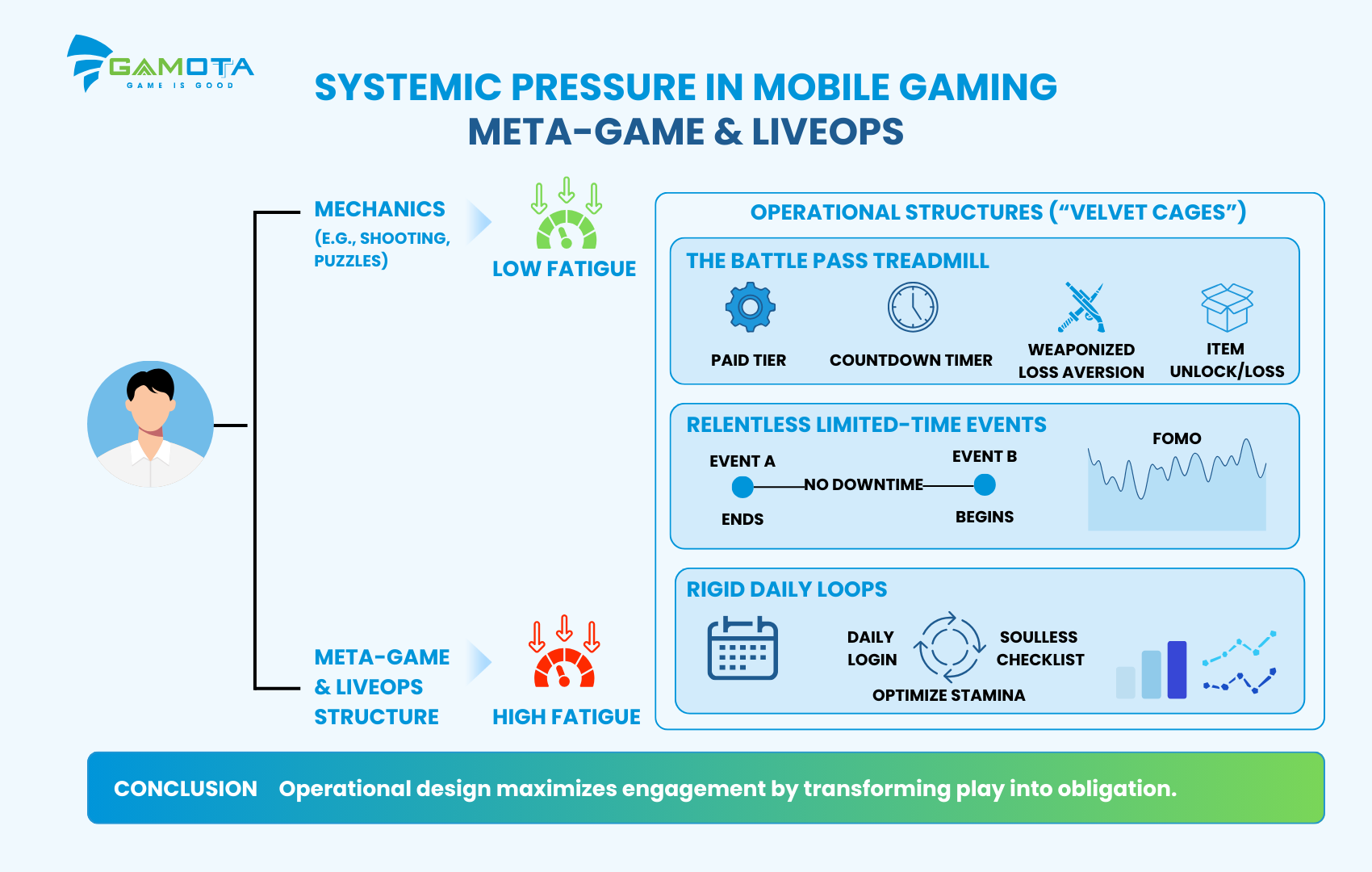
If you analyze user feedback, players rarely complain that the act of shooting, solving puzzles, or matching gems is exhausting. The fatigue stems from the Meta-game and the LiveOps structure.[4][5]
Game designers have constructed sophisticated “velvet cages”:
-
The Battle Pass Treadmill: A giant countdown timer. “You have 10 days to reach Level 50, or you lose the item you already paid for the chance to unlock.” This isn’t motivation; it’s weaponized Loss Aversion.[7]
-
Relentless Limited-Time Events: Event A ends at 8:00 AM; Event B begins at 8:05 AM. There is no downtime. Players are kept in a perpetual state of FOMO (Fear Of Missing Out), where skipping a single day induces genuine guilt.[4][5][6]
-
Rigid Daily Loops: Forcing players to log in at specific times to optimize resource stamina turns gameplay into a soulless checklist.[5][8]
When the operational structure is designed to extract every spare minute of a user’s day, it transforms Play into Obligation.
Retention decline may reflect filtering, not distraction
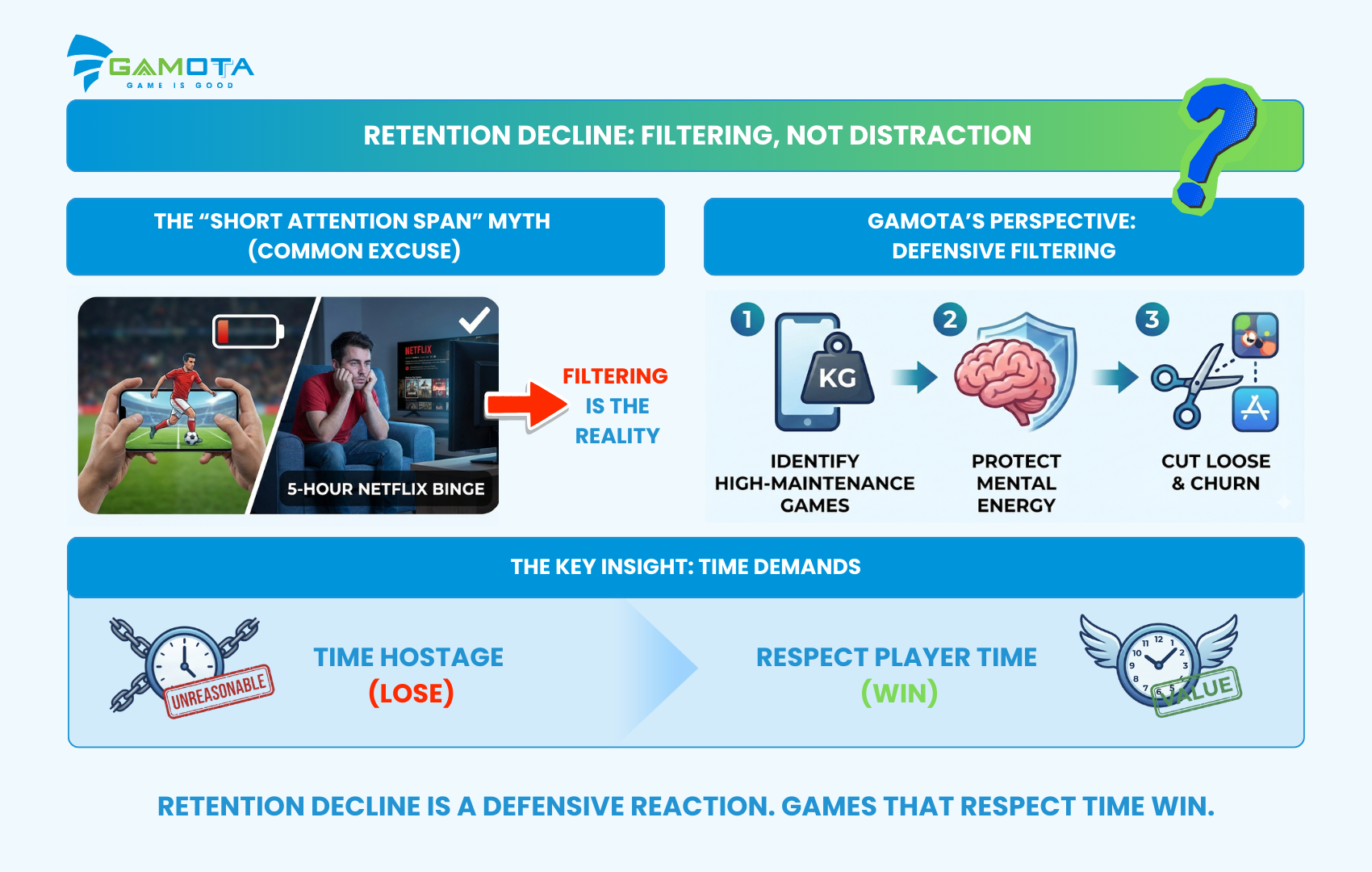
When looking at industry benchmarks (such as GameAnalytics data trends moving into 2025), we often see D30 and D60 retention softening across the board.[9][10] The common excuse is: “Gen Z has a short attention span” or “The market is too saturated.”
However, Gamota proposes a different perspective: Players are becoming smarter, more aggressive filters.
They haven’t lost the ability to focus (they can still binge-watch Netflix for 5 hours). Instead, they are engaging in “Defensive Filtering.” Users are rapidly identifying “high-maintenance” games-titles that demand too much cognitive load-and cutting them loose to protect their mental energy.
Retention decline isn’t a sign of distraction; it is a defensive reaction against unreasonable time demands. Games that respect the player’s time are starting to win over games that try to hold it hostage.
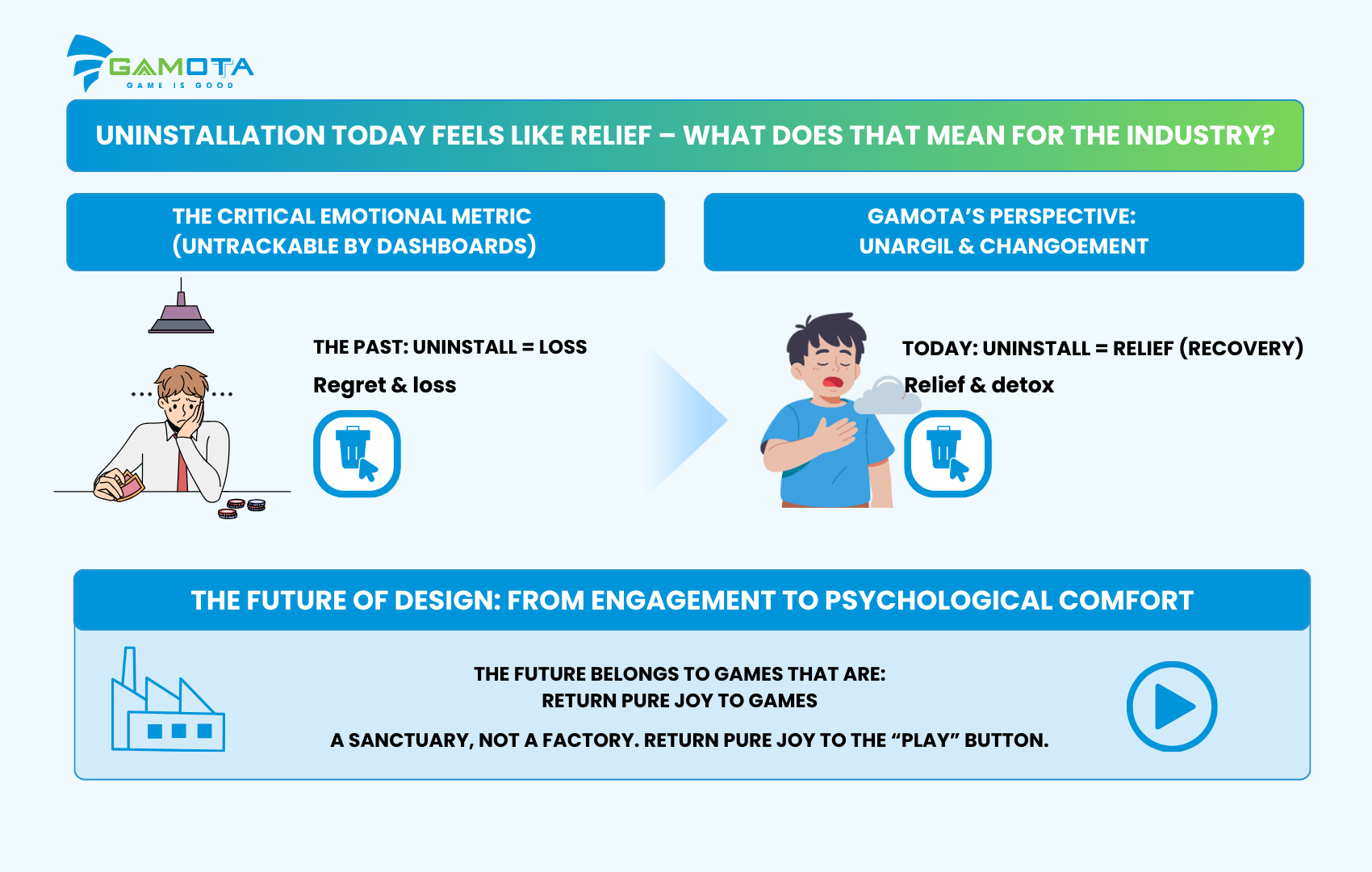
Uninstallation today feels like relief – what does that mean for the industry?
This is the most critical emotional metric that analytics dashboards cannot track: the feeling immediately after deleting a game. Years ago, uninstalling a favorite game came with a sense of loss or regret.
Today, for many gamers, hitting “Uninstall” brings a profound sense of relief. It feels like putting down a heavy backpack. It feels like “recovering.”[11] When a customer feels relieved to stop using your product, that is a systemic failure of design.
Conclusion: The future of mobile gaming will not belong to the titles that demand 24/7 attention. It will belong to the games that position themselves as a sanctuary where players visit because they want to, not a factory where they must clock in every day. It is time to return pure joy to the “Play” button.
References
[1] GameAnalytics. (n.d.). The compulsion loop explained.
[2] GameAnalytics. (n.d.). Why habit formation is the key to long term retention.
[3] GameAnalytics. (n.d.). Learn push notifications: Best practices for mobile games.
[4] Metaplay. (2024). Live service gaming 2024.
[5] PC Gamer. (n.d.). I’m officially exhausted by all the live service games and I want to see way less next year.
[6] Game Developer. (n.d.). How video games abuse the fear of missing out.
[7] The Psychology of Games. (2025, January). Psychology and Marvel Rivals.
[8] Mobile Free To Play. (n.d.). Understanding and eliminating energy systems.
[9] AVOW. (n.d.). Retention strategies for mobile gaming app players.
[10] GameSpot. (n.d.). Live-service games’ success depends on limiting ‘churn’ more than huge launches, analysts say.
[11] Destructoid. (n.d.). How to uninstall League of Legends from your PC.
[12] Armchair Arcade. (2025, June 17). Gaming fatigue: What causes it and how to prevent it.