
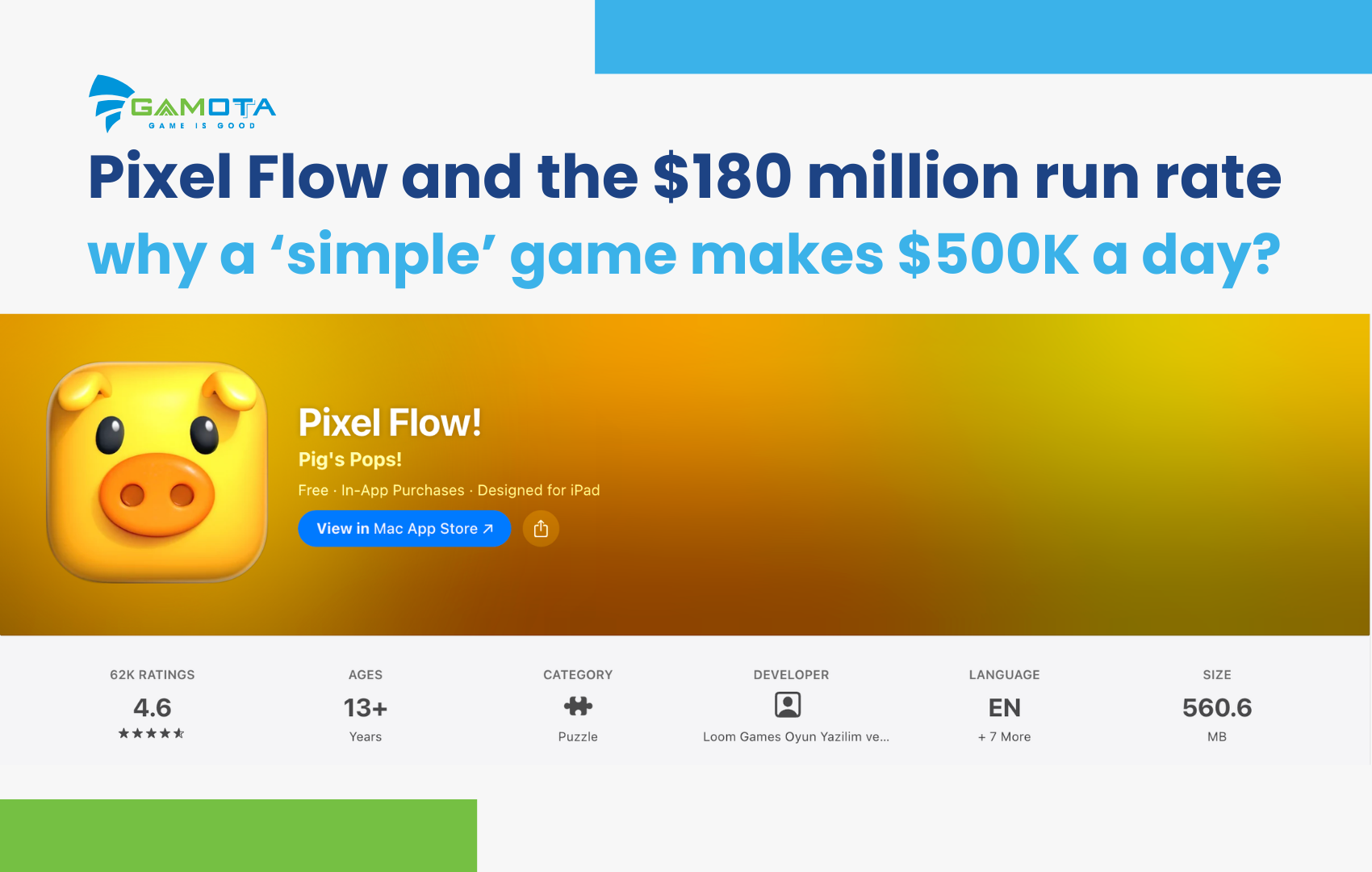
A few months after its launch, Pixel Flow has quickly become one of the most prominent names in the mobile puzzle game segment. According to industry analyst estimates, the game hit a daily revenue threshold of $500,000 within just four months of release. This translates to an approximate annual run rate of $180 million. [1] This is a rare growth rate even in an overly familiar genre, like color-sorting games.
For the game development community, this is an exemplary case study in design thinking and monetization optimization. Interestingly, Pixel Flow didn’t invent a new mechanic or monetization trick. The success of this hybrid-casual title stems from redefining the depth of experience in a genre traditionally considered shallow and passive.
Find out more about Gamota
What is Pixel Flow?
Pixel Flow is a hybrid-casual color-shooter where players queue shooters to hit same-colored pixel cubes and clear the board piece by piece. On Google Play, the game describes its core loop as putting shooters onto a constantly moving conveyor belt. Each shooter has a limited amount of ammo to shoot at pixel cubes of its own color, then leaves or retreats to one of the waiting slots to be brought out later. [3]

This conveyor belt has a strict capacity. This means if you manage the order and timing poorly, the whole system will jam. [3] This is the key point that sets the game apart. Pixel Flow is not simply a color-sorting game, but a sorting challenge under the pressure of a non-stop flow.
Loom Games is the studio behind this title, founded in Istanbul by Kübra Gündoğan and Emre Çelik. Although the initial team only had about 10 people at launch, the founders had accumulated 5 to 6 years of game development experience beforehand. [1] Pixel Flow might look like a random breakout hit at first glance, but it is actually the result of years of learning game design, rapid iteration, and effective product launching.
Decision Density: Breaking the Puzzle Game Mold
Most sorting puzzle games have rather passive pacing. However, Pixel Flow broke that mold by adding a continuously moving conveyor belt with strict capacity limits, turning a static problem into a continuous flow management challenge [3]. Each shooter has limited ammo to fire at matching pixel blocks, then leaves or falls back to a waiting slot [3].
-
Lesson for Developers: This shift significantly increases the decision density within each short session. A chain of wrong moves can trigger a domino effect leading to an immediate jam, while hesitation will cost you the game in just seconds [1]. The game demands absolute focus, making players feel like they are constantly competing with themselves. Designing fast drag-and-drop mechanics combined with tray capacity limits turns the game into an experience that demands both cognitive skills and hand reflexes [1] – more akin to Bejeweled Blitz than a traditional passive puzzle. [1]
This game intentionally breaks away from the typical passive puzzle model; Pixel Flow truly requires absolute concentration. This clear division in skill level is crucial because it makes players feel like they are constantly competing with themselves, even without a Player vs. Player (PvP) mode.

Fair Failure Creates the Replay Loop
The tension in Pixel Flow works effectively because players always feel that failure is their own doing. This is a completely deterministic game with no random elements interfering with progression [1].
-
Lesson for Developers: This “fair failure” effect generates a fixable frustration, urging players to hit the replay button instantly and building trust, so spending money doesn’t feel exploitative [1]. In exchange for the difficulty of scaling to a massive user base like luck-based games, this system allows Pixel Flow to push difficulty high without dropping player retention rates.
The flip side of a design with zero randomness is that it’s harder to expand to a broad audience compared to luck-based titles. However, this trade-off is entirely justified. The players who decide to stay fully understand the system, are willing to replay multiple times, and invest more time. This is the ideal target audience for monetization.
Simple Monetization, Precise Timing
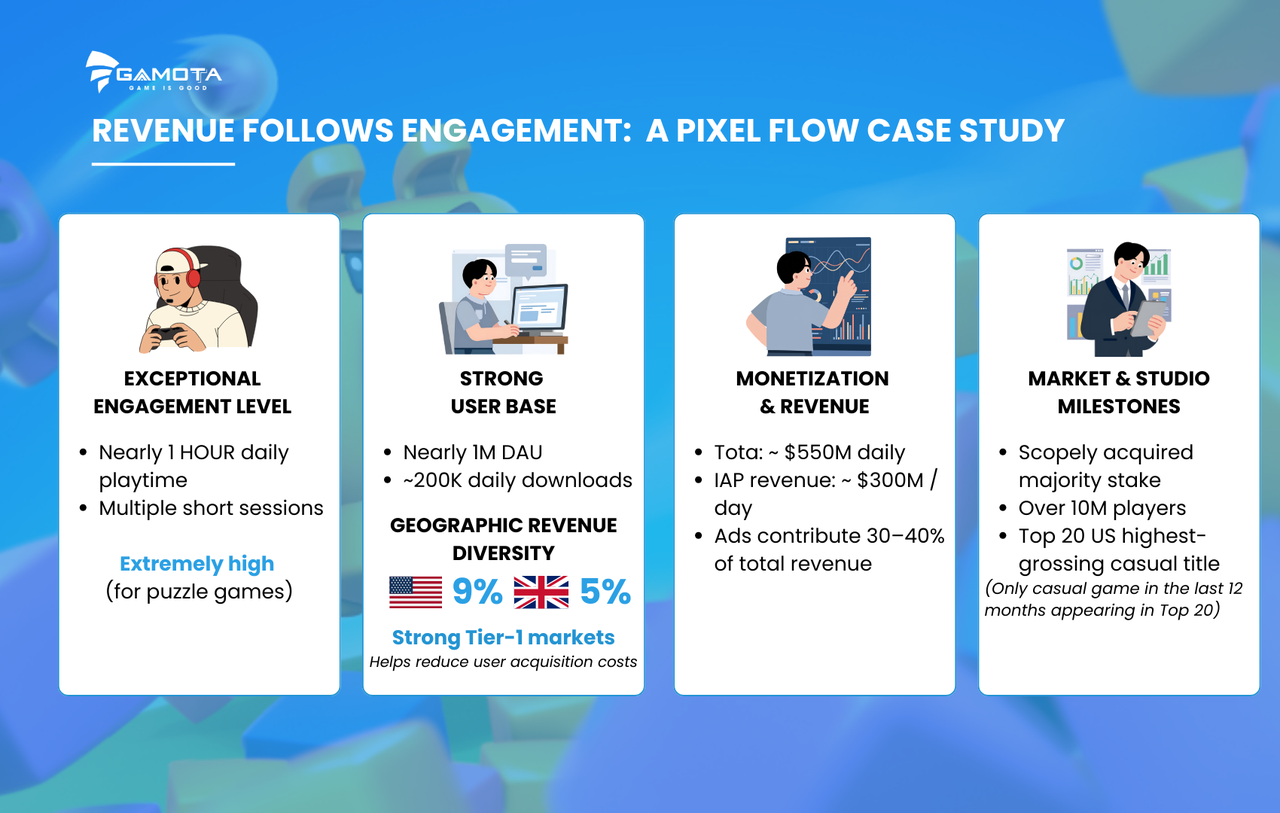
An analysis estimated that in December, Pixel Flow’s in-app purchase (IAP) revenue reached about $300,000 per day, with ads contributing an additional 30-40%, bringing the total daily income to nearly $550,000 [1]. During the same period, the game recorded about 200,000 daily downloads and possessed nearly 1 million Daily Active Users (DAU) [1].
On the US App Store listing, in-app purchase prices are shown directly: “Fail Offer 1” is $5.99, “No Ads” is $7.99, and “Golden Pass 1” is $9.99. [4] While this pricing ladder is fairly standard, the real differentiator is where and when these offers are surfaced in the player journey (touchpoint placement).

The most notable point is the engagement level. Players spend almost an hour a day in the game across multiple short sessions. This is an incredibly high number for a puzzle game. Scopely, the company that later agreed to acquire a majority stake in the studio, stated that Pixel Flow has reached over 10 million players and cracked the top 20 highest-grossing games in the US market. [2] It is the only casual title launched in the last 12 months to achieve that milestone. [2]
-
Lesson for Developers: The game retains players long enough (nearly an hour a day) for monetization strategies to take effect. Interstitial ads appear at times when players are most emotionally receptive, especially right after losing, while rewarded video ads focus on providing boosters [1]. Notably, there is no ad-watching shortcut to bypass a difficult level because it would ruin the tension. Ads here proactively reinforce the need for IAPs, helping the ad-removal pack achieve an extremely high conversion rate.
Pixel Flow’s item store is not complex at all. The game relies on just a few clear offers and lets the player’s frustration of losing do the rest of the work.
Geographically, the game’s revenue structure is quite diverse, with the US market accounting for about 9% and the UK market about 5%, along with a solid presence in other Tier-1 markets. [1] This distribution helps the game maintain a strong User Acquisition (UA) strategy without having its profit margins squeezed by overly expensive Cost Per Install (CPI) in the US and UK.
Production-Optimized Graphics and the Real Battle for Vietnamese Studios
Pixel art graphics allow content to be generated quickly, refreshed frequently, and easily adapted to trends without requiring massive design costs [1]. The core loop is visually satisfying and clearly conveys immediate pressure, making it highly suitable for short-form video ad formats.
In February 2026, Scopely announced the acquisition of a majority stake in Loom Games [2]. Many newspapers reported the deal valued the studio at over $1 billion [6][7], based on achieving certain milestones [5]. Notably, shortly after the game scaled, a studio in Vietnam launched a nearly identical clone and quickly reached revenues of about $140,000 per day [1].
-
Lesson for Developers and the Vietnamese Market: The Vietnamese gaming market stands out for releasing a massive number of games (especially hyper-casual/hybrid-casual) at a very fast pace. The fact that a Vietnamese studio quickly created a similar clone generating $140,000/day is a testament to that speed. However, it also sends a signal: this mechanic works well but is highly vulnerable to being copied. When anyone can make a prototype quickly, the barrier to entry shifts to live operations (liveops) capabilities.
Conclusion
For game developers and studios, especially in Vietnam, the story of Pixel Flow is not just a case study in massive revenue, but also reshapes design thinking for the hybrid-casual genre.
The mobile gaming market remains incredibly lucrative, but the game has changed. In an environment where teams can produce dozens of prototypes a month, the competitive advantage no longer lies in how fast you code or prototype. The current survival challenge for developers is the ability to operate the game and maintain the discipline of a business model at scale.
Pixel Flow also bluntly rejects conventional design thinking: making a hybrid-casual game doesn’t always mean trying to make mechanics as easy as possible to acquire the largest possible user base. Instead of creating a superficial core loop where players can casually swipe the screen while watching a movie, this game forces them to pour 100% of their focus and skill into every decision. Trading off a potentially narrower initial player base, the developers reap a deep level of engagement, thereby firmly consolidating monetization efficiency per capita.
———————-
References:
[1] Deconstructor of Fun – Pixel Flow: The Publisher’s Dream
[2] Scopely (official) – Scopely to acquire majority stake in “Pixel Flow!” and the team behind it
[3] Google Play – Pixel Flow! (store listing, core loop description)
[4] Apple App Store (US) – Pixel Flow! (in-app purchase price points)
[5] Bloomberg – Saudi-owned Scopely buys Loom Games stake for up to $1 billion (milestone-based)
[6] GameDeveloper.com – Scopely acquires majority stake in Pixel Flow! developer Loom Games (values studio in excess of $1B)
[7] PocketGamer.biz – Scopely acquires majority stake in Loom Games at $1bn valuation (performance-based structure)